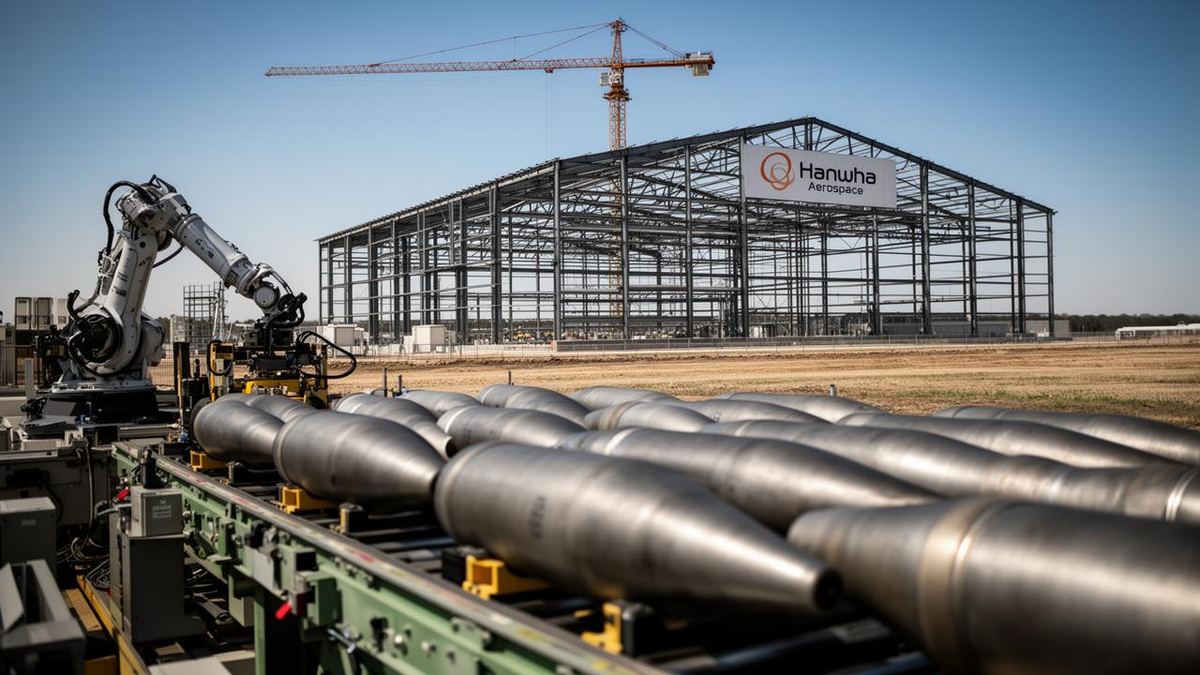
South Korea’s Hanwha Aerospace (012450.KS) is investing $2.2 billion (approximately 3 trillion won) to build an ammunition production hub on U.S. Army property. Its U.S. subsidiary, Hanwha Defense USA, held an office opening ceremony on the 21st (local time) at Pine Bluff Arsenal (PBA), a U.S. Army installation in Arkansas, formalizing its investment plan for the next seven years.
This investment marks the first time a South Korean defense contractor has established a complete ammunition production process on U.S. soil. Hanwha Aerospace will construct facilities for 155mm artillery shell components and propellant charges at the site. The company plans to build a vertically integrated manufacturing system spanning from raw material input to finished product output, with full-process automation equipment.
The new hub will be named the “Hanwha Advanced Manufacturing Campus.” The company expects the facility to create approximately 400 local jobs and contribute to expanding U.S. ammunition production capacity and modernizing the aging ammunition industrial base.
U.S. Army Land Lease… Fruit of 18 Months of Negotiations
Hanwha Defense USA was selected in January as the lessee for the PBA site through a competitive solicitation by the U.S. Army. This office opening represents the first step in executing the ammunition production hub plan.
The ceremony was attended by a host of federal and state dignitaries, including Arkansas Governor Sarah Huckabee Sanders, Jordan Gillis, U.S. Assistant Secretary of the Army for Installations, Energy and Environment, Hugh McDonald, Arkansas Secretary of Commerce, and U.S. Representative Bruce Westerman.
Arkansas worked closely with Hanwha over the past 18 months during the site selection process, including site visits to candidate locations within the state, meetings with Hanwha executives during visits to South Korea, and consultations at the Paris and Farnborough air shows.
Michael Coulter, CEO of Hanwha Defense USA, said, “We are delivering on our commitment to strengthen the U.S. defense industrial base through investment and job creation, leveraging Hanwha’s manufacturing capabilities.” He added, “We will actively contribute to elevating U.S. ammunition industry capabilities to the next level while expanding bilateral defense cooperation.”
A Two-Pronged Strategy with the Alabama Howitzer Hub
Hanwha Aerospace aims to accelerate its push into the U.S. ground defense market with this ammunition production hub. Last month, the company signed a contract with the U.S. Army to supply K9 wheeled self-propelled howitzer (K9MH) prototypes under the Mobile Tactical Cannon (MTC) program, and is currently setting up prototype assembly, integration, and testing facilities in Opelika, Alabama.
The K9MH contract is valued at up to $262.9 million (approximately 360 billion won), marking the first time a complete South Korean weapons system has entered a U.S. Army artillery modernization program. If it proceeds to full-rate production, the program could expand to approximately 10 trillion won (approximately $7.4 billion).
The company’s strategy is to expand its U.S. ground defense business with two pillars: the self-propelled howitzer hub in Alabama and the ammunition production hub in Arkansas.
Expanding into Maritime Defense… Becoming a Comprehensive U.S. Defense Contractor
Hanwha Group’s U.S. defense business is rapidly expanding beyond ground weapons into the maritime domain. South Korea’s Hanwha Ocean (042660.KS) and Hanwha Systems (272210.KS) acquired Philly Shipyard in Philadelphia, Pennsylvania for $100 million in 2024, and have since secured contracts including selection as the builder of two missile test instrumentation ships for the U.S. Missile Defense Agency (MDA).
Hanwha Defense USA plans to begin construction this month on a Medium Unmanned Surface Vessel (MUSV) being developed in partnership with U.S. autonomous maritime startup Magnet Defense, with sea trials scheduled for January next year. The two companies are targeting the U.S. Navy’s MUSV program.
Command structure reorganization has also been completed. Hanwha Systems recently disclosed that it will sell its entire 60% stake in Philly Shipyard to “Hanwha Defense USA Shipbuilding LLC,” funded by Hanwha Defense USA and Hanwha Group’s North America investment platform (HFP). This move expands Hanwha Defense USA’s role from ground weapons to maritime defense, elevating it to a comprehensive defense contractor in the United States.
Chairman Kim Seung-yeon Visits Gumi Plant: “Build Defense AI Capabilities”
With the U.S. defense strategy gaining momentum, Hanwha Group Chairman Kim Seung-yeon visited Hanwha Systems’ Gumi plant on the 22nd, the hub of K-defense exports. This marks his first field visit in about eight months since his trip to the Jeju space center earlier this year.
The Gumi plant is a forward base that develops and produces key equipment including the Multi-Function Radar (MFR) for the Cheongung-II medium-range surface-to-air guided missile system. Chairman Kim toured the manufacturing buildings, inspecting the Cheongung-II MFR assembly and testing operations as well as future battlefield technologies such as AI-based integrated air defense systems.
During a luncheon with employees, he said, “The Gumi plant is the export forward base and technology innovation hub of Hanwha’s defense business reaching out to the global market,” urging them to “cultivate unrivaled defense AI capabilities that no one can replace.”
Kim Dong-kwan, Vice Chairman of Hanwha, and Yang Ki-won, CEO of Hanwha Systems, accompanied the chairman on the visit. Analysts note that Chairman Kim’s choice of Gumi—a defense manufacturing and technology hub—for his second-half field visit, following his early-year visit to the civilian space industry outpost, signals his confidence in and support for Vice Chairman Kim Dong-kwan’s defense and space business portfolio.