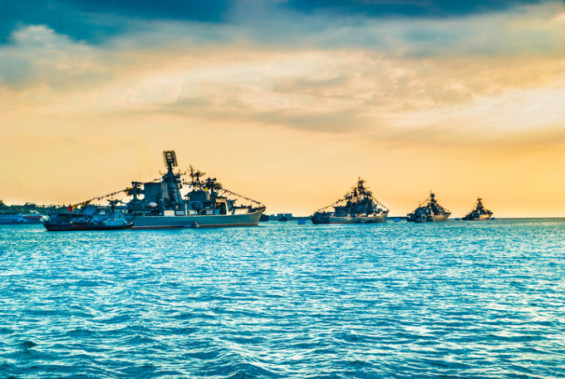

Domestic software has been developed to analyze warship survivability. Provided by Getty Image Bank
Software has been developed to analyze the indicator known as “warship survivability,” which assesses whether a warship can continue its mission under enemy attack. This is significant in that warship survivability analysis software, which previously relied on foreign products, has now been developed using domestic technology.
The Korea Institute of Machinery and Materials (KIMM) announced on the 8th that it has developed an integrated framework for warship survivability design called “isSAFE.” isSAFE builds a warship model, generates various damage scenarios, and then performs vulnerability analysis and results assessment—an entire sequence of processes—within a single integrated design environment.
Warship survivability consists of three elements: susceptibility, which concerns avoiding enemy detection and attack; vulnerability, which refers to withstanding damage when attacked; and recoverability, which involves restoring key functions after damage. Existing technologies analyze each element using different tools and procedures, and related software has heavily relied on foreign products.
Using isSAFE, these three separate elements can be integrated and reviewed comprehensively to assess warship survivability. It is also meaningful in that it lays the foundation for self-reliance in warship survivability design technologies, which have had a high dependence on foreign software.

isSAFE operation screen. Provided by the Korea Institute of Machinery and Materials
isSAFE uses information on the surrounding environment collected through radar, infrared, and other sensors to generate various damage scenarios. It also supports simplified analysis of threats above and below the water surface, enabling assessment of how severely a warship would be damaged when an attack occurs. It analyzes onboard equipment, crew, power supply, and other resources together to examine the probability that a warship will survive an attack. The software is expected to be used by the Navy and shipyards for warship design and survivability assessment in the future.
KIMM plans to further develop isSAFE into software tailored to specific uses such as concept design and training, while also expanding collaboration with demand institutions including the Navy and shipyards.
Kim Euyoung, principal researcher at the AX Convergence Research Center, said, “By collecting diverse opinions from industry, academia, research institutes, and the military, we will continue to develop isSAFE into a framework that can be practically used in real-world warship design work.”
Copyright ⓒ DongA Science. All rights reserved.