
On September 20, 2026, Ukraine launched another large-scale drone attack on the Moscow region. One drone hit a high-rise apartment building in Kotelniki, southeast of Moscow. Another had struck the same building in June. Neither strike killed anyone, but the attacks badly frightened many people in the neighborhood. Reporters from Bereg, a cooperative of independent journalists, visited the Novye Kotelniki residential complex to see how repairs were progressing after the two attacks and how residents had responded. Meduza is translating their report in full.
‘People were shaking, children were crying, older people’s blood pressure was shooting up’
Drivers struggle to find parking in this densely populated neighborhood in Kotelniki, outside Moscow. Shoppers wait in short lines at grocery store checkouts. It’s a warm, sunny weekend day, yet the courtyard of the Novye Kotelniki residential complex is unusually empty.
On September 20, a Ukrainian drone struck one of the complex’s high-rise buildings for the second time. The first strike came on June 18, 2026. The drone crashed into almost the same spot on the courtyard side, in the upper third of the building, and exploded.


A black scorch mark stands out against the beige-and-brown exterior, with a hole at its center. All that remains of the balconies on floors 19–22 is twisted metal and rebar. Some of the facade tiles have broken off.
The few residents walking in the courtyard occasionally look up at the building and whisper to one another. Many decline to tell Bereg how the constant drone alerts have changed their lives. “What is there to say?” says a woman of about 40 in a black hijab, waving off the question, though she had just been discussing that very subject with a friend.
Olga, a blonde woman in a trench coat, comes out of a neighboring building with her two-year-old daughter. She says this is their first walk in the courtyard since the recent attack.
This time, she says, the property management company quickly cleared the broken glass and other debris from the courtyard. But she’s still scared: “You never know, she could pick up a piece of glass or something. You’re more scared for her than for yourself.”


On the day of the attack, Olga woke to explosions at four in the morning. She woke her husband. At first, he thought she was imagining things, but then he heard the explosions, too. Deciding it wasn’t safe to stay in their apartment, they carried their sleeping daughter downstairs to the ground floor, where neighbors had already gathered.
Olga stayed in the lobby until eight in the morning. Throughout that time, she could hear explosions outside. “It was a nightmare: People were shaking, children were crying, older people’s blood pressure was shooting up, and we were all looking for medicine for them,” she tells Bereg. “You feel like you’re in a war zone, and you can’t believe this is happening to you.”
Olga missed the summer attack — her family was away. Perhaps that’s why, unlike many of her neighbors, she hadn’t put a “go bag” with documents, medicine, and other essentials in her entryway. Before the September attacks, she had felt less anxious than others. Afterward, she no longer felt safe.
Still, her family’s daily routine hasn’t changed. She and her husband decided against moving their bed farther from the windows, figuring it wouldn’t save them. “Look at the size of that hole,” she says, gesturing toward the damaged high-rise.
“You keep thinking: God, what if it happens again tomorrow?” Olga says. “I was on sedatives for two days. I definitely don’t feel safe here. I’m stressed every day.”
Her family is considering moving, but unless the attacks become more frequent — “not once or twice, but practically every day” — she and her husband are unlikely to “seriously start looking into it.” Olga hopes things will “get back to normal” because “they [the Ukrainians] have already hit what they wanted to hit, and now they’ll calm down.” She means the Moscow oil refinery, the Ukrainian military’s target. But the high-rise stood in the path of the drones flying toward it.
A few things help Olga manage her anxiety: She’s become even more absorbed in caring for her child and stopped reading the news, although she used to scroll through neighborhood chats even at night. “There’s so much noise now, so many planted stories, so much fake news,” she says. “Even the [real] news — there’s so much of it. You watch all this, and the whole situation keeps playing over in your head. What for?”
Ruslan, who lives in the same complex as Olga, takes the opposite approach: He tries to read all the news. He says the drone attacks don’t make him anxious.
“I knew there’d be an attack — the elections and all that,” Ruslan says. He says the neighborhood has only been quiet for the last few days. Before that, neighbors often heard air defenses in action at night and early in the morning.

On September 20, Ruslan and his family counted “at least 40 explosions.” “We could see flashes in the sky from our window — almost like the ones !” he says excitedly. “There were about 10 a minute at one point.” He saw the drone crash into the neighboring building. He and his family were about to head out into the stairwell when they heard a loud noise outside the window and red light flooded the apartment.
Like Olga, Ruslan doesn’t have a “go bag,” and he says he won’t be getting one. He sees no need, because “our air defenses have gotten better at their job.” “Yeah, there are screwups. Unfortunately, they can’t intercept everything. But overall, our guys are doing their job, and they’re doing it well,” Ruslan says. “Every day on my way home from work, I see the air defense systems changing locations.”
He tells Bereg he believes there won’t be any more strikes on the neighborhood because they’re no longer worth it for Ukraine: “They launched so many, and the results were really . They understand it’s a waste of money.”
With a smirk, Ruslan recalls wondering during the first attack whether the target might have been the apartment building rather than the refinery — “maybe some general lives here.” But he quickly dismissed the idea: First, it was a large-scale attack, and second, “what general would live here?”
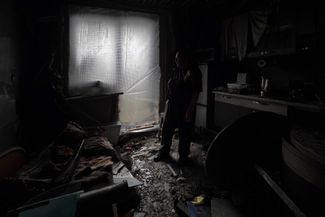
Ruslan believes Moscow and its immediate surroundings are now “very well protected” and that the authorities should focus on deploying air defense systems in other regions. That’s his only complaint about the security measures. “I think our government will take care of us, and everything will be fine. Our army will handle it,” he says. “Maybe I’m not that well informed, or maybe I’m too optimistic. But I think everything really is fine.”
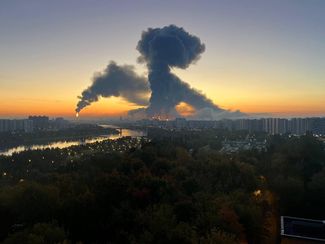
The next large-scale attack on the Moscow region came overnight on October 6. It struck communities northwest of Moscow, damaging private homes and nonresidential buildings in settlements in the Solnechnogorsk, Volokolamsk, Istra, and Domodedovo districts. Ukrainian Telegram channels that monitor attacks and the Russian outlet Astra also reported a fire at the Volodarskaya oil depot, southeast of Moscow. The Ukrainian strikes and Russian air defense operations killed two people and injured nine.
Ruslan’s school-age daughter looks at him admiringly. They chuckle together as they recall a neighbor who panicked during the latest attack. “Run, run, we’re under attack!” Ruslan says, imitating her, though he quickly adds that “everybody’s different.”
His daughter says that after the summer attack, one of her classmates transferred to another school — her family had decided to move. “They were renting [their apartment]. Maybe if we rented here instead of owning, we’d feel better about moving, too,” Ruslan says. “Plus, we’ve got a mortgage here — where are we gonna go?”
 ‘I’ll be working to pay the rent. I’m just scared to live here.’
A man in a black jacket, probably an employee of the property management company, walks through the courtyard with a ring of keys. He unlocks a door marked “Shelter” leading to the basement, looks inside, locks it again, and moves on to the next building. Each of the complex’s more than 20 high-rises has a shelter.
Residents of Novye Kotelniki say the management company told them the basements are kept locked because they contain “technical equipment that the engineers are responsible for.” In the event of a real threat, residents are to call the dispatch office. A staff member will then come during the attack and unlock the basement door. The company promises this will happen quickly.
But on September 20, residents of some buildings complained in the neighborhood Telegram chat that they hadn’t been able to get into the basements until after seven in the morning, although the large-scale attack began at four.
Signs reading “Shelter” have been hung at the basement entrances, but the management company has done little to equip the rooms, residents say. Some have benches; others don’t even have those, leaving people to sit on the concrete or stand.

Aleksandra, a resident in her mid-40s, is smoking near the entrance to one shelter. Asked how she feels about the increasingly frequent attacks, she says emphatically: “It’s really bad, really bad!”
Aleksandra lives in the building that drones have struck twice. Or rather, she used to — after the recent strike, she realized she was afraid to stay in her apartment. “As they say, what happens once might never happen again, but what happens a second time…” she says.
Aleksandra was home during both attacks. On June 18, she and her husband woke to repeated explosions and began getting ready to go to the shelter. As she was tying her sneakers, a drone crashed into the building. “I hear this huge bang — and plaster starts falling down in our apartment!” she tells Bereg. “I opened the door, and there was already smoke in the stairwell. We didn’t know if we’d be able to get downstairs.”
No one opened the shelter, and neighbors crowded onto the ground floor. “It all ended around eight, and that’s when they opened the basement,” Aleksandra says indignantly. “Well, what’s the point of going down there once it’s all over?”
On the day of the second drone strike, Aleksandra again heard “a lot of activity” as explosions kept going off. First, she went out onto the communal balcony to take a look. From there, she could see several fires near the Moscow oil refinery, the Mega shopping mall, and the Sadovod market. She was horrified. “I wake my husband up: ‘Get up, there’s a real war out there — everything’s burning, everything’s in flames!’” she says.
To reach the stairs, Aleksandra and her husband had to pass through the communal balcony. As soon as they opened its door, there was a loud explosion, and a wave of heat hit them. “I knew it had hit the building,” she says. “Something went bang, and things started falling.”
As we talk in the courtyard, there’s a crash in the distance, quiet but distinct. Aleksandra flinches and abruptly turns toward the sound.
“I think something fell at the construction site.”
“I react like that all the time now [to sudden noises],” Aleksandra says. “My nerves are completely shot. I went a week without proper sleep, even with Novo-Passit, glycine, and things to calm me down. I’d sleep for two hours, then be awake again.”
On September 20, Aleksandra and her husband waited for the explosions to stop, went back up to their apartment, packed everything they needed, and left for their dacha. They’re staying there temporarily but return to their apartment in Novye Kotelniki every few days.

“We’re living out of bags: one in the car, one at the dacha, and one here. We come back, wash up, do the laundry, hang it up, and head back out,” Aleksandra says. “We try to get everything done as fast as we can. They’ve just posted [on Telegram channels] again that apparently another large-scale attack is expected. Who knows?”
But they can’t stay at the dacha for long: It has almost no amenities, and the trip to work takes three hours. Driving every day proved too expensive, so they switched to public transportation.
Aleksandra took out a mortgage to buy her apartment. She has no other home and no relatives who can take her in. Now she’ll have to pay both her mortgage and the rent on a new place in a safer neighborhood. “I’ll be working to pay the rent. What else can I do?” she says with a sigh. “I don’t know what I’ll eat, but I’m just scared to live here.”
“Looking at the windows, I could tell that lots of people had left — almost no one was still here,” she says. “Today we packed up a bunch of bags and took a heater. And everyone coming toward us had bags, too. People are leaving, and no one wants to come back.”
‘I thought the same place wouldn’t get hit twice. Turns out it doesn’t work that way here.’
Far fewer people go into the high-rise hit by the two drone attacks than into the other buildings. Many residents emerge carrying large bags — clearly, they’re leaving for a long time.
The lobby has two entrances: one from the courtyard, the other from the road. The courtyard entrance is now cordoned off with barriers wrapped in red and white tape. The concierge warns that residents can’t leave through that door, either. A chair braces it shut from inside, and a sign on it reads: “No entry! Risk of death!” It doesn’t explain the danger.
Another notice asks residents not to use the elevators between 9 a.m. and 6 p.m. so they can be available to “construction workers repairing the building.” Residents ignore the request, and there are no workers in sight.
Residents say that for the first few days after the attack, the elevators ran only in the evenings. Those with apartments on the upper floors of the 25-story building had to take the stairs or enter through the neighboring stairwell, use the elevator there, and cross the roof to reach their own building. The management company temporarily opened access to the roof for that purpose. The elevators are now running, and access to the roof has been closed off again.


On many floors, boxes and bags of belongings are scattered about, along with plastic-wrapped crates of toys, black bags of construction debris, window frames, packages of building materials, and parts from household appliances.
The smell of smoke still lingers on the fifth and sixth floors. On September 20, burning debris landed on a windowsill and started a fire. On the upper floors, it smells of burned plastic.
The 21st floor suffered the worst damage. Workers had to remove the front panels from one elevator and the structure surrounding the shaft opening. A padlocked grille has replaced the door separating the elevator lobby from the apartments. The apartment the drone struck is on this floor.
Georgy, whose name has been changed, was home in a neighboring apartment at the time. He and his wife, Yelena, whose name has also been changed, were about to head downstairs when he heard an unusual humming sound from the direction of the balcony. “I go over to the balcony and realize it [the drone] is getting closer, but I can’t see it. I can’t figure out where it’s coming from,” he tells Bereg. “I look down — and there it is, coming from the direction of the quarry, heading straight at me.”
Georgy managed to shout to Yelena to run. He didn’t have time to get out of the way himself. The drone hit the neighboring apartment and exploded. The blast wave and a hail of fragments hit him.

His arms and legs were badly cut. Bleeding heavily, he got dressed and pulled on his sneakers. His wife retrieved their cat, which had hidden under the bathtub. They grabbed a bag of documents and jewelry they had prepared in advance and ran downstairs.
“If it had flown just a little higher, that would’ve been it — we wouldn’t be talking now,” Georgy says, visibly shaken as he looks at his bandaged wrists. “The explosion was unreal. I’d never experienced anything like it in my life. I wouldn’t wish that on anyone.”
The couple went to the home of friends who lived nearby. From their friends’ window, Georgy saw an ambulance arrive at the complex. He went over to the medics himself for first aid and to have them “record [him] as one of the injured.” A few hours later, the couple returned to their apartment for belongings, then went back to their friends’ home. After that, they went to Yelena’s relatives’ home, where they’re now staying.
Georgy shows photos of the wrecked apartment on his phone. The stretch ceilings have melted. The windows and balcony are gone, and everything is covered in soot. Furniture and appliances have toppled over, and fragments and pieces of the walls are scattered everywhere. After what he’s been through, Georgy tries to avoid going to Novye Kotelniki unless he absolutely has to. He arranged to meet Bereg’s reporter at a shopping mall in Moscow.
“I thought the same place wouldn’t get hit twice. Turns out it doesn’t work that way here,” Georgy says. It wasn’t until several days later, he says, that he fully realized “what could have happened.” It’s been hard to cope with. The other day, he went to get a haircut, and the buzzing of the clippers made him uneasy.
“I barely slept for three nights. I asked my doctor to prescribe something to calm me down, but it’s still pretty tough,” Georgy says. “It’s okay, we’re strong, we’ll get through it. I think time heals.”

Moscow regional authorities are working out how to repair the apartment and pay compensation, but Georgy is avoiding those subjects for now. Over the past week, he’s had to return to the apartment several times to let in specialists who are to assess the damage from the attack, as well as local administration representatives and officers from the Investigative Committee, Russia’s criminal investigation agency. Those visits convinced him that he could no longer live in the complex, even if the building were fully repaired.
“When you go back there, you start shaking — the atmosphere’s different, the aura’s different,” he says. “I’ve developed a phobia of the place, so I want to get everything sorted out as soon as possible and put this nightmare behind me.”
Georgy’s neighbors are collecting signatures for a petition to the management company and the authorities. They’re demanding additional protection for the building that drones have now hit twice.
“It feels unfair that they can’t keep our homes or our lives safe. You don’t feel very safe in your own capital,” Georgy says.
He believes the air defenses can’t handle the number of drones flying toward Moscow. He sees only one way to guarantee an end to the attacks:
It wouldn’t hurt to end this military operation. One decision — and it would all be over.
At Meduza, we are committed to transparency about our use of artificial intelligence in the newsroom. The story you’re reading was written by one of our living, breathing journalists and translated from Russian using an AI model configured to follow our strict editorial standards. This translation process is the result of extensive testing and refinements to ensure our English-language coverage is timely and accurate. A Meduza editor reviews every draft before publication.
If you find any errors in this translation, please contact us at [email protected].
To read Meduza’s exclusive content in English, please subscribe to our newsletter.