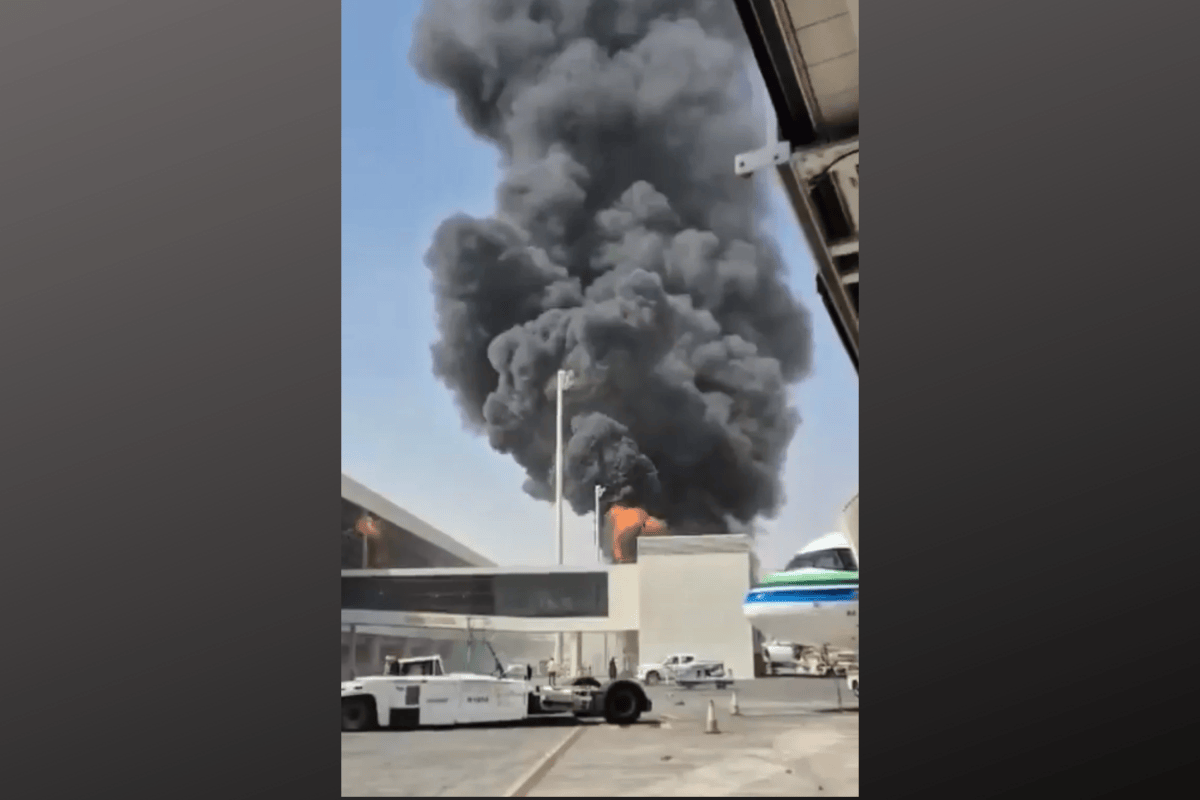
A missile struck a passenger terminal at King Khalid International Airport in Riyadh, Saudi Arabia, on Saturday, wounding multiple people and prompting evacuations as attacks on the kingdom intensified, according to the Associated Press.
Two regional officials confirmed the airport had been attacked, with one saying the missile struck a passenger terminal and wounded many, AP reported. The officials spoke anonymously because they were not authorized to speak publicly. Ambulances were also seen rushing toward the airport.
An unnamed witness told Agence France-Presse (AFP) that they were waiting to board a flight when they heard an explosion. According to the outlet, another witness said they saw people wounded and fleeing after the strike, adding, “I was on gate 403…I saw 401 hit; I saw injured in front of my eyes. Everyone was running.'”
Read More on News
According to a report from the Financial Times, citing a Western diplomat, Terminal 3 was struck during the incident, resulting in multiple people being evacuated.
About 50 people were injured, some critically, the Financial Times reported. The number of injured has not been confirmed by Newsweek.
Saturday’s attack was the latest strike on King Khalid International Airport during a sharp escalation in fighting involving Saudi-backed Yemeni government forces and Yemen‘s Iran-aligned Houthis.
When asked on Saturday if the U.S. would get involved after the latest attack, “We may. We’re going to look at it. We just found out about the recent attack, so we’ll make a decision. We move very quickly.”
Newsweek reached out to the State Department and the White House Saturday for comment on the attack.
Nations Respond to the Attack
The U.S. Mission in Saudi Arabia warned Americans to avoid King Khalid International Airport, saying travelers should be prepared for “potential flight cancellations, airspace closures, and travel disruptions.”
The United Kingdom also warned travelers to avoid Riyadh’s airport “until it is secure” and check their flight status before departing, while Canada issued a similar warning.
“We have updated our travel advice for #SaudiArabia due to military activity affecting operations at King Khalid International Airport in Riyadh,” the Government of Canada’s travel advisory said. “Avoid all travel to the airport due to the security situation.”
In a post on X Saturday, Tom Berendsen, Minister of Foreign Affairs of the Kingdom of the Netherlands, said, “NL condemns the Houthi attacks on the Kingdom of Saudi Arabia, including multiple attacks on AirPorts which have caused casualties. My deepest condoleances [sic] to the families of the victims. NL stands in full solidarity with the people of Saudi Arabia and our Gulf partners.”
The Ministry of Foreign Affairs and Expatriates of the State of Palestine wrote in an X post on Saturday that it “strongly condemns the attacks that targeted the sisterly Kingdom of Saudi Arabia.” which struck King Khalid International Airport in Riyadh and resulted in the martyrdom of several Saudi citizens and the injury of numerous civilians.”
Major Airline Disruptions and Flight Cancellations
In a statement on X, Kuwait Airways announced “the cancellation of flight KU775 (Kuwait to Riyadh) and flight KU776 (Riyadh to Kuwait) today, Saturday, 10 October 2026, due to the closure of the airport resulting from the security situation.”
The airline added: “The company urges all passengers to monitor the status of their flights. Notifications and text messages will be sent to the phone numbers registered in their bookings to inform them of any updates. Passengers may also follow the latest developments via Kuwait Airways’ official channels.”
Etihad Airways and Qatar Airways also canceled multiple flights involving Riyadh, with some cancellations extending into Monday.
“Flights scheduled to land at Riyadh (RUH) are being diverted, with many heading to Jeddah,” AirNav Radar, a flight-tracking app, said in a post on Facebook. “Air traffic disruption so far: 266 flights canceled and 219 delayed.”
Escalating Attacks on Riyadh Airport
The airport has been targeted multiple times since a Saudi-led coalition began a major military offensive against the Houthis in neighboring Yemen.
The Houthis claimed responsibility for earlier attacks, including one Wednesday that killed a Sudanese national, but had not immediately claimed responsibility for Saturday’s.
Saturday’s incident came two days after attacks at the Riyadh airport killed three Saudi citizens, including a pilot.
Reuters reported that the airport had been attacked twice earlier in the week, leaving four people dead, others wounded and an aircraft badly damaged. A still taken from a video obtained and verified by the AP shows thick black smoke and flames rising from a fire at the airport after Friday’s attack.
 Travel Advisories and Regional Security
The U.S. State Department currently lists Saudi Arabia at Level 3: Reconsider Travel, citing risks including armed conflict, Iranian drone and missile attacks, terrorism and exit bans. The advisory, issued September 15, also notes threats from Iran-backed Houthi rebels and warns that airports and other infrastructure have been targeted by missile and drone attacks.
Americans are advised not to travel to the Yemen border region, which is designated Level 4 because of terrorism risks and previous drone, missile and rocket attacks.
Escalating Fighting With the Houthis
The Houthis are an Iran-backed armed movement that controls much of northwestern Yemen and has fought Yemen’s internationally recognized, Saudi-backed government for years.
Fighting escalated again this year amid the wider U.S.-Iran war, with the Houthis launching missile and drone attacks against Saudi Arabia while Saudi-backed Yemeni forces battle the group for control of strategically important territory along the Red Sea.
According to Reuters, the Houthis have warned airlines to avoid Saudi airspace, which they declared a zone of military operations after the Saudi-backed Yemeni government began an offensive against the group earlier this month.

Newsweek’s reporters and editors used Martyn, our AI assistant, to produce this story. Learn more about Martyn here. Contact Newsweek editors for this story: Steve Mollman and Anthony Murray.