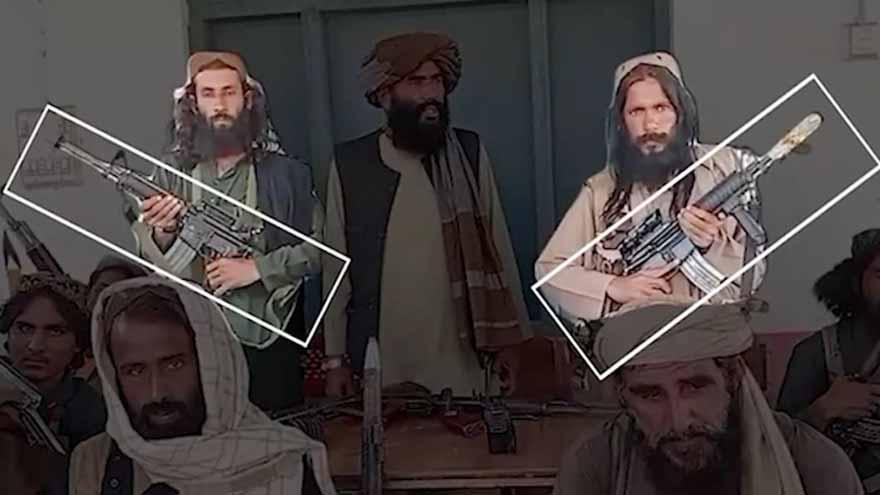
 Image labelled as showing TTP members with US-made M16 rifles.
Weapons worth $7.1 billion left behind after the 2021 US withdrawal from Afghanistan have raised serious security concerns, with US-made rifles, machine guns and night-vision equipment reportedly recovered from terrorists operating in Pakistan.
The withdrawal of US and NATO forces from Afghanistan in 2021 left behind a vast arsenal of military equipment that has since become a major concern for Pakistan’s security. Reports by the US government, United Nations monitoring bodies and international media investigations have documented the presence of former Afghan security force weapons in the hands of terrorists operating in Pakistan.
According to the July 2023 report of the Special Inspector General for Afghanistan Reconstruction (SIGAR), US and NATO forces left behind 167,550 rifles, 41,500 machine guns and 265 mortars when Afghan security forces collapsed following the withdrawal. The abandoned equipment was valued at approximately $7.1 billion and included more than 40,000 military vehicles, among them 12,000 Humvees.
The subsequent diversion of some of this equipment into illicit arms markets and terrorist networks has raised concerns about the growing firepower available to groups carrying out attacks in Pakistan.
293 US-made weapons reportedly recovered from terrorists
By 2025, Pakistani security forces had reportedly recovered 293 US-made weapons and optical sights from terrorists, according to figures provided in the source material.
The reported inventory included 208 M16 rifles, 53 M4 carbines, seven machine guns, four sniper rifles and 21 miscellaneous optical sights.
These recoveries highlight concerns about the availability of weapons originally supplied to Afghan security forces before the Taliban takeover in August 2021. However, the origin and transfer route of individual weapons must be established through forensic tracing and official recovery records.
 US-made weapons shown in material documenting arms recovered from terrorist groups.
Washington Post traces weapons seized in Pakistan
A 2025 investigation by The Washington Post traced the serial numbers of at least 63 weapons seized from terrorists in Pakistan to weapons supplied by the United States to Afghan forces before 2021.
The investigation provided evidence that at least some weapons originally intended for Afghanistan’s former security forces subsequently entered terrorist hands in Pakistan.
The findings have intensified scrutiny of how military equipment was secured, transferred or diverted following the collapse of the former Afghan government.
Advanced weapons increase the threat to Pakistani security forces
Videos circulated by terrorist groups have frequently shown fighters carrying US-made M16 and M4A1 rifles, weapons fitted with under-barrel grenade launchers, bulletproof vests, PVS-14 night-vision goggles and rifle-mounted laser sights.
Other weapons identified in the source material include the M249 Squad Automatic Weapon, M240B machine gun and M2 Browning heavy machine gun. The reported presence of such equipment raises concerns about the firepower available to terrorist groups, although the claim that these weapons have become standard across all groups requires further verification.
The availability of night-vision devices, thermal optics, sniper rifles and handheld communications equipment can also improve terrorists’ ability to operate in darkness, observe troop movements and coordinate attacks.
 Image labelled as showing TTP members with US-made M16 rifles.
Night-vision devices complicate counterterrorism operations
Night-vision devices (NVDs) and thermal optics can give armed groups a tactical advantage in low-light conditions. By improving visibility and surveillance at night, these technologies can make it more difficult for security forces to detect movement and maintain the element of surprise during counterterrorism operations.
When combined with advanced firearms and communications equipment, these capabilities can complicate operations and increase the risks faced by security personnel.
The reported availability of modern sniper rifles has also raised concerns about attacks at longer distances and in low-light conditions. However, the frequency of night-time sniping and the extent to which abandoned Afghan equipment has enabled it require incident-specific evidence.
 The supplied image is labelled as showing NATO leftover weapons recovered from BLA terrorists.
Preventing weapons from reaching terrorists
The circulation of weapons left behind in Afghanistan presents a continuing security challenge for Pakistan. The reported recovery of US-origin firearms, alongside international investigations tracing some weapons to former Afghan security force stocks, underscores the need to investigate illicit arms networks and prevent military equipment from reaching terrorist organisations.
Effective weapons tracing, stronger controls on arms trafficking and cooperation among relevant authorities are essential to understanding how the equipment has moved across borders.
For Pakistan, the central concern is that weapons originally supplied to support Afghanistan’s former security forces have reportedly found their way into terrorist networks, adding another dimension to the threat posed by cross-border terrorism.