Loading the Audio Player…
This year, the nation’s capital saw numerous projects to prepare for the 250th anniversary of the Declaration of Independence. Officials devoted special attention to restoring and beautifying Washington’s monuments and historic spaces. For those interested in the role of religion in America’s founding, a temporary exhibition in the District of Columbia’s Freedom Plaza merits particular notice.
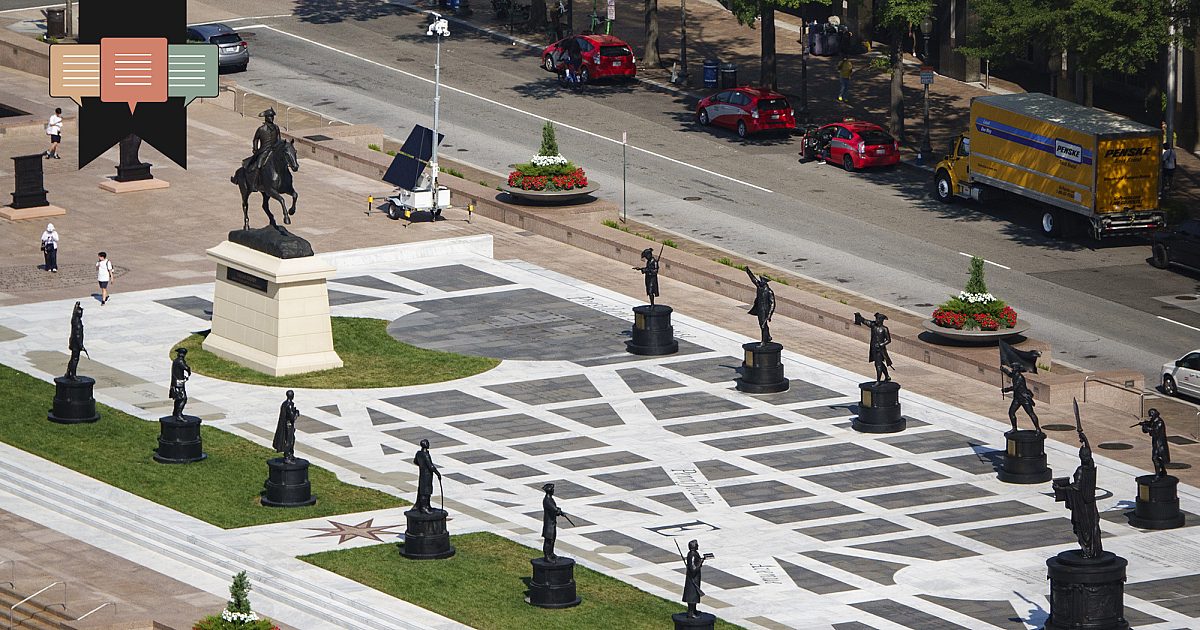
Located two blocks east of the White House, Freedom Plaza is temporarily home to an exhibition called the Spirit of ’76. At its center stands an equestrian statue of Caesar Rodney, a signer of the Declaration of Independence. Surrounding Rodney are what the National Park Service calls the “12 Soldiers of the Revolution”—bronze statues commemorating Americans who participated in the war. Among them are three remarkable pastors.
James Caldwell was a Presbyterian minister whose support for American independence earned him the nickname “the Fighting Parson of New Jersey.” Ordained in 1760, Caldwell served as a chaplain when war came.
His patriotism came at extraordinary personal cost. In January 1780, British forces burned Caldwell’s church. Five months later, during the Battle of Connecticut Farms, his wife, Hannah, was shot and killed as British troops advanced through the area.
Just 16 days later came the episode for which Caldwell is best remembered. During the Battle of Springfield on June 23, American troops needed paper wadding for their weapons. Caldwell rushed into a nearby Presbyterian church and emerged carrying hymnals containing the works of Isaac Watts, the famous English hymn writer. According to the story that became part of Revolutionary lore, Caldwell distributed pages to the soldiers, crying, “Give ’em Watts, boys!”
Another minister commemorated by the Spirit of ’76 is John Peter Gabriel Muhlenberg. Muhlenberg was ordained a Lutheran minister in 1768 and later served as an Anglican priest. By the end of 1775, the war was well underway.
When asked to serve, Muhlenberg accepted a commission as a colonel in the Continental Army. According to the traditional account of his farewell sermon to his congregation on Jan. 21, 1776, he preached from Ecclesiastes 3—the familiar passage declaring that “to everything there is a season.” Reaching verse eight—“a time of war, and a time of peace”—Muhlenberg reportedly told his congregation that there was a time to preach and pray, but “there was a time to fight—and that time had now come.”
After praying, Muhlenberg removed his black clerical robe, revealing the uniform of a Continental Army colonel. He left the pulpit and called for recruits. Approximately 300 men from his congregation and surrounding communities eventually joined him, forming the core of the 8th Virginia Regiment.
Caldwell, Muhlenberg, and Daggett understood that Christian ministry did not relieve them of the responsibility to understand the times in which God had placed them.
Perhaps the most surprising of the three stories belongs to Naphtali Daggett. He was not a professional soldier but a theologian. Born in Massachusetts in 1727, Daggett graduated from Yale in 1748, entered the ministry, and returned to Yale in 1756 as a professor of divinity. He later served as president pro tempore from 1766 to 1777.
By 1779, Daggett was 51 and again serving primarily as professor of divinity. Then the British came to New Haven. On July 5, more than 2,500 British troops landed near the city. Local residents and Yale students organized to resist their advance. Daggett joined them.
One account describes Daggett riding toward the fighting with a firearm in hand. Yale historian Joanne Freeman notes that his students already knew he supported armed resistance; now they watched their professor put those convictions into practice.
Daggett exchanged fire with the advancing British until he was captured. The soldiers beat him, jabbed him with bayonets, took his shoes, and forced the wounded professor to walk barefoot beneath the July sun toward New Haven. Daggett later wrote that he reached New Haven only by “the supporting power of God.” He never fully recovered from his injuries and died about 16 months later.
The stories of Caldwell, Muhlenberg, and Daggett are remarkable. Each had devoted his life to Christian ministry and teaching. Yet when war came, each chose, in his own way, to join the American patriot cause.
Christians today need not view every decision these men made as a template for modern political engagement. The circumstances of the American War for Independence were extraordinary, and questions of war, civil authority, and Christian responsibility require careful biblical and moral consideration.
Yet this qualification should not prevent Christians from considering their example. Caldwell, Muhlenberg, and Daggett understood that Christian ministry did not relieve them of the responsibility to understand the times in which God had placed them. They sought to apply their convictions amid the political, cultural, and moral crises confronting their churches, communities, and country.
As the United States celebrates its 250th anniversary, the stories of these ministers—and others honored at Freedom Plaza—deserve to be remembered. Their examples should encourage Christians to consider their own calling with similar seriousness: to honor God, serve Christ’s church faithfully, and live wisely and courageously in the time and place God has given them.