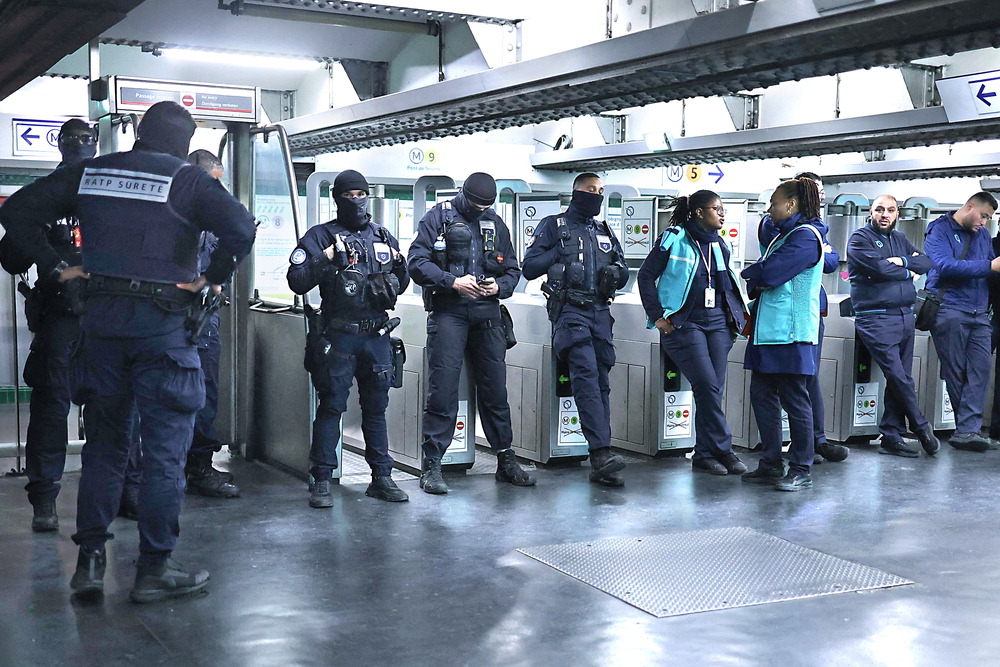
 사진 확대 Security guards at the Paris subway station on the 20th (local time) at the République subway station in Paris, France, where security guards and employees of the Paris Transportation Authority (RATP) are kept closed. AFP Yonhap News Agency
France has decided to mobilize troops to prevent a repeat of violent protests that swept the country over the weekend. Ahead of further protests on the 24th (local time), anti-terrorism operations forces have been deployed to strengthen the alert posture. Italy has also decided to deploy 500 soldiers to Milan, raising the level of response to violent protests in European countries.
French Prime Minister Sebastian LeCornu announced a large-scale security operation in parliament on the 20th, Reuters and others said. “The deployment of troops will take place on a large scale this Saturday,” he said, stressing that restoring security is a top priority.
French Interior Minister Laurent Nunez also announced a plan to deploy military troops. He explained, “We will deploy ‘Saintinel’ troops, the military’s counterterrorism alert operation, so that the police and military police will focus on responding to the protests.”
The French government decided to mobilize the military because of mounting criticism for failing to respond properly to the violence on the 17th. At that time, protests against high prices and worsening public services spread to looting and arson in major cities such as Paris, Marseille, and Lyon. Shops and public facilities were attacked one after another as the police failed to control the protesters.
Prime Minister LeCornu mistakenly admitted failure to gather information, rigid police deployment, and failure to cancel police leave. Minister Nunez also acknowledged responsibility for the failure to respond. The French parliament has decided to form a fact-finding committee, and authorities are sending 200 investigators to track down participants in the violence.
The government has imposed curfews in some areas. This is because tensions are rising as student groups and groups advocating for the “Yellow Vest” movement herald further protests on the 24th.
Italy also mobilized military troops to strengthen security. Italian Prime Minister Jorja Meloni has decided to deploy 500 military personnel to maintain security by the end of the year following looting and violence in Milan over the weekend. The government is also pushing to expand the detention authority of minors who participated in violent protests and fine their parents. Over the weekend, 80% of those arrested on charges of vandalism were minors.
The economic damage caused by the violence was found to be significant. According to the French government’s preliminary tally, at least 3,000 companies across the country have been affected. Luxury stores such as Louis Vuitton and Kenzo were also looted. Retail giant Carrefour said it had lost tens of millions of euros.
Morningstar DBRS, a credit rating company, estimated that the insurance money for the riot would reach up to 1 billion to 1.2 billion euros (about 1.4861 trillion to 1.788 trillion won). This exceeds the insurance premium of 798 million euros (about 1.1859 trillion won) during the 2023 French riots. If additional protests become violent, the damage is expected to be even greater.
Suspicions have also been raised over the forces involved in the violence. In France, the possibility of intervention by the far-left protest force Black Bloc, which wears black clothes and masks and clashes with police, was discussed. However, no concrete evidence has yet been presented that they led the violence.
There were also suspicions that foreign forces such as Russia and Iran encouraged social conflict in France online. Accounts linked to these countries have spread posts highlighting controversy over police violence and racism, the British daily The Times reported. French Foreign Minister Jean-Noel Barro criticized Russia, China, and Iran for exploiting the French student protests by spreading hostile claims online.
Meanwhile, the 10-year interest rate on French government bonds exceeded 5% for the first time since 2002 due to growing anxiety over the French public finances.
According to Reuters and Bloomberg on the 21st, the 10-year interest rate on French government bonds rose to 5.002% during the day. This week alone, it has soared 0.2 percentage points.
[Reporter Kim Jae Kwan]