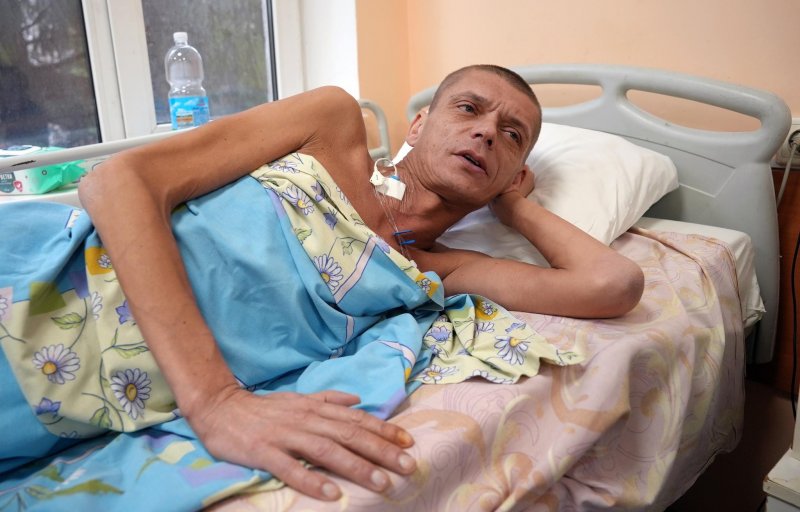
A Ukrainian soldier who lost both feet and survived for 491 days on the frontline has been rescued in an extraordinary military operation involving a giant drone that carried him 15 kilometres to safety.
The 49-year-old infantryman, Kostiantyn Vlasenko, spent nearly eight months sheltering beneath the boiler of a destroyed school after suffering devastating injuries in a Russian drone attack, Reuters reports.
The October 4 rescue, described by Ukrainian commanders as the first known aerial drone evacuation of a wounded soldier, highlights the extraordinary challenges of battlefield survival in an increasingly drone-dominated war.
How did the Ukrainian soldier become trapped for 491 days?
Vlasenko, a member of Ukraine’s 30th Mechanized Brigade, was deployed to a frontline position in the Kharkiv region in May 2025 alongside another soldier known by the call sign Basky.
The two men remained in a cramped underground shelter, where supplies were delivered by drones because Russian surveillance and attack aircraft made movement across the surrounding territory extremely dangerous.
As fighting intensified, their planned rotation became increasingly difficult.
According to Vlasenko, two soldiers sent to replace them were killed while approaching their position. Two additional servicemen who attempted to recover the bodies were also killed.
In February 2026, flooding forced Vlasenko and Basky to abandon their shelter and relocate to a damaged school building.
However, a Russian surveillance drone reportedly detected them when they emerged to collect food and clothing delivered by Ukrainian forces.
A subsequent drone attack killed Basky on his 50th birthday and seriously wounded Vlasenko.
Unable to escape, the surviving soldier crawled into a small opening beneath the school’s metal heating boiler, where he remained isolated for months.
Why was Vlasenko forced to amputate his own foot?
The Russian drone strike left Vlasenko with severe injuries to both lower limbs.
His left foot was badly damaged, while his right leg was broken so severely that he could barely move.
Trapped beneath the boiler and unable to receive conventional medical treatment, the soldier struggled to survive as his wounds progressively deteriorated.
According to his account, his left foot eventually suffered extensive tissue damage, while a bone protruding from his injured right leg made movement increasingly difficult.
Approximately three months after the attack, Vlasenko concluded that he could no longer survive without removing his remaining foot.
Using a knife, he amputated the injured foot himself and applied a tourniquet to control the bleeding.
Despite the pain, blood loss and extremely difficult conditions, he managed to remain alive with supplies delivered remotely by Ukrainian military drones.
From his hospital bed in Kharkiv, Vlasenko later told Reuters that he had almost abandoned hope of returning home.
His survival was particularly remarkable because he remained in an exposed combat area where medical evacuation was considered nearly impossible.

Why were Ukrainian forces unable to rescue him earlier?
The area surrounding Vlasenko’s position had become what soldiers describe as a kill zone, where large numbers of surveillance and attack drones make movement potentially fatal.
Ukrainian commanders repeatedly explored ways to reach the wounded infantryman, but conventional evacuation methods presented an unacceptable risk.
According to an officer involved in planning the rescue, identified only by the call sign Alex, sending pickup trucks or armored vehicles into the area was considered exceptionally dangerous.
The military subsequently attempted to use unmanned ground vehicles, which can transport supplies or casualties without exposing human drivers.
However, two robotic vehicles dispatched toward Vlasenko’s position were destroyed by Russian drones before reaching him.
With ground evacuation attempts unsuccessful, Ukrainian commanders began exploring an alternative approach involving a heavy-lift aerial drone.
The breakthrough came when they learned about a new six-rotor aircraft being developed by Ukrainian manufacturer Gurzuf Defence.
The drone, known as the Ayudag-6, could transport loads weighing up to 90 kilograms over distances of approximately 25 kilometres.
Its capabilities offered a possible solution to a problem that had prevented Vlasenko’s evacuation for months.

pan.bg
How did a giant drone carry the wounded soldier to safety?
Ukrainian military specialists modified the heavy-lift aircraft to transport a person suspended beneath its frame.
Commanders estimated that Vlasenko weighed approximately 70 kilograms after his prolonged deployment, meaning the drone could potentially carry him to a safer position 15 kilometres away.
In early October, one of the soldier’s regular supply deliveries contained an unusual package: a special evacuation harness and a mobile phone containing recorded instructions explaining how to attach himself to the aircraft.
On October 4, the rescue operation began.
Vlasenko emerged from his shelter and secured himself to a cable hanging from the drone’s electric winch.
The six-rotor aircraft then lifted him approximately 70 metres above the ground.
Three smaller Vampire drones escorted the rescue aircraft to distract Russian attack drones.
At the same time, Ukrainian artillery units and additional drone operators targeted Russian drone positions to reduce the risk of interception.
The rescue aircraft successfully transported Vlasenko over a distance of 15 kilometres, completing the flight in approximately 15 minutes.
Despite the dangers, the operation ended with the soldier reaching a secure Ukrainian position.

Footage from the Ukrainian military’s aerial evacuation of Kostiantyn Vlasenko. Source: Ukrainian 92nd Assault Brigade.
What does the rescue reveal about the changing nature of warfare?
Following the evacuation, Vlasenko was transported to a hospital in Kharkiv, where he began receiving treatment for his injuries.
Reuters said the Ukrainian military and footage recorded by a camera mounted on the rescue drone supported key elements of the soldier’s account, although not every detail could be independently verified.
Ukrainian commanders described the mission as the first known evacuation of a wounded soldier directly from an active battlefield using an aerial drone.
The operation also demonstrated how rapidly unmanned systems are transforming military activities.
Throughout the Russia-Ukraine war, drones have become essential tools for reconnaissance, precision attacks and the delivery of supplies to otherwise inaccessible positions.
The evacuation of Vlasenko suggests that heavy-lift drones may also provide an emergency rescue option in areas where ground vehicles and medical teams cannot safely operate.
However, transporting wounded personnel through contested airspace involves serious risks, including drone interception, mechanical failure and injuries during flight.
For Vlasenko, the successful mission brought an end to 491 days on the frontline and months of isolation following the attack that left him without both feet.
His rescue illustrates both the severe human consequences of modern warfare and the potential for military technology to be adapted for life-saving operations.