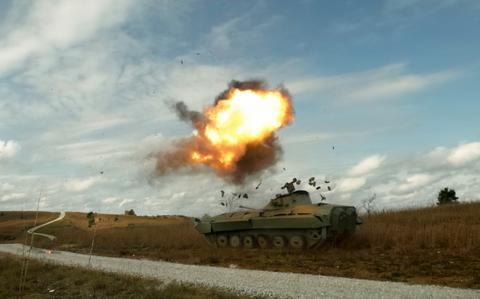

A simulated enemy vehicle explodes after being struck during a demonstration of autonomous vehicles at Fort Knox, Ky., Oct. 15, 2026. At the request of U.S. European Command, the Defense Department tested four autonomous ground vehicles that scout for targets on their own. (Courtesy of Defense Advanced Research Projects Agency)
The Defense Department tested a team of autonomous ground vehicles designed to hunt enemy targets, a demo sought by U.S. European Command as it explores ways to send robots into combat ahead of American troops.
Four unmanned vehicles maneuvered across a training range at Fort Knox, Ky., coordinating their movements before a simulated rocket strike, the Army said in a statement Thursday.
“All the mobility, all the movement, all the detections, all of that is autonomous,” said Jason Gregory, a technical adviser at the Defense Advanced Research Projects Agency. “But they don’t pull the trigger until a human says pull the trigger.”
EUCOM asked for the test to see “how we can deploy robotic assets beyond the forward line of troops to do early detection for the soldier,” he added.
The demonstration earlier this month is an example of the technology U.S. and allied forces are increasingly looking to as part of a first line of defense against a potential Russian invasion.

An Anduril attack drone flies above an Overland AI autonomous ground vehicle during a demonstration at Fort Knox, Ky., Oct. 15, 2026. U.S European Command requested the test as a way of advancing the new deterrence strategy for NATO’s eastern flank. (Courtesy of Defense Advanced Research Projects Agency)
Under the Eastern Flank Deterrence Initiative, U.S. and allied military planners envision a robotic force that takes the initial punch if a NATO country is invaded. Such a force would be powered by a network of autonomous vehicles, drones and sensors.
Fort Knox was chosen for the demonstration because its terrain could serve as a stand-in for the European battlefield, DARPA said.
During the test, an operator received satellite imagery identifying a potential enemy position and directed the robotic team to investigate.
One vehicle advanced independently, using onboard sensors to navigate the terrain while searching for targets, the statement said. After detecting a possible enemy position, it stopped and awaited further instructions.
Two other vehicles then pushed forward to provide support before a simulated rocket struck the target about 300 yards away, according to the Army statement.
The lead vehicle also carried a drone that could be launched for reconnaissance or armed to attack enemy positions.

Operators monitor four autonomous ground vehicles on laptops and a wall screen during a demonstration at Fort Knox, Ky., Oct. 15, 2026. The vehicles don’t fire until a human tells them to pull the trigger, said Jason Gregory, a technical adviser at the Defense Advanced Research Projects Agency. (Courtesy of Defense Advanced Research Projects Agency)
The eastern flank deterrence concept was pioneered by recently retired Gen. Christopher Donahue, whose team at U.S. Army Europe and Africa and NATO’s land command has drawn numerous lessons from the high-tech war in Ukraine.
NATO’s ground forces have tested a range of unmanned systems across the eastern flank as allies develop the initiative.
Gregory said the vehicles used in the Fort Knox demonstration can be equipped with machine guns, rockets and other weapons. They also could transport supplies and ammunition or evacuate wounded soldiers.
DARPA plans another round of testing in December with soldiers who will evaluate the technology and give feedback on how it could be used in combat.