
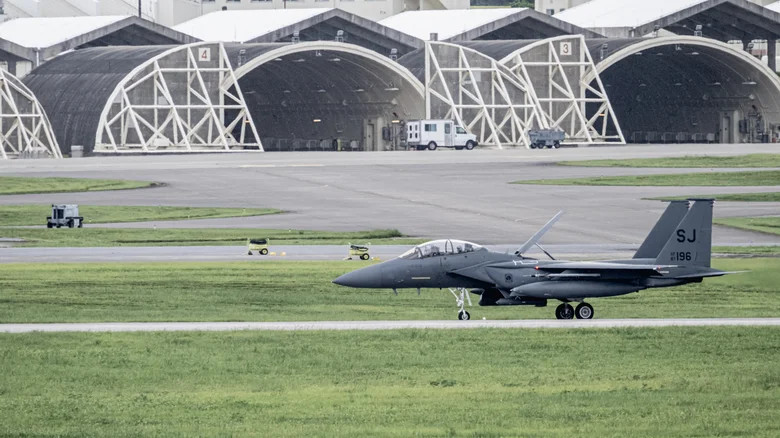
According to Carscoops , the ban is in effect at Kadena Air Base on Okinawa Island ( Japan ), about 1,600km southwest of Tokyo.
Accordingly, security forces at the base have been instructed to refuse all BYD-branded vehicles starting today, October 26th. This applies to taxis, delivery vehicles, and contractor vehicles.
This move is believed to stem from security concerns related to the potential for modern vehicles to collect data in sensitive military areas.
BYD is on the Pentagon’s list of companies under scrutiny.
Lieutenant Colonel Alli Stormer, representing Kadena Air Force Base, stated that these vehicles pose unforeseen risks to military operations. However, the base did not disclose details of the reasons behind the decision.
Reports suggest concerns center on cameras and sensors fitted to BYD’s cars, trucks, and SUVs. These devices could record images, ambient data, and inadvertently collect sensitive information inside or near military areas.
The move in Japan comes amid growing caution in the US regarding technologies originating from China .
According to Carscoops, BYD was previously included in a list of companies that the Pentagon believed were involved in supporting the Chinese military. The updated list, published in June 2026, also mentioned automaker Nio, e-commerce giant Alibaba, and technology company Baidu.
Currently, Chinese automotive brands are unable to widely market in the US due to tariff barriers and regulations on software originating from China. Polestar, a brand owned by Geely, also faces obstacles related to software, despite having manufacturing facilities in Ridgeville, South Carolina.
Some U.S. lawmakers are pushing for measures to block or remove Chinese vehicles from the U.S. market. Concerns not only relate to trade competition but also focus on data security and the risk that information collected from vehicles could be misused.
Previously, China had also imposed restrictions on Tesla vehicles at certain government locations due to concerns about potential data collection. According to Carscoops, these restrictions will be lifted in 2024 after Tesla models manufactured in China meet the country’s data security requirements.
BYD expands globally but faces difficulties in Japan.
Although not yet present in the US market, BYD and many other Chinese car brands are expanding their operations in other markets, including Europe. However, in Japan, BYD still holds a very small market share, around 0.1%, in a market traditionally dominated by domestic automakers.
To improve its competitiveness, BYD introduced the Racco, an electric car in the kei car segment specifically for the Japanese market. This is a small-sized vehicle, suitable for the traffic conditions and urban commuting needs of the country.
With the ban on BYD vehicles at Kadena Air Base, experts believe this is a worrying move for the Chinese automaker.
The incident highlights how concerns about data security are becoming a significant factor in the proliferation of modern automobiles.
As vehicles become increasingly equipped with cameras, sensors, and connectivity systems, data protection is no longer just about user privacy but can also relate to security in sensitive areas.
However, according to Carscoops, citing reliable sources, the ban is limited to a single military base on the island and does not apply to BYD vehicles nationwide, nor to all Chinese cars in general.
(According to Carscoops)
Please leave your comments below the article or send them to otoxemay@vietnamnet.vn. Thank you!