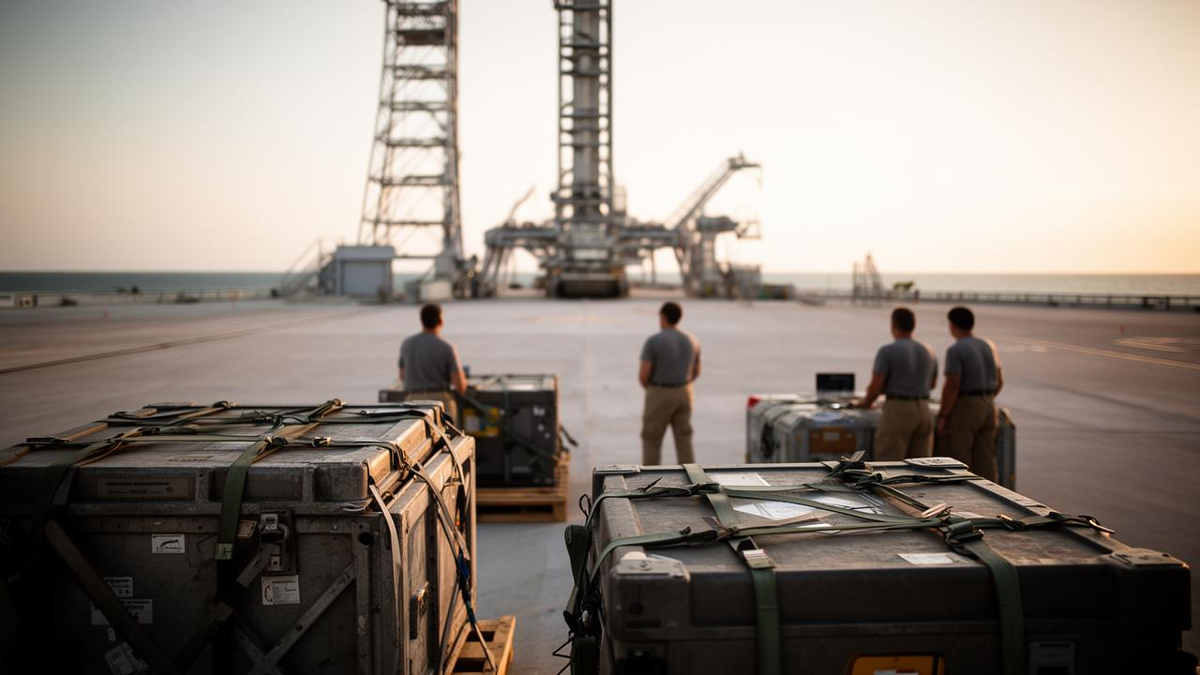
The US Air Force has for the first time demonstrated a technology for transporting earthly cargo through space using a commercial reentry capsule. It marks an early validation phase of the “Rocket Cargo” program, which aims to deliver large volumes of military supplies to remote areas and conflict zones lacking runways or roads in roughly an hour.
The US Air Force Research Laboratory (AFRL) said on the 20th (local time) that it conducted a test at Cape Canaveral Space Force Station in Florida, launching SpaceX’s reentry capsule “Starfall” loaded with a cargo pod and sensors. Starfall lifted off the same day aboard a Falcon 9 rocket as part of SpaceX’s rideshare mission “Bandwagon-5.”
The core of the test was to verify whether cargo can withstand the harsh conditions of launch, orbital flight, and atmospheric reentry. Researchers placed a satellite communications tracker, batteries, a reverse-osmosis desalination device, emergency medical equipment, and survival supplies inside the pod, collecting data on temperature changes, shock, and vibration. They also checked whether a 20-person life raft, the “Unipack III,” could be loaded into the capsule for future tests.
Starfall is a disc-shaped reentry capsule developed by SpaceX for microgravity scientific research and in-space manufacturing. It can carry up to 1 ton of cargo and uses a special carbon-fiber heat shield on its underside to block frictional heat during reentry. It has no engine of its own but adjusts its attitude in orbit using a cold-gas control system that expels compressed nitrogen; once a target point is set, it separates from the rocket’s second stage, deploys a parachute, and descends.
Previously, in June, SpaceX launched Starfall into orbit aboard a Falcon 9, and after it circled the Earth one and a half times, successfully recovered it at sea in the Pacific Ocean. At the time, private companies that had consigned cargo revealed their items had returned intact, confirming the capsule’s commercial viability.
The Rocket Cargo program has been underway since 2021. The US Air Force envisions using large liquid-propellant rockets to deliver tens of tons of cargo anywhere on Earth within 90 minutes. A payload of 100 tons is equivalent to one and a half of the US military’s main battle tank, the M1 Abrams, or hundreds of heavily armed special operations troops along with armored vehicles at once. The ultimate goal is to secure multiple commercial launch providers and build a system capable of sending large volumes of supplies into orbit whenever needed.
The speed advantage is overwhelming. The shortest distance from Florida to Perth, Australia — on the opposite side of the globe — is about 18,000 km, a distance an F-15 fighter cruising at roughly 1.2 times the speed of sound would need more than 12 hours to cover without aerial refueling. In practice, range limitations require multiple refuelings, and factoring in overflight permits and sonic-boom regulations, the time required grows even longer. By contrast, researchers estimate that a capsule entering the atmosphere from low Earth orbit can reach any point on Earth within one to two hours, with no airspace concept or intermediate stops.
The military’s primary intended use is dropping communications equipment and emergency medical supplies onto islands with destroyed runways, battlefields with severed roads, and waters difficult for rescue teams to reach. Responses to chemical, biological, and radiological contamination zones and disaster relief missions are also under consideration. However, military experts also note that if large numbers of reentry capsules are deployed in low Earth orbit and loaded with precision-guided bombs or suicide drone swarms in a contingency, they could be converted into strike assets difficult to stop with air-defense networks. It appears the fractional orbital bombardment system (FOBS) pursued by the US and the Soviet Union during the Cold War is being revived against the backdrop of falling launch costs for reusable rockets and advances in precision-guidance technology.
AFRL assessed that this launch means more than a simple large-rocket launch. Brig. Gen. Douglas Wickert, commander of AFRL, said, “Today’s launch once again demonstrates how AFRL works with industry to reduce risk, gather real measured data, and deliver technology that brings victory to the operational force.”
Challenges remain before commercialization. Key tasks ahead include technology to prevent cargo damage amid the extreme frictional heat and vibration of launch and reentry, and establishing procedures to land precisely at a target point and recover the payload quickly. Ahn Jae-myung, a professor of aerospace engineering at KAIST, analyzed, “Space delivery is a model aimed not at mass-market demand like ordinary parcel delivery right now, but at the military’s time-critical emergency resupply, or at companies seeking to safely recover high-value new drugs or semiconductor materials made in microgravity environments back to the ground. SpaceX, which has drastically lowered launch costs by launching reusable rockets roughly every two days, is now opening a new market called ‘space logistics.'”
This demonstration is significant in that it signals the business scope of private space companies — previously confined to launch services — is expanding into reentry, recovery, and logistics. Some observers say that if military demand forms the initial market, launch costs and recovery procedures will become standardized, which could in turn open up commercial demand such as satellite manufacturing and the ground recovery of space experiment cargo.