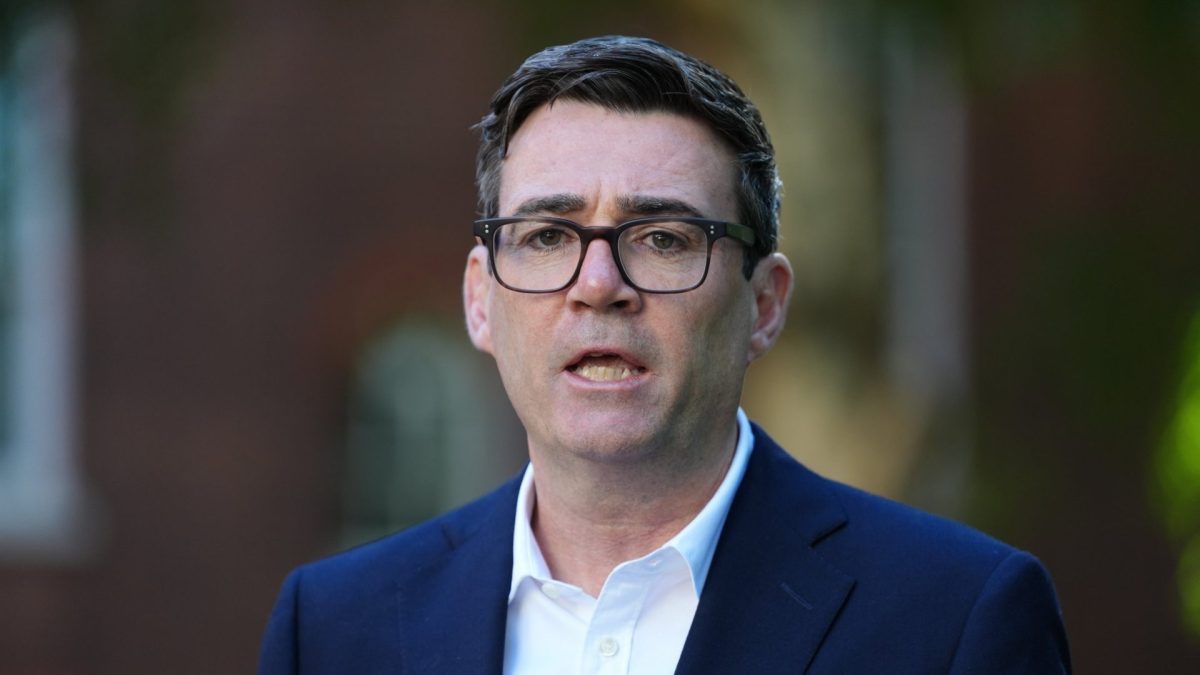
Andy Burnham has authorised the first deployment of the UK military since becoming Prime Minister, agreeing to provide defensive support to Saudi Arabia as Iran-backed Houthi rebels intensify attacks across the region.
The Royal Air Force will provide air-to-air refuelling for Saudi aircraft carrying out defensive missions against the Yemen-based militants, who are threatening vital energy supplies and trade routes.
The support is expected to begin in the coming days and will be limited to “weeks”, with a single RAF Voyager assigned to the operation. The Voyager is the RAF’s air-to-air refuelling tanker, allowing fighter aircraft to remain airborne for longer and operate over greater distances.
Shorts
Scroll to previous short
Scroll to next short

How middle-aged men are turning to weight-loss drugs

The new military squadron to protect UK satellites

 Men are getting more interested in weight loss drugs (Photo: Maskot/Getty Images/Digital Vision)
news
How middle-aged men are turning to weight-loss drugs

Slimming jabs have so far been used by overwhelmingly more women than men. However, according to sales figures from online pharmacy Phlo Clinic, men are now using the drugs in growing numbers as they are available in tablet form.
The stats behind the change
Before the Wegovy pills were introduced, 23 per cent of customers were men. Now. it is 34 per cent.
The average age of men previously buying the injection was 51. Now, due to the pills, it’s 56.
A study of over 5,000 people by University College London in 2025 found that over twice as many women were using weight-loss jabs compared to men.
The same study also found that middle-aged people were most likely to use the jabs.
Why are men less likely to use weight-loss medication?
Phlo chief pharmacist Alistair Murray said: “There’s persistent stigma around men asking for help with their health, and an injection can feel like one more reason to put it off. A tablet is a lot easier, it fits into daily life, and so it doesn’t feel like such a leap.”
 Caption: Overweight diabetic man injecting insulin into abdomen at home. Close up.
Photographer: Halfpoint Images
Provider: Getty Images
Source: Moment RF
Dr Ehtasham Ahmad, a diabetes and obesity specialist at the University Hospitals of Leicester, also pointed out that women have traditionally faced more societal pressure to stay slim.
 Alzheimer’s is thought to be caused by a build-up of amyloid – in orange – among brain cells, eventually killing them (Photo: Kateryna Kon/Getty)
news
The drugs that could slow Alzheimer’s – and when they could come to NHS

Two Alzheimer’s drugs with new mechanisms could be used in the NHS within the next five years, experts said at a conference last week.
The new military squadron to protect UK satellites
The UK is launching a new military unit tasked with defending satellites, protecting vital services on Earth and potentially supporting offensive operations.
 Caption: Satellite in space orbiting the planet Earth for space research mission or GPS communications. NASA Public Domain Imagery
Photographer: yalax
Provider: Getty Images
Source: iStockphoto
Protecting everyday services
The new No III Space Effects Squadron will protect satellites used to detect incoming missile threats, maintain communications and help navigate ships, the Ministry of Defence (MoD) said.
 Caption: MAN IN COMBATS USING LAPTOP
Photographer: Peter Dazeley
Provider: Getty Images
Source: The Image Bank RF
The unit will bring together specialists from across the Armed Forces to respond to hostile activity in space and safeguard satellites that are relied on for everyday services.
How will it combat adversaries?
The MoD said the new unit would combat threats in space using advanced technology, including electronic warfare, “to disrupt, degrade and deny hostile actions”.
It is intended to support offensive and defensive space operations and will grow over time as new capabilities enter service.

4 min read

4 min read
The context
The scheme is announced as other nations continue to build up their military capabilities in space.
The UK Space Command warned last year that Russia was attempting to jam UK military satellites regularly.
Earlier this month, the US said that it had deployed weapons in space for the first time.
Responding to the US announcement, the Chinese foreign ministry said Washington was “preparing for war in outer space”, and cautioned against turning space “into a battlefield, as well as an arms race there”.
Watch more from The i Paper
Could Russia’s latest strike on Ukraine be a warning to the West? A Russian drone struck a passenger train just two kilometres from Nato member Poland, shortly after a diplomatic train carrying Boris Johnson and other senior European figures travelled along the same route. Ukraine says the diplomatic train may have been the intended target, while Russia says it was targeting railway infrastructure used to transport military supplies. EU foreign policy chief Kaja Kallas believes the strike was intended to “scare Western countries” away from supporting Ukraine, as Russian attacks move increasingly close to Nato’s borders. #News #UkraineWar #Putin #Russia
It marks a significant early test of Burnham’s approach to the use of British military power.
The Prime Minister approved the deployment after receiving a formal request from the Saudi government and taking advice from the Defence Secretary and Foreign Secretary.
This is in addition to the decision taken in March by the then defence secretary, John Healey, to deploy a Sky Sabre, the Army’s medium-range ground-based air defence system, to Saudi Arabia’s King Fahd air base.
‘Defensive’ move to protect British interests and help against Houthis
Speaking to reporters en route to the United Nations General Assembly (UNGA) in New York City, Burnham said the decision was intended to protect British interests as well as help Saudi Arabia respond to the growing threat from the Houthis.
“We have received a request from the Kingdom of Saudi Arabia for military support, and on the advice of the Defence Secretary and the Foreign Secretary, last night I agreed to that request for defensive air-to-air refueling, and that’s the agreement that we’ve given,” the Prime Minister said.
The move comes after a dramatic deterioration in the regional security situation over the past week. Houthi forces have made significant territorial gains in Yemen, including around the strategically important Bab al-Mandab strait, while launching attacks against Saudi Arabia and its energy infrastructure.
The strait, which connects the Red Sea with the Gulf of Aden, is a crucial maritime chokepoint and any prolonged disruption could have consequences for international shipping and energy markets.
Burnham said those “pathways” needed to be “kept open” to avoid “potential further disruption”.
“I got back to the point I made about cost of living pressures and acting to secure the interests of Britain and the wider region, because of course Saudi Arabia has been experiencing attacks, is looking at potential further disruption, and we need to keep those pathways open,” he said.
How long will UK military support of Saudi Arabia last?
The Prime Minister stressed that the assistance would be time limited and kept under review.
“It’s defensive support. We have support in the region to maintain the Strait of Hormuz open. We are playing our part,” he added.
Asked whether he would encourage the US President to bring the conflict with Iran to an end when the two leaders meet on Tuesday, Burnham said the UK wanted to see the conflict end “as quickly as possible”.
“Of course the message is that we want to see an end to the conflict as quickly as possible and we stand ready to play our part,” the Prime Minister said.
The decision to deploy the RAF puts Burnham in a delicate position as he seeks to support a key regional ally without drawing Britain deeper into the conflict.
It also echoes a decision by his predecessor, Keir Starmer, whose government allowed RAF Voyager aircraft to provide air-to-air refuelling support for US forces operating against the Houthis.
Ministers argued at the time that the UK was acting alongside its closest ally in collective self-defence and to protect freedom of navigation, while the decision prompted criticism over Britain’s involvement in the US campaign.
Burnham is now offering similar aerial-refuelling capability, but for Saudi aircraft undertaking defensive missions.