They also suggested it could set a potential precedent for seeking charges against countries that often slip through the fingers of the International Criminal Court, including the United States.
“The Special Tribunal for the Crime of Aggression against Ukraine represents one of the most significant developments in international criminal justice since the establishment of the ICC,” said David Crane, founder of the Global Accountability Network and former chief prosecutor for war crimes in Sierra Leone.
“Its significance extends beyond Ukraine,” he continued. “Whether the tribunal ultimately secures convictions or not, its creation marks a pivotal moment in the continuing evolution of international criminal justice, one that may shape the future of accountability for aggression in the 21st century.”
Established in 2025 by Ukraine and the Council of Europe in the wake of Russia’s ongoing war in Ukraine, the tribunal is intended to fill a gap left by the International Criminal Court (ICC) by prosecuting officials in Russia and other countries on a personal level for the crime of aggression against Ukraine — a charge the ICC cannot levy in practice. The ICC can, and is, working to prosecute Russia for charges of other war crimes, crimes against humanity and genocide against Ukraine.
The ICC cannot prosecute the crime of aggression against countries that don’t recognize its jurisdiction and permanent members of the United Nations Security Council (like Russia) can use their veto power to block the court from prosecuting a crime of aggression. While some legal scholars who spoke Tuesday suggested that should be amended, the group’s focus was on forming this special tribunal to more immediately fill the gap left by the ICC’s current lack of jurisdiction.
“The special tribunal responds to a specific gap in the existing international criminal justice architecture,” said Ambassador Miroslav Papa, a permanent observer of the Council of Europe to the United Nations Office at Geneva.
The tribunal’s significance stretches beyond its potential to prosecute Russian officials on a personal level for the death and destruction their crimes of aggression in Ukraine have caused, lawyers and diplomats emphasized Tuesday. Forming this tribunal, they said, would provide the precedent and framework to prosecute leaders of other powerful countries for crimes of aggression, including the United States.
“This special tribunal on the crime of aggression against Ukraine plants that flag, sends a signal to a whole bunch of other bad actors in this world who are thinking about looking across the border, taking over the sovereignty of another nation,” said David Cattin, who has served as secretary-general of parliamentarians for Global Action. “This sends a signal, ‘If you do it, we now have a precedent that potentially you could be held accountable for that aggression.’ If we do nothing else, this is a political victory already, and I think that that’s important.”
Discussion on the larger significance of the tribunal and how to continue moving it forward was one of the New York City Bar Association’s goals in holding Tuesday’s event, the organization said. Multiple members of the audience said they believed special tribunals should be formed to prosecute the United States for its actions internationally, and speakers joined them in saying the U.S. has committed crimes of aggression in this and past years.
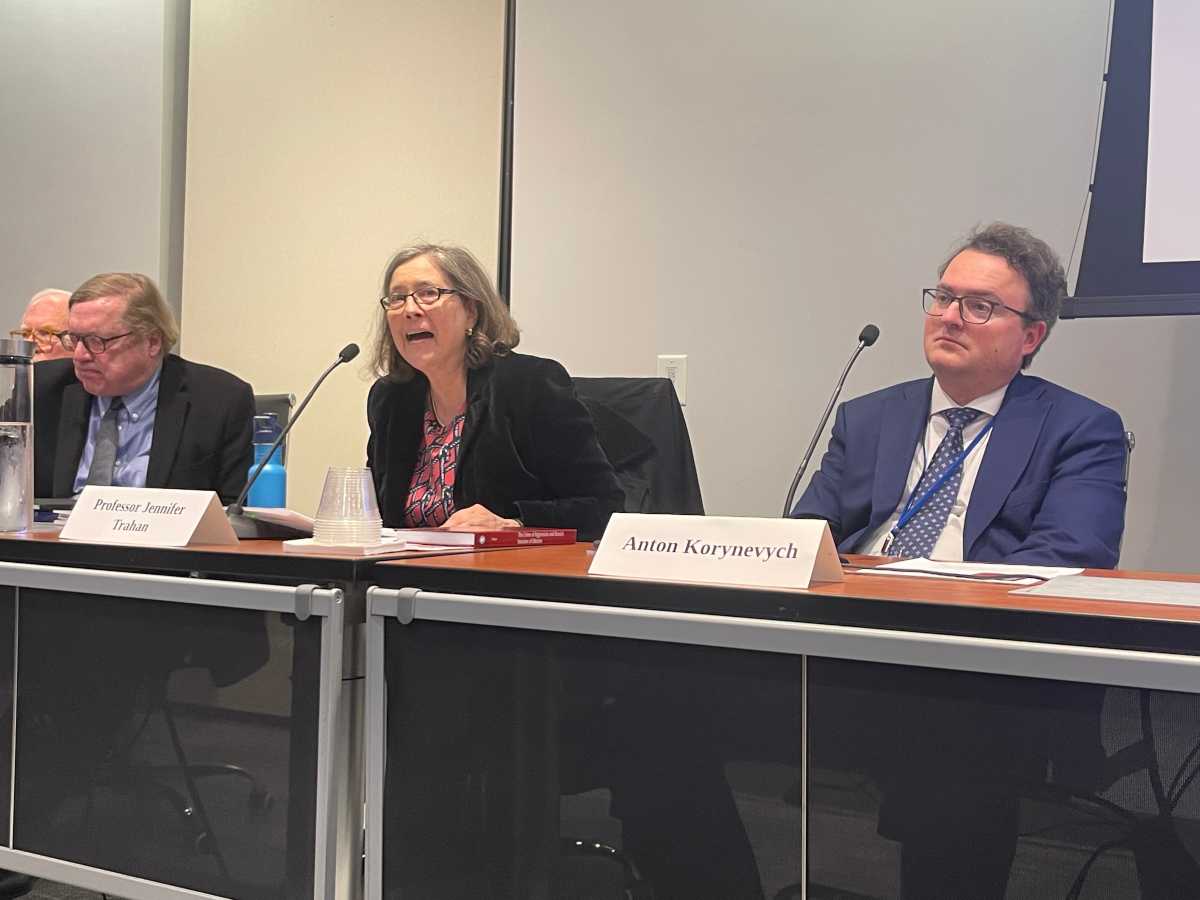
“International law and UN institutions often develop in steps and stages,” said Jennifer Trahan, who serves as a special advisor to the tribunal. “We have broader goals. Of course, there are powerful states that are against it. So we are really at a dynamic where the smaller and mid-sized states say we want this crime to be prosecuted, not just when Russia invades, but more broadly, because we don’t have the most powerful armies and we need the protection of the rule of law.”
“But there are other militaries that say no. We want the leeway to commit aggressive war,” continued Trahan, who is also the convenor of the Global Institute for the Prevention of Aggression. “It’s really an untenable position because they want the leeway to violate the UN Charter … We start here, and we see where we go.”
The Council of Europe initially called for the tribunal’s formation in April 2022, two months after Russia launched its full-scale invasion of Ukraine. Since then, the ad hoc group has obtained the support of Ukraine and countries worldwide, and its formation agreement was signed in June 2025.
Its legal and historic precedent comes from the Nuremberg Trials in 1945 and 1946 after World War II, in which prosecuted 24 high-ranking Nazi officials and convicted 19 of them on charges of conspiracy, war crimes, crimes against peace, and crimes against humanity.
“Nuremberg established the revolutionary principle that individuals, including political and military leaders, could be held personally accountable under international law for crimes committed on behalf of states,” Crane said. “The Nuremberg Tribunal prosecuted crimes against peace, war crimes, and crimes against humanity, while the Nuremberg Principles laid the formative foundation for modern international criminal law.”
“The tribunal seeks to revise and operationalize the Nuremberg principle that aggressive war is the supreme international crime by filling the jurisdictional gap left by the limitations of the ICC,” he added.
The Special Tribunal for the Crime of Aggression Against Ukraine still needs to obtain full funding and secure a host location and its full operational capacity. It is expected to be more formally running sometime next year.
It will not be able to prosecute sitting heads of state, heads of government and foreign ministers (like Russia’s President Vladimir Putin) while they remain in office, but can prepare investigations and indictments against those officials and prosecute them once they’re no longer in power. It will include 15 judges and a prosecutor nominated and elected by members of the tribunal’s management committee.
The tribunal’s work will center on linking the specific acts of aggression or state conduct, or the “what” or the war, to the people, or leaders, responsible, explained Jessica Kim, a former U.S. special prosecutor for the crime of aggression.
“It’s really not as easy as it seems,” said Kim, who is working as part of the team collecting evidence against Russia and has been based at the International Centre for the Prosecution of the Crime of Aggression Against Ukraine in The Hague. “People always say, ‘This case is easy. We all know who did this.’ But ‘we all know’ is not evidence.”
“The crime of aggression has not been investigated or prosecuted in 80 years,” Kim said, adding the team was analyzing the precedent set by Nuremberg to understand exactly how to prosecute. “You have to establish that individuals were in a leadership position who had enough control and influence over state actions that they should be held individually responsible. And, it’s about holding those responsible who controlled or directed the planning, preparation, initiation, and execution of the state act of aggression.”
It will also focus on centering victims of Russia’s actions, lawyers emphasized. Sophia Murashkovsky Romma, who co-chairs the City Bar’s European Affairs Committee and whose family is from Ukraine, opened the event by telling the audience how important the special tribunal was to her and her family.
“The role of the law is to remember when power demands that we forget,” Romma said. “The tragedy of this war lies not only in the horrifying destruction of physical infrastructure … it lies in the systemic destruction of human relationships.”
“We must never forget that every legal principle in international law exists because of human pain,” Romma added.