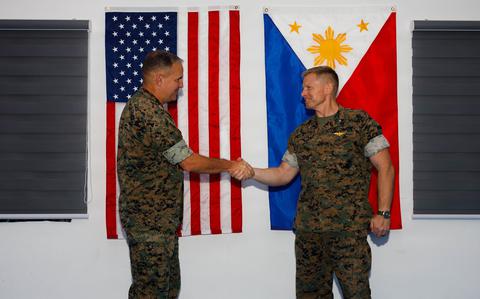

Col. Coby Moran, incoming commandier of Marine Rotational Force-Southeast Asia, left, greets the outgoing commander, Col. Robert Bunn, during a turnover at Clark Air Base, Philippines, Oct. 26, 2026. (Eric Huynh/U.S. Marine Corps)
The Marine Corps is reinforcing its foothold in the Philippines, sending another rotation of troops as the U.S. ally confronts Beijing over disputed waters in the South China Sea.
The new contingent from I Marine Expeditionary Force at Camp Pendleton, Calif., will replace Marines already serving with Marine Rotational Force-Southeast Asia, according to a Thursday news release.
The deployment is the second consecutive rotation focused on the Philippines, marking a shift for a force that previously trained in Brunei, Indonesia, Malaysia, Singapore and Thailand.
“The deployment marks the second MRF-SEA rotation focused on the Philippines to continue a persistent rotational Marine Corps presence designed to strengthen combined readiness and the U.S.-Philippine Alliance,” the service said in its release.
It did not disclose how many Marines are deploying and did not immediately respond to an emailed interview request Thursday.
The outgoing Marines, also from Pendleton, arrived in March and participated in the annual Balikatan and Kamandag exercises between April and July.

Sgt. Daniel Hernandezsandoval, a transmission system operator with Marine Rotational Force-Southeast Asia, works with a Filipino counterpart in Puerto Princesa, Philippines, Sept. 25, 2026. (Lizeth Fuentes/U.S. Marine Corps)
“Our goal was never simply to be present in the Philippines,” Col. Robert Bunn, commander of the outgoing rotation, said in the release. “Presence has to have purpose. Every exercise, planning session and repetition alongside our Philippine Allies was an opportunity to become more interoperable, responsive and capable together, progressively getting better with each event.”
The military uses the terms interoperable and interoperability to describe the ability of one country’s armed forces to use another’s training methods and equipment.
The incoming force will participate in the next Balikatan exercise in the spring, building on training in command and control, maritime surveillance, weapons coordination, aviation and unmanned systems, according to the Marines.
“We will build on the relationships, lessons and interoperability developed by the Marines and Sailors before us and continue working shoulder-to-shoulder with our Philippine Allies,” Col. Coby Moran, commander of the incoming rotation, said in the release.
The Marines’ presence in the Philippines is “de facto permanent,” Patricio Abinales, a professor at the University of Hawaii’s School of Pacific and Asian Studies, said by email Thursday.
“No one wants to use the word in public,” he wrote.
The United States withdrew from its permanent Philippine bases in 1992, but the 2014 Enhanced Defense Cooperation Agreement now provides access to nine Philippine military facilities.
Abinales said the Marines’ presence is crucial to Philippine forces as they evolve from a counterinsurgency force into one oriented to external defense.
“My sense is that the future will most likely be the evolution of a multinational force (US-coordinated, with the Philippines, Taiwan and Japan as the other members of the core, backed by Australia, France, and maybe Singapore) that could confront China in case of war,” he wrote.