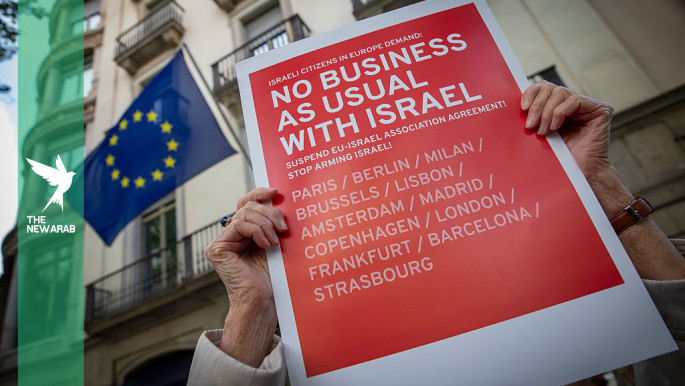
Amid growing popular discontent for Israel over the Gaza genocide, Israeli military and surveillance firms are finding alternative pathways to expand their presence in the European market [Getty]
Israeli military and surveillance companies linked to the genocide in Gaza are expanding into Europe through subsidiaries, acquisitions and rebrandings that obscure their origins and human rights records, according to a new report by human rights groups.
The report, entitled “European Gateway for Genocide Technology” finds that European rearmament and fragmented regulation are opening markets for technologies developed and tested against Palestinians.
Published on Thursday by the Observatory for Human Rights and Business in the Mediterranean (ODHE) and Irídia – Centre for the Defence of Human Rights, and coordinated by SUDS and the International Institute for Nonviolent Action (NOVACT), the study identifies nine routes into Europe, including NATO procurement, EU research programmes and cybersecurity hubs such as Barcelona.
The expansion comes amid rapid growth in Israel’s defence-technology industry. Citing the Israeli economic development organisation Startup Nation Central, the report says the sector comprised more than 300 start-ups in 2025, compared with 160 in 2024. Europe accounted for 54 percent of Israel’s defence export contracts in 2024, when their total value reached approximately $14.7 billion.
But overseas expansion also reflects insecurity and difficulties attracting investment within Israel, researchers said.
“Many startups and companies are in need of investment,” Felip Daza, a senior researcher at ODHE, told The New Arab.
The relocation of technology workers seeking security and companies seeking capital were converging, he said, making Europe “an attracting pole for these companies”.
Europe offers cover for Israeli firms
Establishing European subsidiaries and acquiring local companies can help Israeli firms access contracts and funding while distancing themselves from their human rights records, the report argues.
Carlos Bodoque, a senior researcher at ODHE, said rebranding and corporate structures could conceal companies’ connections to products used against Palestinian civilians.
“Many of these cybersecurity companies and surveillance companies participate in European funding programmes, starting with the European Defence Fund, but also Horizon, together with universities and other public institutions,” he told The New Arab.
The report highlights Intracom Defence, a Greek company acquired by state-owned Israel Aerospace Industries. According to the study, Intracom participates in 15 European Defence Fund projects, seven awarded after its acquisition and the start of the genocidal war on Gaza in October 2023.
Germany, Cyprus and Luxembourg provide different routes into the market, through military-industrial cooperation, favourable business conditions and corporate structures, the researchers say.
Daza described Cyprus as offering a “soft landing framework”, citing its proximity to Israel and flexible tax and administrative arrangements.
“Having a base in Europe facilitates access to the single market, public contracts, and research programmes,” he said, outlining how a European foothold could offer legitimacy and opportunities to expand.
Barcelona becomes a cybersecurity foothold
Barcelona in Spain’s autonomous Catalonia region illustrates how this expansion extends beyond traditional arms manufacturers into Europe’s technology hubs.
Bodoque pointed to figures from Catalonia’s cybersecurity agency showing more than 500 companies operating in the sector.
He highlighted the spyware company Palm Beach Networks, citing media reporting that Alexei Levin, with links to NSO Group, had interviewed prospective recruits for the company in Barcelona.
NSO manufactures Pegasus spyware, which has been implicated in surveillance targeting journalists, lawyers and human rights defenders, the report notes.
For Bodoque, the Barcelona case raises questions about whether authorities adequately scrutinise the backgrounds of people establishing security-technology businesses.
The concern, he said, was that individuals linked to companies implicated in abuses could establish new ventures without effective barriers or scrutiny of their previous activities.
Yet establishing legal responsibility across borders remains difficult.
“We know, of course, it’s their know-how, it’s their technology, but we’re talking here about different legal frameworks, and sometimes it’s very difficult to connect,” Bodoque said.
The expansion of Israel-linked firms sits in contrast to widespread popular support for Palestinians. Spain recognised Palestinian statehood in May 2024, while Barcelona’s city council voted in May 2025 to sever institutional relations with the Israeli government and end its friendship agreement with Tel Aviv. The council’s measures also targeted procurement and the participation in trade fairs of companies profiting from war and occupation.
Yet Bodoque’s account raises questions about whether those commitments translate into sufficient scrutiny of the companies and individuals entering Barcelona’s technology sector.
Daza described a wider divide between European civil society and political and business interests, saying military and economic actors “speak openly about the need for Israeli technology”.
Rearmament outweighs scrutiny
European rearmament and rising NATO defence spending are creating further opportunities for Israeli suppliers, while research partnerships and technology fairs help companies develop institutional relationships, the report finds.
Many produce dual-use technologies with civilian and military applications. The authors warn that systems developed in contexts of occupation and warfare can also serve border enforcement, policing and surveillance in Europe.
Oversight, however, remains divided between national jurisdictions in the EU.
“The European Union is not acting as a unique body,” Daza said. “There’s a huge fragmentation at the regulatory level.”
The researchers argue that this fragmentation allows commercial cooperation to continue despite companies’ human rights records and public opposition to their activities.