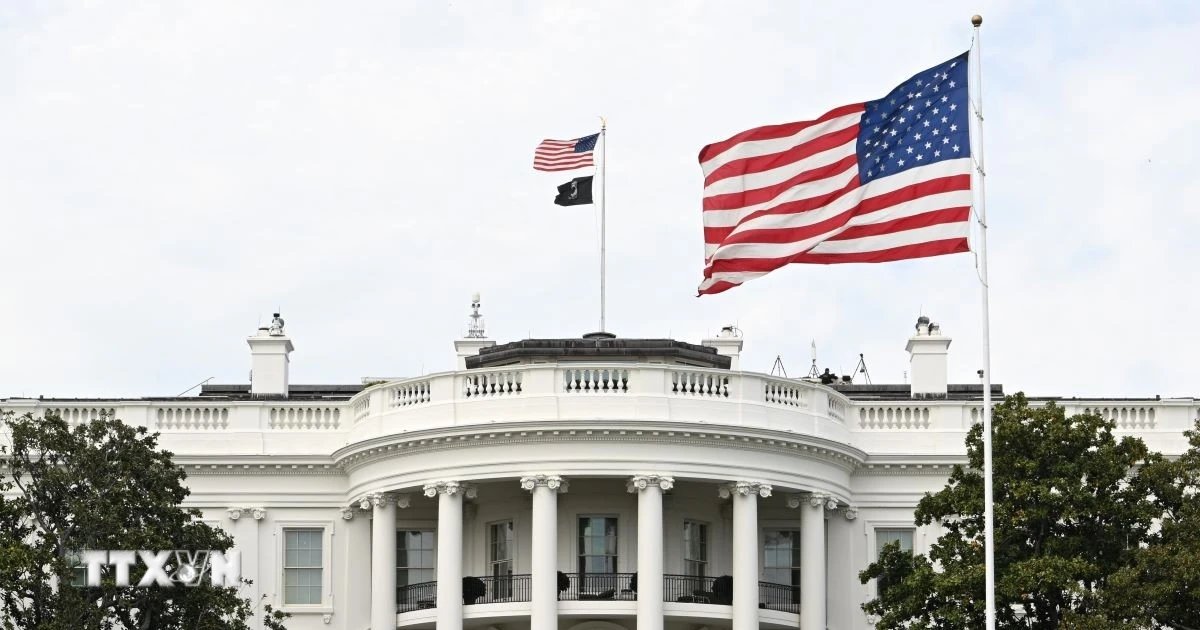
According to the Vietnam News Agency correspondent in Washington, the top US commander in the Middle East, Admiral Brad Cooper, briefed President Donald Trump directly at the White House on October 29 on military options regarding Iran, as the US considers resuming large-scale military operations.
Attending the meeting alongside Admiral Brad Cooper were Secretary of War Pete Hegseth and Chairman of the Joint Chiefs of Staff, General Dan Caine. Some sources indicated that other cabinet members also participated and discussed other topics, including the ongoing US blockade.
Admiral Cooper rarely reports directly to President Trump, so this meeting could be a sign that the U.S. is moving closer to deploying large-scale military operations.
One source familiar with the matter said the high-level meeting took place after a session on October 28 at the White House, in which military officers met with Vice President JD Vance.
Trump officials have asked Gulf Arab nations to prepare for a short but fierce military campaign following the midterm elections. According to sources, Vance contacted one of Iran ‘s most powerful hardliners in an effort to resume peace talks.
Meanwhile, according to newarab.com, US President Donald Trump said that Vice President Vance’s contact with Iran was aimed at helping the country obtain medical supplies.
Iranian media reported that Tehran had received a letter from the US Vice President but had not yet responded. The Tehran government asserted that the US must meet Iran’s seven conditions and that “any position contrary to this framework is unacceptable.”
Regarding the conflict, Iranian armed forces said that four oil tankers caught fire on October 29 after hitting mines while attempting to pass through the Strait of Hormuz.
According to Tasnim news agency, the Iranian Revolutionary Guard Corps (IRGC) Navy stated: “The oil tankers switched off all radar and navigation systems and attempted to leave the prohibited southern shipping lane in the Strait of Hormuz, despite warnings from the IRGC Navy.”
According to the Vietnam News Agency correspondent in the Middle East and North Africa, Rear Admiral Jalil Moghadam, Deputy Commander-in-Chief of the Iranian Navy, said that the country’s naval forces have conducted more than 20 operations targeting US warships during the 40-day conflict, which began on February 28.
In addition, approximately 300 other operations were conducted targeting U.S. interests in various locations, using missiles and unmanned aerial vehicles (UAVs).
Moghadam also rejected the US claim that Iran’s naval forces had been destroyed, asserting that military operations demonstrated that their combat capabilities remained intact.
He said Iran used strategic cruise missiles against the aircraft carrier Abraham Lincoln, forcing it to suspend operations for three days before leaving the Iranian coast.
According to Moghadam, the conflict has also prompted Iran to review its military doctrine, adjust its operational priorities, and develop its equipment. He warned that the Iranian armed forces remain ready to confront the risk of renewed conflict, regardless of how diplomatic efforts unfold.