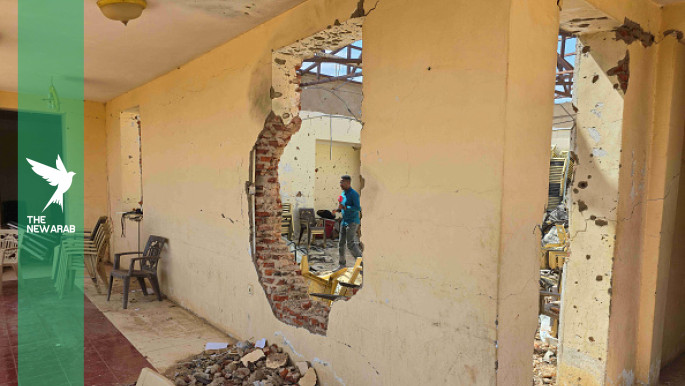
Drone strikes have killed civilians and damaged critical infrastructure across Sudan, while arbitrary arrests and surveillance fuel fear. [Getty]
Civilians in the Sudanese city of El Obeid, the capital of North Kordofan state, are facing the threat of drone attacks by the paramilitary Rapid Support Forces (RSF) and an increase in arbitrary arrests by Sudanese army-affiliated forces amid escalating violence in the war-torn country, UN-appointed investigators have warned this week.
In its latest report, the UN Independent International Fact-Finding Mission for the Sudan said that, more than three years after the conflict broke out in April 2023, the war was becoming increasingly widespread and dangerous for civilians.
The latest warnings also highlight deteriorating humanitarian conditions in El Obeid, which had already been identified as being at risk of famine, alongside other parts of Sudan.
“Thousands have been arrested by SAF security cells, detained and tortured in unofficial locations and in El Obeid Central Prison, kept under appalling conditions,” said Mona Rishmawi, an expert member of the UN’s Independent International Fact-Finding Mission for the Sudan.
“These practices must stop immediately.”
Roughly 30% of hospitals in El Obeid are currently functioning following RSF drone attacks, according to the UN report.
It added that the strikes had continued to kill and injure civilians in the city, while also targeting homes, schools, displacement sites, and electricity and water systems.
The report cited a drone attack on a market in Abyei earlier this month, reportedly carried out by forces aligned with the military government, which killed at least 80 people.
The UN also said it would investigate reports of Egyptian airstrikes on goldmining sites near the Sudan-Egypt border, which reportedly killed at least 72 miners.
The UN further highlighted an increase in detentions, with approximately 2,000 people reportedly being held at El Obeid Central Prison.
The report cited a former detainee who said people were being confined in a cell measuring roughly 2.5 metres by 2 metres.
UN investigators have warned that security actors affiliated with the Sudanese Armed Forces (SAF) have increased surveillance and are “targeted people engaged in humanitarian, human rights and peace work”.
The latest findings come a year after the brutal RSF takeover of El Fasher, the capital of North Darfur, where more than 10,000 people were reportedly massacred by the paramilitary group over two days after it seized the city in October 2025, following an 18-month siege.
A reported surge in RSF drone strikes on El Obeid and nearby areas since June has prompted the UN to warn that the city could face a repeat of the atrocities in El Fasher.
Joy Ngozi Ezeilo, another expert member of the UN’s Independent International Fact-Finding Mission for the Sudan, has renewed calls to extend the UN arms embargo to cover the whole of Sudan, as it is currently limited to Darfur.
“Sovereignty should not shield mass atrocity crimes, period,” Ezeilo said.
“One year after the devastation of El Fasher, civilians in other parts of Sudan continue to pay the price of a conflict that is becoming increasingly destructive and difficult to escape.”
She added: “In El Obeid, attacks on electricity networks, water facilities, hospitals, schools and displacement sites demonstrate how damage to critical civilian infrastructure can reverberate through entire communities long after an attack has occurred.”
“The passage of time should not diminish attention to what has happened in El Fasher. On the contrary, it should remind us of the cost of impunity.”
Now in its fourth year, Sudan’s war began in April 2023, when fighting broke out in Khartoum between the RSF and the Sudanese military before spreading across the country.
The conflict has killed at least 59,000 people, according to conflict monitor ACLED, although other aid groups argue that the true death toll is likely to be higher.