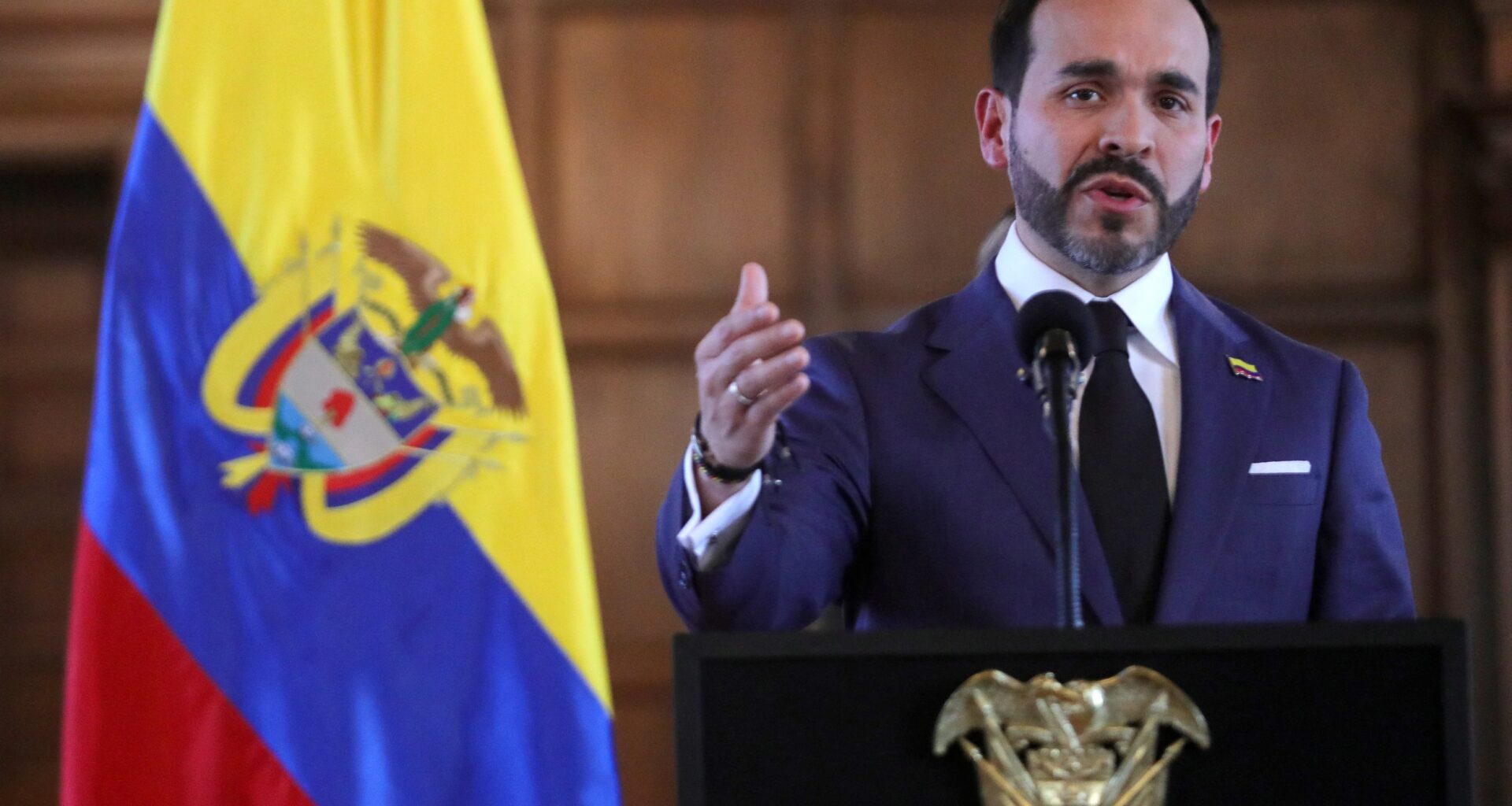

Colombia’s President Abelardo de la Espriella speaks during a press conference at the Palacio de San Carlos in Bogota on August 12, 2026. Colombia’s President Abelardo de la Espriella announced on August 12, that he will declare an economic emergency in Colombia to confront the earthquake that has left thousands of victims, a measure that allows him to impose taxes and modify the budget without going through Congress.
Photo by ESTEBAN VEGA LA-ROTTA / AFP via Getty Images
The Briefing:
De la Espriella took office August 7 after winning the closest certified election in Colombia’s modern history — 49.66% against 48.70% for leftist senator Iván CepedaThe Trump White House committed $1 billion to Colombia on inauguration day; a 12.5% U.S. tariff on Colombian exports remains in place, with possible removal signaled but no timeline setA nationwide protest on October 14 — led by former President Gustavo Petro — marked the opposition’s first organized push against labor, pension and policing reformsThe Colombian diaspora in New York and Florida gave De la Espriella roughly 80% of the overseas vote, and community leaders are now pressing him to convert Washington alignment into concrete immigration protections
Two months into his term, President Abelardo de la Espriella has dismantled his predecessor’s peace framework, flooded Colombian cities with security forces, and signed the tightest U.S.-Colombia defense arrangement in a generation — all without losing his political footing. This is the fastest ideological reversal in Colombia’s modern history, and for the 1.6 million Colombians living in the United States, from Jackson Heights in Queens to Miami’s Brickell corridor, the stakes are unmistakably personal.
How “El Tigre” Got Here
De la Espriella, a 48-year-old millionaire criminal defense lawyer with Colombian, American and Italian citizenship who spent more than a decade in Miami before his campaign, arrived on the national stage as a political outsider with no prior elected office and a Trump endorsement that polarized the country. When preliminary results on June 21 confirmed his razor-thin victory, Trump posted on Truth Social: “Congratulations to ‘El Tigre’ Abelardo de la Espriella, the new President of Colombia! It was my Great Honor to endorse him.” That alignment has defined the first two months of his presidency as much as anything he has done domestically.
Dismantling the Petro Legacy, Decree by Decree
De la Espriella wasted no time. La Silla Vacía counted 399 administrative acts in his opening month alone — appointments, emergency measures and policy reversals stacked atop one another like the controlled demolition of a rival government’s architecture.
His inaugural address declared peace negotiations with armed rebel groups finished, ending Petro’s signature “Total Peace” initiative. The military offensive that followed produced headline-generating figures almost immediately: more than 14,000 arrests of suspected gang members and criminal organization figures in the first month, along with the restoration of aerial glyphosate spraying over coca plantations — a practice Petro had suspended citing documented health risks to rural communities.
On the economic front, the program borrows openly from Argentina’s Javier Milei: a pledge to slash government spending by as much as 40%, restart oil and gas exploration, and permit fracking — while preserving, as a concession to fiscal reality, some Petro-era social programs. Finance Minister Miguel Gómez was dispatched to Washington within weeks to begin refinancing Colombia’s elevated public debt with international lenders.
Washington Reset — With a Tariff Asterisk
The U.S.-Colombia relationship has not been this close in years. After a protracted period of friction between Trump and Petro — including U.S. sanctions targeting the former Colombian president in October 2025 — De la Espriella arrived as Washington’s natural regional partner. On August 7, inauguration day, the White House announced a $1 billion commitment to support Colombia’s counter-narcotics and economic development priorities.
Colombia has since formally joined the U.S.-initiated Shield of the Americas regional security coalition. More than 300 U.S. troops began arriving October 27 for joint military training exercises with Colombian forces under the Vanguardia del Sur 2026 program at the Tolemaida Military Fort, running through November 11 — a deployment that has prompted Colombia’s own Congress president, Honorio Henríquez, to formally request a public explanation from the government.
On trade, the picture remains complicated. A 12.5% U.S. tariff on most Colombian exports — imposed in July 2026 — remains in place, with Colombian exporters estimating up to $4.4 billion in annual sales at risk. Trump, speaking to reporters outside the White House on October 12, left the door open to removing the levy, calling De la Espriella “a great friend” who is “doing a great job.” No timeline has been set.
October 14: The Streets Push Back
The opposition found its footing on a Wednesday. Thousands of Colombians poured into Bogotá, Medellín, Cali and other cities on October 14, led by former President Petro alongside teachers’ unions, Indigenous groups, students and feminist organizations. Their grievances encompassed proposed pension and labor reforms, the government’s crackdown on Venezuelan migrants, and a foreign policy that protesters argued had traded national sovereignty for proximity to Washington.
The day before, De la Espriella signed Decree 1525, overhauling police protocols for responding to public demonstrations — a move that galvanized rather than suppressed turnout. The marches remained peaceful across the country.
Despite the unrest, De la Espriella recorded a 54% positive image rating in AtlasIntel’s first government survey, conducted in late August and early September. A follow-up poll in early October showed that rating had eased to approximately 49% — still the highest positive standing among all Colombian political figures measured, but a sign that the initial honeymoon is beginning to narrow.
What Jackson Heights and Brickell Are Watching
The Colombian diaspora delivered De la Espriella roughly 80% of the overseas vote — a margin that helped offset Cepeda’s stronger performance in Europe. That electoral leverage has since been converted into organized demands. Community leaders in New York and New Jersey have formally pressed the new government to use its rapport with the Trump White House to shield undocumented Colombians from deportation, pointing to data showing that remittances from the diaspora surpassed foreign direct investment as Colombia’s top dollar inflow in 2025 for the first time in two decades.
In Jackson Heights — the commercial and cultural center of New York’s Colombian community — the mood is divided. Many who voted for De la Espriella did so because Petro’s security failures struck families directly back home. But community leaders are now pressing him to convert Washington alignment into concrete immigration protections before the federal deportation apparatus turns toward Colombians without legal status.
In South Florida, where De la Espriella built much of his American life over a decade, the reception among established Colombian-American professionals has been more enthusiastic — and more transactional. The calculation: a market-oriented government in Bogotá means better conditions for the Colombian businesses and real estate investments that bind the diaspora to its homeland.
Two months in, “El Tigre” has moved faster than almost anyone predicted. Whether the pace holds — or whether the coalition fractures, the courts push back, or the streets keep filling — will define a presidency that is already, undeniably, reshaping Colombia.
© {{Year}} Latin Times. All rights reserved. Do not reproduce without permission.