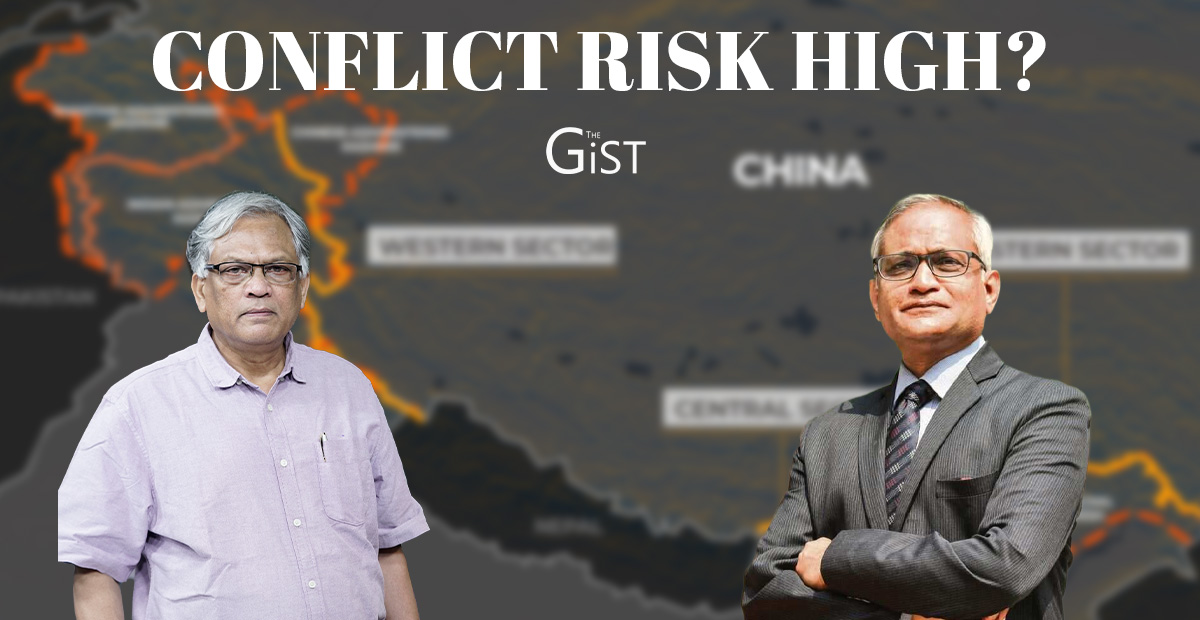
“We have seen in recent times the outgoing army chief, outgoing air chief, and also the navy chief expressing their concerns just before they were about to retire. This is the only choice for them because of the kind of civil military relations system we have in India.”
Prof Srikanth Kondapalli was a guest on The Gist, commenting on a recent statement by the retiring Director-General of the Indo-Tibetan Border Police Shatrujeet Kapoor, who had referred to face-offs with Chinese personnel along the Line of Actual Control (LAC).
“The number of transgressions on the border have increased since the Indian nuclear tests in 1998,” Prof Kondapalli said giving historical context to Kapoor’s remarks. “I want to remind you that in 1979, between China and Vietnam, the number of transgressions shot up like anything and it resulted in a border conflict in 1979.”
He pointed to Chinese naval transgressions in the waters of Japan’s Senkaku Islands, which are very high, suggesting high potential for conflict. Comparatively, Chinese transgressions vis a vis India are lower at between 380 and 430 every year.”
Nevertheless, it underscored Kapoor’s warning of the potential for conflict if left unaddressed.
India, given its late start, has done quite well in terms of building infrastructure along the LAC. One hundred infra projects have been completed in the last three years, of 73 strategic roads 44 have been completed, there are plans for a railway line and the Indian Army’s Vibrant Villages campaign focusing on improving border villages has made good progress.
But there’s no getting away from the visible asymmetry, Prof Kondapalli said. For one China’s $19 trillion economy vs India’s $4 trillion, and China’s mammoth $500 billion defence budget vs India’s $90 billion.
For all these reasons, India needs to keep the dialogue with Beijing going, which has enabled the two sides to bring down the number of disputed areas on LAC from 21 to 18. But no understanding or agreement with the Chinese is sacred, this is also a fact.
The Galwan crisis erupted because China ignored all those agreements signed with India in pursuit of what Xi Jinping has referred to as “core interests”.
Thus, since January this year, the Shaksgam Valley handed over to China by Pakistan in 1963, is now Chinese territory, not a part of Kashmir which was the original declaration. Tibet is core interest, therefore Arunachal Pradesh is core interest since China defines it as “South Tibet”.
Tune in for more in this conversation with China scholar and commentator Prof Srikanth Kondapalli.