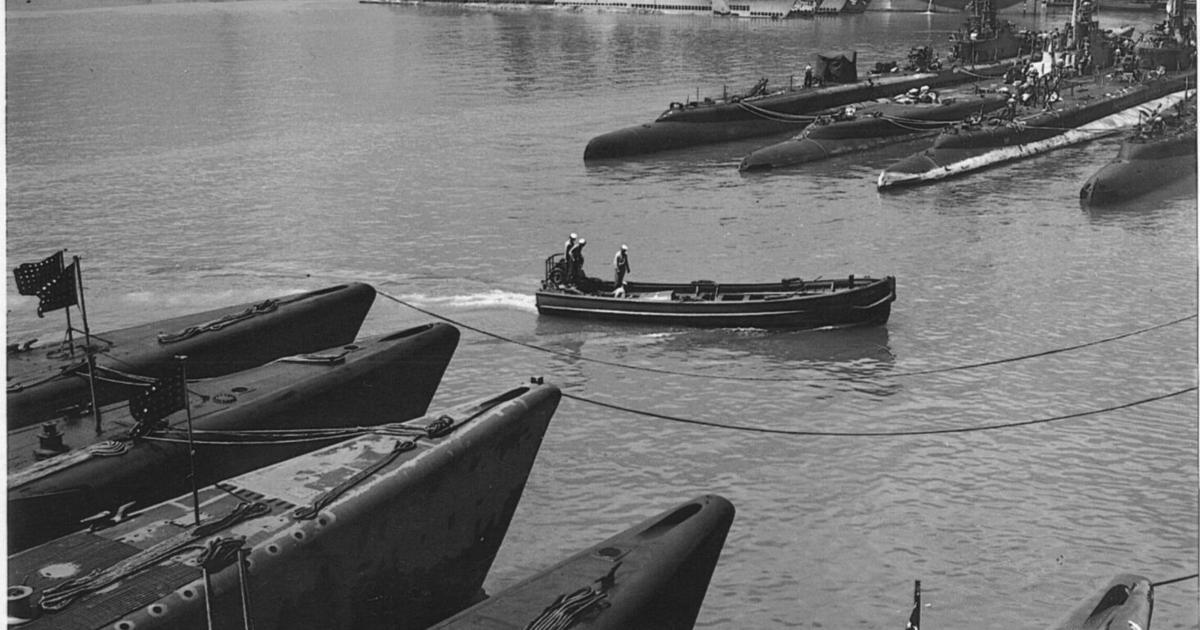
I recently obtained a photo of the US Navy Submarine Division 17 while anchored in Apra Harbor on Oct. 29, 1924 on their long voyage from the west coast of the United States to the Philippines.
The voyage consisted of the submarine tender USS Canopus and six S-class submarines, quite primitive submarines by today’s standards, who stayed in the Philippines until 1942 and defended against the Japanese invasion in early 1941.
Pictured in the photo was the initial visit at Guam for U.S. Navy submarines. This became significant as later U.S. Navy submarines began to fill roles in Guam’s history. In 1939, additional submarines stopped at Guam headed to the Philippines.
With Guam being captured by the Japanese in December 1941, U.S. submarines began to patrol the waters around the Mariana Islands designated as Patrol Area 14. A substantial number of Japanese ships were subsequently sunk by the U.S. Navy submarines, resulting in a substantial loss of personnel and equipment that hindered the Japanese preparation to defend the Mariana Islands against the U.S. invasion of the summer of 1944.
After the liberation of Guam, U.S. submarines then became stationed in Apra Harbor Guam and Tanapag Harbor Saipan to continue the war at sea against Japan.
A noted submarine rest camp was established in Ipan, Talo’fo’fo’, Guam, Camp Dealey. With the war’s end, the U.S. Navy submarines departed only to return to Guam on Nov. 29, 1964 for a different mission of Cold War deterrence.
Polaris ballistic missile-armed submarines of Submarine Squadron 15 were based at Polaris Point in Apra Harbor with the submarine tender USS Proteus, and later the submarine tender USS Huntley. Then, with transformations in the U.S. missile deterrence technology, Submarine Squadron Fifteen departed Guam on Sept. 30, 1981.
Years later, on Feb. 23, 2001, Submarine Squadron Fifteen returned to Apra Harbor with the submarine tender USS Frank Cable on a different mission and different submarines, attack submarines, to counter the threat from China.
This was the beginning of the current military buildup on the Mariana Islands and perhaps serves Guam’s most essential function of being a deterrent to any military aggression as the U.S. Navy submarines cannot be detected at sea.
Furthermore, in the imminent threat of military action, the submarines cannot be a target in Apra Harbor since they will have immediately gone to sea to disappear in the vast depths of the Pacific Ocean to avoid being a target in port and to fulfill assigned missions.
Rather ironically, the U.S. Navy submarines, probably the most effective military function based on Guam, has the least impact on our environment and community as compared to other components of the military buildup.
Dave Lotz, a U.S. Navy veteran, is a vocal advocate for protecting Guam’s unique heritage, knowledgeable and long-time hiking enthusiast and environmental advocate, and critic of inept government.