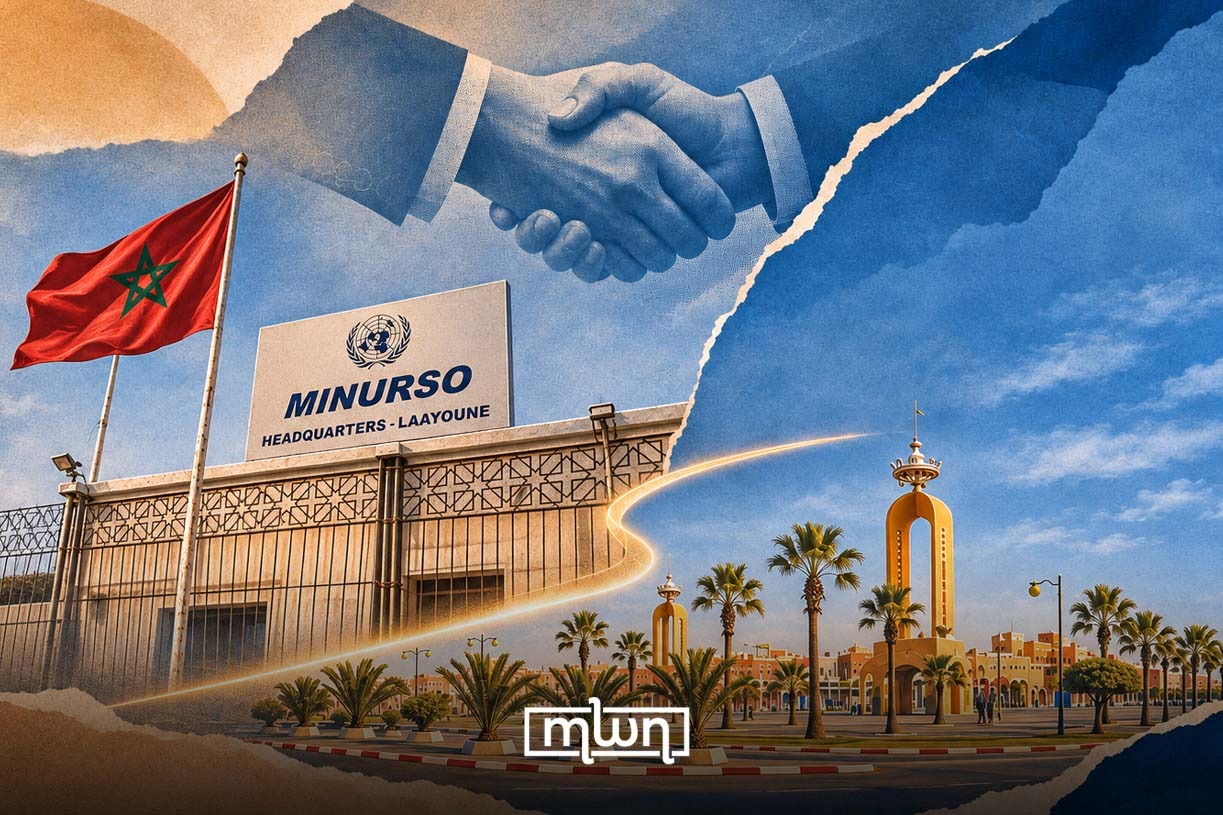
I began my professional career with Morocco’s Ministry of National Education in August 1997, in the city of Boujdour, one of the major cities in the kingdom’s southern provinces. I arrived there aboard a Supratours bus that had departed from Marrakech approximately twelve hours earlier, shortly after the arrival of the train that had brought me from Fez, which I had boarded nearly twenty-four hours before.
This journey became a recurring experience over the course of nine years, during which I encountered numerous human, social, cultural, and political experiences. Yet, in this brief reflection, I wish to revisit just one dimension of that period: its political significance. It is a dimension that has remained particularly vivid in my memory, perhaps because I had not originally set out for Boujdour in search of such an experience. Rather, circumstances and fate had led me there, without any deliberate planning or prior intention on my part (as newly placed teachers had no choice over their destinations, and they had to serve where the government wanted them to) .
The geopolitics of MINURSO’s presence in southern Morocco
I vividly remember the international presence that shaped everyday life in cities of the southern provinces like Laayoune, Boujdour, and Dakhla, manifested in the various symbols and activities of the United Nations: flags, vehicles, and soldiers wearing blue helmets. The scene suggested that something was out of the ordinary. Only a few years earlier, in our history classes, we had learned that Morocco’s historical sphere of influence extended as far as the northern reaches of present-day Mali and western Sudan. Yet here I was, in one of Morocco’s cities, witnessing an international presence that seemed, at the time, at odds with what one might expect in a sovereign country.
However, as someone who came of age during a period marked by conflicts between cultures and nations, and who witnessed wars that transformed the face of countries and their political systems, I soon came to understand that what appeared on the surface to be a United Nations presence associated with the management of a regional dispute could conceal a complex web of geopolitical calculations, economic interests, and power dynamics. Conflicts, more often than not, are not fully explained by what is immediately visible. They resemble an iceberg, of which only a small portion can be seen above the surface, while the greater part remains hidden beneath the water.
I am now writing against the backdrop of the latest developments and the United Nations decisions concerning Morocco’s territorial integrity, particularly the failure of the United Nations Security Council to renew MINURSO’s mandate following its expiration on 31 October 2026. As such, I find myself drawn to a theoretical approach that I first encountered while studying literary criticism as a student at Saiss Faculty of Letters in Fez, and which I later came across again during a Masters program at the Heller School for Social Policy and Management in the United States. This is what is known as the “Bottom-up Approach,” or the grassroots approach to some types of conflict.
Finding a balance between the role of the UN and the aspirations of locals
In its political dimension, this approach involves seeking solutions from the ground up, starting with realities on the ground and engaging local stakeholders and the parties concerned. It gives them a meaningful role in shaping solutions and directing the course of the process. Rather than treating those directly affected by a conflict as mere recipients of decisions made elsewhere, it recognises them as partners in forging a solution and helping determine its direction and priorities. Put simply, it is an approach that places initiative in the hands of those on the ground, allowing them to take the wheel and steer the vehicle towards its intended destination.
By contrast, a significant part of the process through which the Sahara dispute has been managed can be described as closer to a Top-down Approach. This rival approach proceeds from international institutions and bodies, with the expectation that the parties concerned will respond to proposals and solutions formulated at levels far from the local, social, and historical realities of the dispute. Which raises one of the fundamental questions: How can solutions developed in distant international settings achieve lasting results and gain acceptance unless they are grounded in local realities, reflect the will of those concerned, and take into account the particular characteristics of the context in which they are to be implemented?
Perhaps what is needed today is not to exclude the top-down approach or dispense with the role of international institutions, but rather to restore a balance between it and the bottom-up approach. This means making local realities, people, and stakeholders on the ground an integral part of the solution-making process, rather than treating them as mere parties waiting for negotiations and international decisions to run their course.
A new horizon under Moroccan sovereignty
In my view, the developments surrounding Morocco’s territorial integrity open up a new horizon for considering the nature of the next phase. The issue should no longer be confined to the management of a political and diplomatic dispute. Instead, it should extend to considering how the gains associated with legitimacy and sovereignty can be translated into tangible development and institutional progress, enabling citizens to experience sovereignty not merely as a political concept, but also as a responsibility in governance, fairness in the distribution of opportunities, and meaningful participation in decision-making.
From this perspective, the challenge should not be limited to consolidating territorial integrity and strengthening the international legitimacy of Morocco’s position. It should also involve turning this moment into an opportunity to develop the very model of the state: a state that is strong through its institutions, democratic through the participation of its citizens, and cohesive through its commitment to equitable development and its ability to listen to all its constituent communities and regions.
Ultimately, moving from conflict management to forging a solution requires a shift from waiting for solutions to actively participating in producing them, and from merely defending sovereignty to making it a foundation for building a state that is stronger, fairer, and more democratic. That, in my view, is the greater challenge we must rise to in this new phase.