
Reducing the outcome of the 44-day war to the effectiveness of drones means focusing on the weapons while overlooking the strategy. Liam Collins and John Spencer’s book, The War for Karabakh: Strategy, Technology, and Victory, offers a deeper explanation: Azerbaijan’s military success grew out of years of state building, military transformation and leadership capable of bringing national resources together in pursuit of a clearly defined objective.
The value of this research lies first in the questions it asks. What decisions enabled Azerbaijan to overturn a military situation that had endured for decades? Why did its investment in weapons translate into battlefield effectiveness? How did political leadership, officer training and the actions of individual soldiers combine to produce victory?
These questions move the discussion beyond simply describing the outcome towards understanding its causes.
Presented in Baku on 3 November, Collins and Spencer’s book examines Azerbaijan’s experience within a broad historical and military-political framework. Its focus includes preparations for war, the campaign itself, and the relationship between strategic decisions and battlefield results.
Two years of research: Moving beyond first impressions
According to the information presented about the book, its preparation took approximately two years. That matters when studying a recent war. Early assessments inevitably depend on available footage, official statements and the most visible engagements. A systematic investigation requires comparing accounts, examining terrain and reconstructing the sequence of decisions.
The authors’ connections to West Point’s military research community add professional weight to the study. John Spencer holds the position of Chair of Urban Warfare Studies at the Modern War Institute at West Point, while Liam Collins was the institute’s founding director. Their research should nevertheless be distinguished from an official institutional assessment by the US military.
For Azerbaijan, the significance lies in the fact that its military experience is receiving detailed professional examination abroad. Victory is being studied in terms of the organisation of its armed forces, the quality of command and the state’s ability to sustain military transformation.
 Source: AZERTAC
Behind the drone footage stood an army
The most recognisable images of the 2020 war were videos showing the destruction of military vehicles and defensive positions. Their impact encouraged an appealingly simple explanation: drones had determined the outcome of the campaign.
Collins and Spencer challenge the adequacy of that interpretation. The book’s description places technological advantages alongside training, military reform, leadership and coordinated combined-arms operations.
This distinction is fundamental. Possessing modern weapons does not automatically create a modern army. Intelligence must reach commanders in time to inform their decisions. Fire support must assist advancing units. Gains must be consolidated on the ground.
The elements of modern warfare highlighted in the book – concealment, dispersion, small-unit manoeuvre, suppression of enemy fire and coordination between different branches – therefore belong to a single operational system.
The broader analytical lesson concerns the organisation employing the weapons. An army gains an advantage when it can connect technical capabilities with training, initiative and effective command.
Around 100 interviews: Why field research matters
According to the research outline, the book draws on approximately one hundred interviews with military and civilian specialists, alongside visits to the principal battlefields.
This approach is particularly valuable when studying the Karabakh war. On a map, an offensive may appear as the steady movement of a front line. On the ground, it involves crossing difficult slopes, securing roads, sustaining supplies and making decisions with incomplete information.
In their study of Hadrut, the authors explicitly state that many details came from interviews with Azerbaijani soldiers during a research visit to the battlefield in March 2025. This connects participants’ accounts to the physical geography of the operation.
The number of interviews alone does not guarantee a comprehensive account. Their value depends on comparison with documents and other evidence. Fieldwork nevertheless makes it possible to investigate questions that strike footage cannot adequately answer: how command functioned, why particular approaches were chosen and how units adapted as conditions changed.
State building as the foundation of military success
One of the most substantial arguments in the book is the connection between victory and national power.
The economy supports procurement and sustainment. State institutions provide continuity in decision-making. Military education develops commanders. Diplomacy shapes external conditions. Public resilience helps a country withstand losses and uncertainty.
These resources do not come together automatically. Their effective use requires leadership capable of establishing priorities and sustaining them over many years.
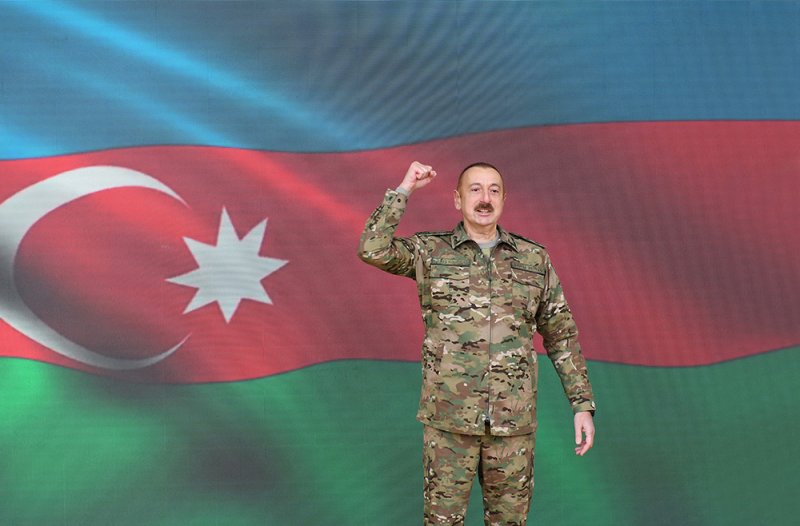
President Ilham Aliyev’s role should be assessed within this framework. His strategic achievement can be understood as the ability to connect the strengthening of the state with the development of military capabilities and the pursuit of a clearly articulated political objective.
This is a question of leadership effectiveness. Resources must produce trained forces; trained forces must conduct effective operations; and military results must create political opportunities. Without that sequence, even substantial defence spending can remain a collection of separate purchases.
 Source: AZERTAC
Ilham Aliyev: Leadership and strategic communication
The combination of supreme command and public communication deserves particular attention.
During a war, society needs reliable information, the armed forces need clarity about their objectives, and international audiences need an explanation of the state’s position. Consistency across these messages has strategic importance.
Speaking at the book’s presentation, John Spencer highlighted the importance of Ilham Aliyev’s daily communication and announcements about the liberation of territories in the information struggle.
From an analytical perspective, such communication can narrow the gap between developments at the front and public understanding. Regular addresses by the head of state help maintain a coherent picture of events and reduce the space available for rumours.
Countering disinformation also requires more than forceful denials. Credibility depends on whether statements can be verified and whether they correspond to events on the ground.
Viewed in this light, a strength of Aliyev’s leadership was his understanding that military, diplomatic and information efforts had to advance together. The coordination of these activities deserves a distinct place in any explanation of Azerbaijan’s success.
Hadrut and Shusha: Testing the broader argument against individual battles
The authors’ earlier publications show how these broader conclusions relate to specific operations.
In their joint study of Hadrut, Collins and Spencer emphasise the importance of integrating special operations forces with mechanised and motorised infantry units. They also highlight preparations for fighting in urban environments. The case illustrates how the skills of smaller specialist units were reinforced by the firepower and capabilities of conventional formations.
John Spencer’s study of Shusha, published in the Canadian Army Journal, examines another dimension of the same challenge: the interaction of difficult terrain, urban combat, technological capabilities and adaptation. It also addresses the limitations of technology, noting that weather conditions could restrict drone operations and increase the importance of ground force proficiency.
Together, these cases help explain Azerbaijan’s victory more precisely. Technology expanded the army’s capabilities, while trained commanders and soldiers operating within a functioning military system converted those capabilities into results.
That is why Collins and Spencer’s research has relevance beyond the South Caucasus. Azerbaijan’s experience poses a universal question for military and political leaders: how does a state turn accumulated resources into the capacity to achieve its objectives?
For Azerbaijan, the answer involves years of preparation, military transformation, the courage of its servicemen and Ilham Aliyev’s strategic leadership. The 44 days were the period in which that preparation produced its decisive result.
By Murad Samedov