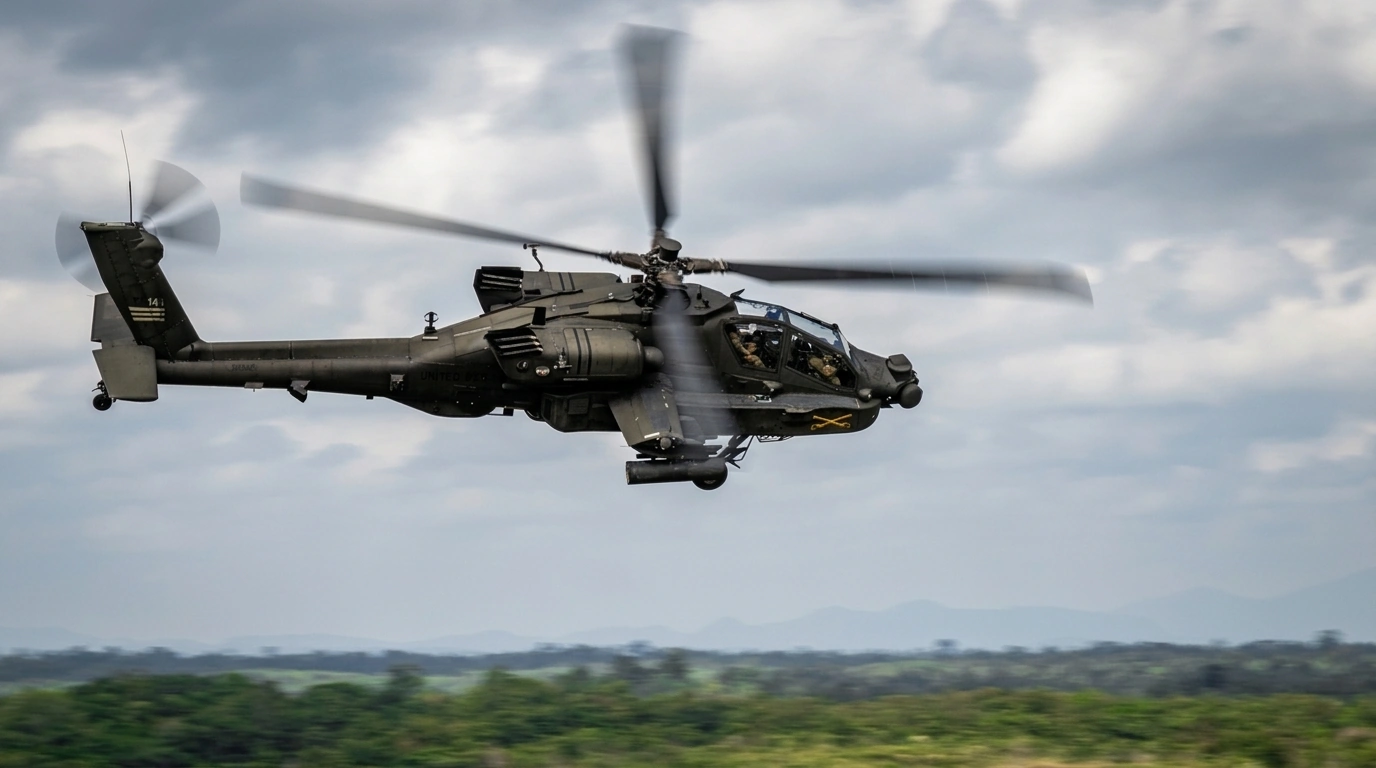
Imagine an attack helicopter that can detect potential threats, gather battlefield intelligence, and coordinate with unmanned aircraft, all while operating at low altitude. That’s the kind of capability the AH-64E Apache Guardian brings to modern military aviation.
Developed by Boeing, the AH-64E Apache Guardian represents one of the most advanced versions of the legendary Apache helicopter. It combines substantial firepower with sophisticated sensors, digital battlefield connectivity, and improved flight performance. But its capabilities extend well beyond carrying missiles and rockets.
 Credit: U.S. Army National Guard/Edwin L. Wriston
What makes this helicopter particularly interesting is how its different systems work together. Its radar can help identify potential targets, thermal imaging supports operations at night, and integrated communications allow crews to exchange information with other military assets.
The result is a platform designed for more than traditional close air support. It can participate in reconnaissance, anti-armor missions, armed escort, and coordinated operations involving ground forces and drones.
However, technological sophistication doesn’t automatically guarantee battlefield dominance. Modern air-defense systems, electronic warfare, and increasingly capable unmanned platforms present serious challenges.
So, how powerful is the AH-64E Apache Guardian? To answer that, we need to examine the engineering, weapons, sensors, and battlefield technologies that define this helicopter.
What Is the AH-64E Apache Guardian?
The AH-64E Apache Guardian is one of the most advanced attack helicopters in modern military aviation. Developed by Boeing, it was designed to give military forces a combination of firepower, battlefield awareness, and operational flexibility. But there’s more to this aircraft than its ability to carry missiles and rockets.
The Apache’s story began in the 1970s, when the U.S. Army sought a dedicated attack helicopter capable of operating in demanding battlefield environments. The resulting AH-64A Apache entered service in 1986, establishing a new standard for helicopter-based anti-armor operations.
Over the following decades, the platform received several major upgrades.
The AH-64D Longbow introduced more advanced targeting technology, including the AN/APG-78 Longbow fire-control radar. This system significantly improved the helicopter’s ability to identify and track potential threats.
Then came the AH-64E Apache Guardian.
Originally known as the AH-64D Block III, the aircraft received its official AH-64E designation in 2012. Boeing introduced substantial improvements to its propulsion system, transmission, avionics, and digital communications architecture.
One particularly important upgrade involved its engines. The AH-64E Apache Guardian uses two General Electric T700-GE-701D turboshaft engines, providing improved power and performance. Its upgraded transmission also supports the demands of operating with increased weight and advanced mission equipment.
However, the biggest development goes beyond mechanical improvements.
The AH-64E Apache Guardian supports Manned-Unmanned Teaming (MUM-T), allowing its crew to receive information from compatible unmanned aircraft. Instead of depending entirely on its own sensors, the helicopter can access additional intelligence gathered by drones operating elsewhere.
This expands its awareness of the surrounding battlefield and improves coordination with other military assets.
Read also: Top 5 Best Attack Helicopters in the World
Today, the AH-64E Apache Guardian serves the U.S. Army and several international operators. Its evolution reflects a broader shift in military aviation: attack helicopters are no longer just airborne weapons platforms. They are increasingly connected systems capable of combining reconnaissance, communications, and precision firepower within a single aircraft.
AH-64E Apache Guardian Specifications and Flight Performance
Powerful weapons are only part of what makes an attack helicopter effective. Its ability to carry those weapons, maneuver across difficult terrain, and remain airborne during demanding missions matters just as much. This is where the AH-64E Apache Guardian‘s engineering becomes particularly interesting.
 Credit: U.S. Marine/Sgt. Mitchell Johnson
The helicopter is powered by two General Electric T700-GE-701D turboshaft engines, each producing approximately 2,000 shaft horsepower. Together, they provide the power needed to operate the aircraft’s main rotor, support its weapons payload, and maintain flight performance under challenging conditions.
The upgraded transmission system is another important component. It transfers engine power to the rotor system while accommodating the mechanical demands of a relatively heavy combat helicopter.
AH-64E Apache Guardian Technical Specifications
Here are the key specifications of the aircraft:
SpecificationDetailsManufacturerBoeingCrew2Engine2 × GE T700-GE-701DEngine powerApproximately 2,000 shp eachMaximum speedApproximately 150+ knotsLengthApproximately 14.7 metersHeightApproximately 4.7 metersMain rotor diameterApproximately 14.6 metersMaximum gross weightApproximately 10,433 kgService ceilingApproximately 6,096 metersFigures are approximate and can vary depending on configuration and operating conditions.
The AH-64E Apache Guardian can reach speeds exceeding 150 knots, equivalent to roughly 278 km/h. That’s impressive for an aircraft carrying substantial armor protection, mission equipment, and external weapons.
Its flight characteristics also support operations at relatively low altitudes. This allows crews to use terrain features when planning missions, although actual flight profiles depend on environmental conditions and operational requirements.
Another important consideration is payload flexibility. The Apache features four external weapons stations, allowing different combinations of missiles and rocket pods depending on mission requirements.
However, carrying more equipment introduces trade-offs. Additional weapons and fuel affect aircraft weight, endurance, and overall performance.
The AH-64E Apache Guardian’s engineering is therefore about balancing several competing requirements. It needs sufficient speed, lifting capability, maneuverability, and endurance without compromising the systems that make it effective in modern military operations.
AH-64E Apache Weapons and Firepower
The AH-64E Apache Guardian carries an impressive weapons package designed to handle different battlefield requirements. From its automatic cannon to precision-guided missiles, the helicopter offers several options for engaging ground targets and supporting friendly forces.
Rather than relying on a single weapon system, the Apache combines three main categories: automatic cannon fire, guided missiles, and aerial rockets. Each provides a different capability, giving crews considerable flexibility during operations.
M230 30mm Chain Gun
One of the Apache’s most recognizable weapons is the M230 30mm chain gun, mounted beneath the helicopter’s forward fuselage.
Developed by Hughes Helicopters and now associated with Northrop Grumman’s production and support, the electrically driven cannon fires 30×113mm ammunition at approximately 625 rounds per minute.
Its turret-mounted design allows the weapon to move independently of the helicopter’s main body. The crew can therefore direct the cannon toward different positions while maintaining their flight path.
The M230 is particularly useful for close air support and engaging lightly armored or unprotected ground targets.
 Credit: U.S. Army/Sgt. Scyrrus CorregidorAGM-114 Hellfire Missiles
The AGM-114 Hellfire is arguably the most important missile associated with the Apache. Originally developed for anti-armor missions, it has evolved into a family of weapons with different guidance systems and capabilities.
Depending on the variant, Hellfire missiles use laser guidance or millimeter-wave radar guidance. These technologies help improve targeting flexibility under different operational conditions.
The AH-64E Apache Guardian can carry up to 16 Hellfire missiles, depending on its configuration. This provides substantial precision-guided firepower without requiring the helicopter to return to base after every engagement.
Hydra-70 and APKWS Rockets
The Apache also supports Hydra-70 rockets, a widely used 2.75-inch rocket family found across several military aircraft.
These rockets provide additional weapons flexibility, particularly when operators require a different option from larger guided missiles.
Some Hydra-70 configurations can incorporate the Advanced Precision Kill Weapon System (APKWS). This upgrade adds laser-guidance capability, turning compatible rockets into precision-guided weapons.
That distinction matters. Operators gain another precision-engagement option without necessarily relying on more expensive missile systems.
AGM-179 Joint Air-to-Ground Missile
The AGM-179 Joint Air-to-Ground Missile (JAGM) represents another important development in the Apache’s weapons ecosystem.
Designed to build upon the capabilities of the Hellfire family, JAGM incorporates a dual-mode seeker combining semi-active laser and millimeter-wave radar guidance.
This approach is intended to provide greater flexibility against different target types and operating conditions. Its integration and availability depend on aircraft configuration and operator requirements.
Ultimately, the AH-64E Apache Guardian’s firepower comes from the combination of these systems. Its cannon, missiles, and rockets provide different capabilities, allowing the helicopter to adapt its weapons configuration to the demands of each mission.
Advanced Sensors, Longbow Radar and Targeting Systems
Firepower alone doesn’t make the AH-64E Apache Guardian a formidable attack helicopter. Its ability to detect, identify, and track potential threats is equally important. After all, carrying advanced missiles means little if the crew cannot locate suitable targets.
This is where the Apache’s sophisticated sensor architecture comes into play. The aircraft combines radar technology, thermal imaging, and advanced targeting equipment to improve battlefield awareness during day and night operations.
AN/APG-78 Longbow Fire-Control Radar
One of the Apache’s most recognizable technologies is the AN/APG-78 Longbow fire-control radar, developed by Northrop Grumman and mounted above the main rotor.
Unlike conventional nose-mounted radar systems, this elevated position allows the helicopter to gather information while keeping much of its fuselage behind terrain or other obstacles.
The radar operates in the millimeter-wave frequency band, helping it detect and classify multiple potential targets across the battlefield.
This capability is particularly valuable in environments where visibility is limited or ground conditions make visual observation difficult. The crew can receive target information without depending entirely on direct visual contact.
However, the Longbow radar is not fitted to every AH-64E Apache Guardian configuration. Its availability depends on the operator and aircraft equipment package.
 Credit: Army National GuardModernized Target Acquisition and Designation Systems
The Apache also uses the Modernized Target Acquisition Designation Sight (MTADS), which provides advanced electro-optical and infrared imaging capabilities.
Its thermal imaging technology allows crews to observe heat signatures, making it particularly useful during nighttime operations or in conditions involving smoke, dust, and reduced visibility.
The Pilot Night Vision Sensor (PNVS) provides additional nighttime viewing capability, helping pilots maintain situational awareness while flying at low altitudes.
Together, these systems give both crew members access to important visual information, although their specific displays and functions differ.
How These Sensors Work Together
The real advantage comes from combining different sources of information.
Radar can help identify potential targets, while thermal imaging provides another way to observe objects and surrounding conditions. The targeting system then helps the crew maintain awareness and manage available weapon options.
Think of it as having several different sets of eyes, each designed for a particular purpose.
This integrated approach makes the AH-64E Apache Guardian more adaptable across different environments. Whether operating during daylight, at night, or in challenging weather conditions, its sensor architecture helps crews build a clearer picture of the battlefield.
AH-64E Apache Guardian’s Battlefield Capabilities
The AH-64E Apache Guardian was designed to do much more than carry weapons into combat. Its combination of sensors, communications equipment, and flight performance allows it to support several military missions. From protecting ground forces to conducting armed reconnaissance, the helicopter plays an important role in modern combined-arms operations.
One of its primary responsibilities is close air support (CAS). In this role, the Apache provides aerial support to ground units operating in demanding environments. Its ability to carry precision-guided missiles, rockets, and a 30mm cannon gives commanders several options when coordinating air support.
Another important mission is anti-armor operations. The Apache was originally developed with armored formations in mind, and its Hellfire missile family remains an important part of that mission. Its targeting systems also help crews identify and track potential threats across complex terrain.
The helicopter is equally valuable for armed reconnaissance. Instead of operating purely as a weapons platform, the AH-64E Apache Guardian can gather battlefield information while monitoring areas of operational interest. Its radar and electro-optical sensors help crews maintain situational awareness, particularly when visibility becomes challenging.
 Credit: BoeingEscort Missions and Force Protection
The AH-64E Apache Guardian can also perform armed escort missions, protecting transport helicopters and other military aircraft during operations.
For example, when transport helicopters move personnel or equipment into a potentially contested area, Apache crews can provide additional aerial protection and battlefield observation.
This capability is particularly relevant during operations involving multiple helicopter formations. Transport aircraft focus on moving personnel and supplies, while attack helicopters provide security and additional situational awareness.
Supporting Combined-Arms Operations
Perhaps the most important aspect of the Apache’s battlefield role is its ability to work alongside other military assets.
The helicopter can coordinate with ground troops, surveillance aircraft, unmanned systems, and command networks. This connectivity helps commanders build a more complete understanding of changing battlefield conditions.
However, its effectiveness still depends on external support, trained personnel, reliable communications, and appropriate logistical infrastructure.
The AH-64E Apache Guardian is therefore best understood as part of a larger military system. Its greatest value emerges when its sensors, weapons, and flight capabilities work together with the forces operating around it.
What Makes the AH-64E Different? Avionics, Drone Integration and Survivability
The AH-64E Apache Guardian brings something particularly important to modern military aviation: the ability to operate as part of a connected battlefield network. Its advanced weapons and sensors are impressive, but its digital architecture gives the helicopter another dimension of capability.
One of its most significant features is Manned-Unmanned Teaming (MUM-T). This technology allows Apache crews to receive information from compatible unmanned aircraft, including surveillance feeds and other battlefield data.
Instead of depending entirely on its own radar and onboard sensors, the helicopter can benefit from information collected by drones operating in different locations. This expands the crew’s awareness without requiring the Apache to expose itself simply to gather additional information.
Manned-Unmanned Teaming: Connecting Apache With Drones
The AH-64E Apache Guardian supports different levels of MUM-T integration, depending on the equipment and unmanned aircraft involved.
Through compatible data links, crews can receive video feeds, monitor sensor information, and coordinate with unmanned platforms. Some configurations also support direct control of selected drone functions.
Consider a scenario where an unmanned aircraft is monitoring an area beyond the helicopter’s immediate observation range. The Apache crew can receive information from that aircraft while maintaining its own operational position.
This creates a more flexible approach to reconnaissance and battlefield coordination.
Advanced Avionics and Digital Connectivity
The Guardian also features modernized avionics designed to improve information sharing and coordination.
Its digital architecture supports communication with other military platforms and command networks. Depending on configuration, systems such as Link 16 can help exchange tactical information with compatible aircraft and military units.
 Credit: Wikimedia Commons
This connectivity matters because modern military operations increasingly depend on information moving between different platforms. An attack helicopter must understand more than what its own sensors can detect.
Survivability in Modern Battlefields
The AH-64E Apache Guardian also incorporates equipment designed to improve crew and aircraft survivability.
These include threat-warning systems, defensive countermeasures, and electronic protection features. Depending on operator configuration, the helicopter can use missile-warning sensors, radar-warning equipment, and countermeasure dispensers.
However, no defensive system makes an attack helicopter invulnerable. Modern air-defense networks, electronic warfare, and increasingly capable drones present serious challenges.
The Apache’s survivability therefore depends on several factors working together, including crew training, mission planning, intelligence support, and defensive equipment.
Ultimately, the AH-64E Apache Guardian’s greatest technological advantage isn’t simply its ability to carry more advanced weapons. It’s the way its avionics, sensors, and unmanned aircraft integration allow it to operate as part of a much larger military network.
How Powerful Is the AH-64E Apache Compared to Other Attack Helicopters?
The AH-64E Apache Guardian remains one of the world’s most capable attack helicopters. However, several other platforms offer competing technologies and operational advantages.
These include Russia’s Mi-28NM and Ka-52, Europe’s Tiger, and Turkey’s T129 ATAK. Each reflects different military requirements and engineering priorities.
The Apache’s main advantage is its combination of firepower, advanced sensors, and digital battlefield integration. Its Hellfire missiles, M230 30mm cannon, and optional Longbow radar provide substantial operational flexibility.
Its Manned-Unmanned Teaming capability adds another advantage, allowing crews to receive information from compatible unmanned aircraft. This expands battlefield awareness beyond the helicopter’s onboard sensors.
However, technological superiority isn’t determined by specifications alone. Crew training, maintenance infrastructure, weapons availability, and operational experience all influence battlefield effectiveness.
The AH-64E Apache Guardian stands out because it combines mature engineering with modern networked warfare capabilities. Its strength comes from how these systems work together, rather than any single weapon or technology.