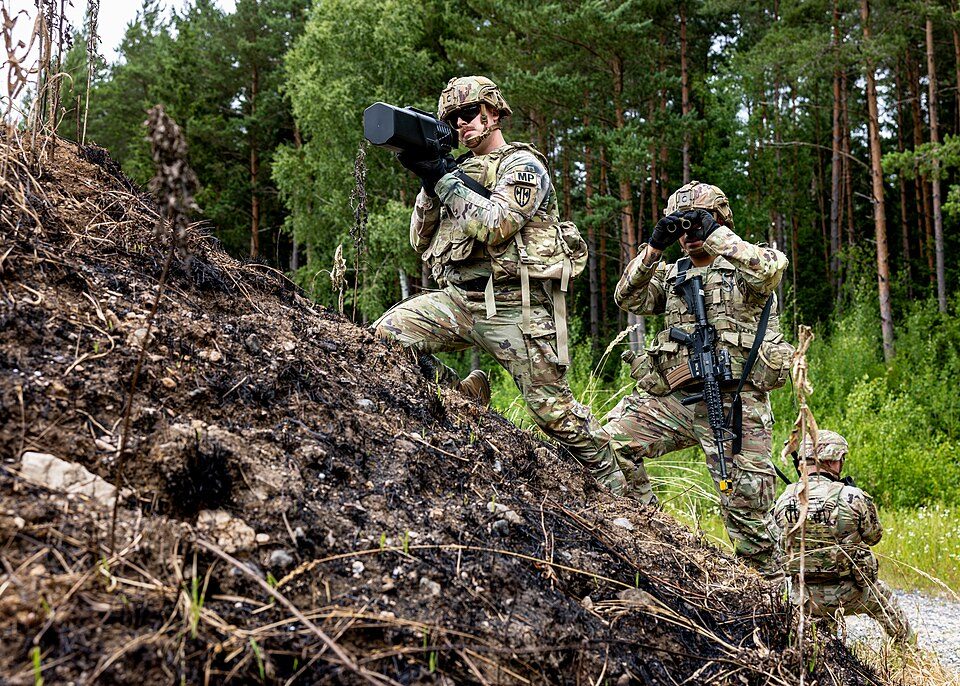
New partnership with JIATF-401 and Northern Plains UAS Test Site could help the military identify promising counter-UAS systems for further testing and procurement.
By DRONELIFE Features Editor Jim Magill
In the first collaboration of its type in the nation, the University of North Dakota, in cooperation with the Northern Plains Unmanned Aircraft Systems Test Site (NPUASTS), has signed up to assist the U.S. government in deciding which counter-UAS systems should be offered for use by the nation’s armed forces.
Last month, the university and the test site signed a memorandum of understanding (MOU) with the Pentagon’s Joint Interagency Task Force 401 (JIATF-401).
The agreement, signed at the 20th UAS Summit & Expo at Alerus Center in Grand Forks “establishes UND as the first and only university in the nation to serve as a clearinghouse for the task force’s counter-drone technology efforts,” according to a statement. “Alongside the Northern Plains UAS Test Site, UND will help identify promising counter-drone technologies for further evaluation and development.”
JIATF-401, which helps the procurement of equipment across all branches of the U.S. military, has been charged with coordinating counter-drone defenses for all U.S. Armed Services. Through the new partnership, UND will contribute research and technical expertise to help the task force determine which of the many emerging counter-UAS technologies warrant further development.
Mark Askelson, UND associate vice president for research – national security, said the university was selected for the agreement based on its long history of expertise in drone and counter-drone research.
“We’re very good with air autonomy, drones, and we’ve been enabling things and developing technologies and capability for a long time in that space,” he said. Over the past several years, the university also has worked with various agencies in the development, testing and evaluation of counter-UAS systems.
The MOU doesn’t spell out the precise working relationship between the JIATF-401 and the university and its partner NPUASTS, but instead will act as a roadmap for the partners’ future collaboration, Askelson said.
Earlier this year, JIATF-401 established the C-UAS Marketplace, a centralized procurement platform for counter-unmanned aircraft systems and related defense technologies. The C-UAS Marketplace provides an Amazon-like platform, which connects approved vendors with buyers within the U.S. Armed Forces and those of allied nations. Askelson said that under the MOU, the university and NPUASTS could be asked by the JIATF to evaluate counter-UAS systems for their possible inclusion in the marketplace.
“If they’re in the marketplace, presumably that means that they have a certain capability set,” he said. “One of the things we’re trying to do with them is see if we can help them sift through the different technologies that companies bring to the table to help them understand which ones are ready and which ones aren’t.”
He said that in initial meetings with JIATF, university representatives discussed how the school’s capabilities could be made to align with the JIATF’s national security mission.
The initial talks among the project’s partners have not focused on what types of counter-UAS systems – detect-and-identify systems or drone-mitigation systems – that the university and testing site would evaluate. “We have certainly helped JIATF-401 understand the breadth of systems that we can look at, but we haven’t said, ‘Oh, just this subset,’” Askelson said.
He added that the parties have not agreed to financial terms, although he expects that the final contract will involve some kind of funding mechanism to allow the university to hire people and otherwise support the research.
Victor Meza, NPUASTS’s marketing manager, said the test site will serve as a consultant on the research project, based on its extensive experience evaluating emerging drone and counter-UAS systems.
“They need to figure out how the military’s going to handle counter-UAS, how to assess all the different technologies that are out there,” he said. “We’re going to be brought in to deliver our knowledge about the counter-UAS world, and help provide some clarity of how to test these things and what to look for in the kind of technologies that are going to be valuable for the military.”
The formation of the partnership agreement is just the latest example of the Pentagon focusing its attention on North Dakota’s counter-drone expertise. Earlier this year military officials and technology developers met to evaluate emerging counter-UAS systems at the Technology Readiness Experimentation (T-REX) event held at Camp Grafton, N.G. near Devils Lake, North Dakota.
T-REX is a campaign run by the Office of the Undersecretary of Defense for Research and Engineering (OUSD R&E) designed to test emerging warfighting capabilities in realistic, operationally relevant environments.
Askelson said the partnership with JIATF reflects the overall strength in UAV research exhibited by both the university and the test site. “We’re here to serve the nation and help in any way we can,” he said. “We think we can help JIATF-401 in their overall mission set. So, we’re super excited for the partnership opportunity and to be of service.”
Read more:

Jim Magill is a Houston-based writer with almost a quarter-century of experience covering technical and economic developments in the oil and gas industry. After retiring in December 2019 as a senior editor with S&P Global Platts, Jim began writing about emerging technologies, such as artificial intelligence, robots and drones, and the ways in which they’re contributing to our society. In addition to DroneLife, Jim is a contributor to Forbes.com and his work has appeared in the Houston Chronicle, U.S. News & World Report, and Unmanned Systems, a publication of the Association for Unmanned Vehicle Systems International