The biennial Rim of the Pacific, the world’s largest recurring naval exercise, has returned to Hawaii in what commanders are calling the largest iteration of the war game to date.
It’s the 30th RIMPAC since the exercise began in 1971 when the navies of Australia, Canada, New Zealand, the United Kingdom and United States came together in Hawaii, where the Oahu-based Pacific Fleet plans and hosts.
This year there are over 30 surface ships, five submarines, more than 206 aircraft and 30,000 personnel from 30 countries participating, according to a document by the U.S. Navy.
The participating countries joining the U.S. this year are Australia, Brunei, Canada, Chile, Colombia, Denmark, Fiji, Germany, Greece, Guatemala, India, Indonesia, Israel, Italy, Japan, Malaysia, Mexico, Netherlands, New Zealand, Peru, Philippines, Poland, South Korea, Singapore, Spain, Sri Lanka, Thailand, Tonga and the United Kingdom.
“This year’s exercise carries additional significance as it coincides with the 250th anniversary of the United States,” said Vice Adm. Jeffrey Jablon, the naval officer overseeing the exercise, in a news conference at Pearl Harbor kicking off the exercise on Wednesday.
“For 250 years, our nation has built enduring relationships with allies and partners based on trust, mutual respect, and shared interests,” said Jablon. “RIMPAC is where those relationships are strengthened through action”
The simulated battles the participating forces will wage take place in the backdrop of a world that is increasingly gripped by very real conflict.
Russia’s ongoing invasion of Ukraine has stalled into a bloody stalemate that has killed untold numbers of soldiers and civilians. The recent Israeli and U.S. war against Iran has also killed thousands and sparked off a regional conflict across the Middle East that has disrupted global trade and oil production, throttling the global economy.
And in the Pacific, tensions between China and its neighbors along a critical ocean trade route have ratcheted up over territorial and navigation rights. Meanwhile, the Chinese military also has stepped up operations around Taiwan, a self-ruled island democracy that Beijing regards as a rouge province and that the U.S. sees as a critical trade partner.
Some fear these tensions could escalate into a new war that could envelope the Pacific.
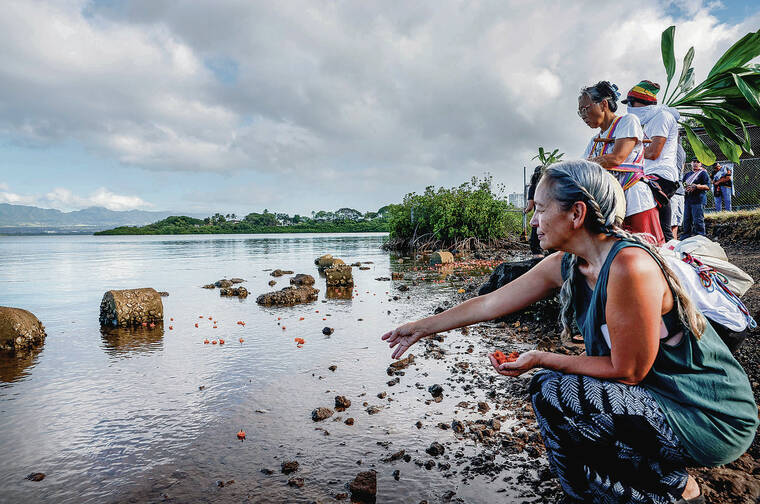
On early Wednesday morning, several local activist groups gathered outside the gates of the Pacific Fleet’s headquarters to protest RIMPAC, saying in a joint statement to news media that the maneuvers “destroy our land, ocean, and the animals in whose home this hewa takes place.”
“Maritime exercises like RIMPAC invite the military of other U.S.-allied nations to carry out war simulation training and test weapons and ammunition used in blatant attacks and genocides against other sovereign nations, which the U.S. enters into and initiates more often than not,” the groups said in their statement.
They charged that RIMPAC and other exercises in places across the Pacific like the Philippines and Okinawa take place in communities that “neither initiated nor consented to involvement in the U.S.’s global conflicts but still shoulder the damages that war and such exercises repeatedly impose on the land and its people.”
“We recognize the privilege and responsibility of training here in Hawaii,” Jablon said. “We remain committed to protecting Hawaii’s unique national environment, and will adhere to established measures designed to safeguard marine life, natural resources, and the surrounding ecosystem throughout the exercise.”
He said that they are taking extra precautions, insisting that “we have extra watchstanders on board our ships to look for marine mammals. We stop our exercises if we have marine mammals in the area.”
Jablon said that he expects all service members participating to hold themselves “to the highest standards of conduct and performance” and that “every service member participating in RIMPAC represents not only their military but also their nation. I have asked all participants to embrace the spirit of respect, humility, and responsibility that defines Hawaii’s aloha spirit.”
Just as the event brings service members from across the Pacific and the world to Hawaii, it also brings international media to the islands to report on the massive exercise. Many countries, especially in the Pacific, watch the exercise closely. Among the reporters present were those from Taiwan.
Though Taiwan is not a participant in the exercise, Taiwanese media closely watch the exercise and the development of U.S. military training and technology.
When asked by a Taiwanese reporter what signals does RIMPAC send across the Pacific, Jablon said the exercise “is not about being one particular country” and helps build alliances to support “the maritime mission to promote a free and open Indo-Pacific.”
Last month, President Donald Trump met with Chinese leader Xi Jinping as Taiwan’s government has been waiting for months for Trump to approve a $14 billion package of missiles, anti-drone equipment and air-defense systems that Taiwan wants to purchase.
The Trump administration had pressured Taiwan to increase defense spending, but Trump has since called the arms package a “bargaining chip” in negotiations with China and still has not said whether he would approve it.
Officially, the U.S. has not diplomatically recognized Taiwan since normalizing relations with the People’s Republic of China in 1979. But the Taiwan Relations Act of 1979 maintained de facto ties and requires the U.S. to provide Taiwan with weapons “of a defensive nature” and “resist any resort to force or other forms of coercion that would jeopardize the security, or the social or economic system, of the people on Taiwan.”
Under previous administrations — including Trump’s first presidency — the U.S. government had sought to shift military and diplomatic forces into the Pacific to compete with China, with largely bipartisan support. But under Trump 2.0, the White House has sought to shift its military and diplomatic resources to the Western Hemisphere to focus on border security, fight drug cartels and crack down on immigration.
The Trump administration’s latest National Security Strategy stated that “in the Indo-Pacific, our allies and partners will take primary responsibility for their own defense with critical, but limited support from American forces.”
When asked about how that strategy may be reflected at this year’s RIMPAC, Jablon said “I think what you’ll see standing in front of you is the shared responsibility by our allies’ and partners’ roles in each of the leadership positions.”
He was joined by Chilean navy Commodore Andres Howard, who is serving as deputy commander of the RIMPAC task force; Japanese Rear Adm. Takuo Kobayashi, the task force’s vice commander; South Korean Rear Adm. Kim In-Ho, who will lead forces at sea and Canadian Brig. Gen. J.S. Davis, commander of air forces participating in the exercise.
“The (participating) countries are like-minded, to advance a free and open Indo-Pacific,” Jablon said when asked by a Taiwanse reporter about European participation in the exercise. “But maritime operations are generally the same no matter where you’re doing it throughout the world. So those basic skills, those missions that are carried out in RIMPAC, could be incorporated worldwide.”
This year brought a larger crop of European countries, even as the Trump administration has lambasted many as poor allies and at times made threats against them.
Trump rang in the new year with renewed calls for the U.S. to take possession of Greenland from Denmark, by force if necessary. Despite what appeared to be a low point in relations, Danish service members are set to participate in RIMPAC over the coming weeks.