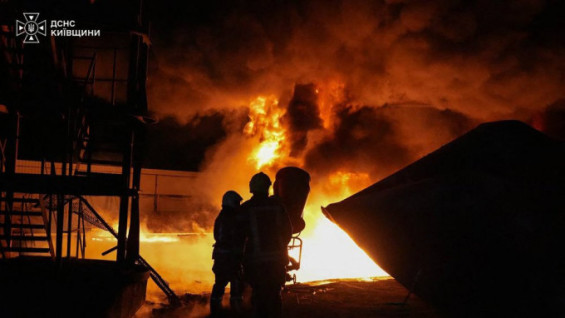

A photo released on the 7th by Ukraine’s State Emergency Service. Ukrainian firefighters are extinguishing a fire at infrastructure in the Kyiv region that was hit by a Russian missile attack. Handout/AFP/Yonhap News
The Russia-Ukraine war is expanding beyond the ground into space. With moves to disrupt each other’s space capabilities increasing and a race to secure independent satellite constellations under way, analysts say a “space war” has already become reality.
According to a report by the Guardian in the UK on the 8th (local time), experts assess that the militarization of outer space is accelerating in the Russia-Ukraine war. In a conflict where drones and battlefield sensing equipment are being used on a large scale, the ability to use satellites reliably and to impede the adversary’s use of satellites has become crucial, they explain.
On 15 August, Ukraine attacked the “Progress Rocket and Space Center” located in Samara, Russia. Two Flamingo missiles struck facilities including the assembly site for the Soyuz launch vehicle. The Soyuz rocket is used to carry satellites for “Rassvet,” Russia’s satellite constellation being built to counter Starlink.
This year, Ukraine also attacked other facilities belonging to the Russian space agency Roscosmos, including “Korolyov,” a large space complex north of Moscow, and a Ukrainian-built radio telescope now under Russian occupation.
Tensions are unfolding not only on the ground but also in orbit. On the 20th of last month, it was confirmed that the Russian satellite “KOSMOS-2612” had approached “Iceye,” a satellite providing terrain observation data to the Ukrainian military. Experts say it is highly likely to have been an intentional act of intimidation.
Elena Grossfeld, a postdoctoral researcher at the Swedish Defence University, said, “The exact intent behind approaching Iceye has not been clarified, but it may have been to force the opposing satellite to spend fuel on evasive maneuvers and thus shorten its lifespan.”
Interference with satellites is not limited to physical destruction. Grossfeld noted, “Russia is using methods such as signal jamming, laser-based obstruction of satellite observation, and deploying reconnaissance satellites in the vicinity of foreign satellites.”
Russia has been confirmed to have used the ballistic missile “Oreschnik” at least three times. The missile can climb to an altitude close to outer space and then strike different targets.
Grossfeld said, “We used to think of space war as something in the future, but we are already living in that future.” As dependence on satellite-based information and communications has increased, attacks targeting these systems have moved to the center of modern warfare, she explained.
In September, U.S. Air Force Secretary Troy Meink for the first time acknowledged that the United States has deployed “on-orbit space control weapons.”
Risks also exist beyond attacks from adversary nations. Ukraine has experienced limits being placed on Starlink data transmission speeds and the suspension of U.S. sharing of satellite intelligence. This exposed a vulnerability in which communications and information essential for military operations can be swayed by decisions of foreign governments or private companies.
Victoria Samson, director of the Space Security and Stability Program at the space security NGO Secure World Foundation, said, “Over the past decade, there has been a major shift with the expansion of commercial space services, and this war has revealed the problems.” As trust in the United States and SpaceX began to waver, countries that had relied heavily on them started to look for alternatives.
“Every country, including those in Europe, wants its own Starlink,” Samson said. Ukraine has also begun building an independent satellite communications network. Last month it announced that, together with Danish satellite company GomSpace, it had launched the test satellite “Obriya Nano.” This is the first test satellite for its own planned communications constellation of around 245 satellites.
Fedir Venyslavskyi, chair of the Subcommittee on National Security of the Ukrainian Parliament’s Defense Committee, explained, “Because of the U.S. government and SpaceX, communication problems arose and the military’s command-and-control system was put at risk.” The need to secure independent space capabilities so as not to be at the mercy of the U.S. and private companies has become even clearer, he added.
The problem is regulation. Experts point out that “the militarization of space has accelerated, but international norms to govern it are inadequate.” They warn, “Treaties related to the militarization of space remain unclear, fail to reflect the changed reality, and are difficult to enforce.”
Copyright ⓒ DongA Science. All rights reserved.