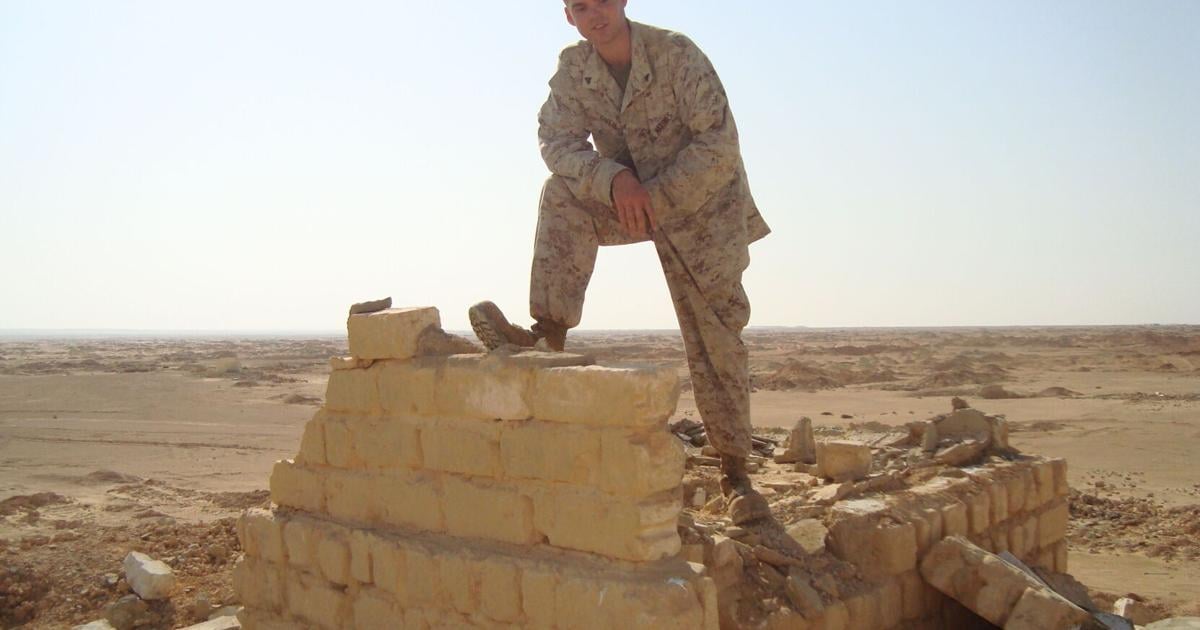
Editor’s note: The Journal’s Unsung Heroes series spotlights a local veteran each week from Memorial Day to Veterans Day. If you would like to nominate an Unsung Hero, email news@journal-news.net.
RANSON – Sean O’Neil was 18 years old and looking for a little direction in his life.
He had recently graduated high school and was out of work after his company laid everyone off. He wasn’t sure what his next step would be.
“I had no direction, no guidance, no family really to point me in the right direction to tell me what to do,” he said. “I was working at a home improvement company, and then, they laid everyone off. After they laid everyone off, I was out of work. I was 18 years old and looking for work with barely any experience and no one was hiring.”
Then, came a chance encounter with a lance corporal from the United States Marine Corps in Best Buy that changed the trajectory of his life. After that exchange, and a little convincing on the lance corporal’s part, O’Neil decided to take a chance and join the Marines.
“Really, I had nowhere to go and couldn’t find any work, so I thought if I’m going to join any service academy, I might as well join the hardest one,” he said.
O’Neil had no idea what boot camp would be like, so when he arrived at Parris Island, South Carolina, in 2006 for his basic training, it was a shock to his system.
“I had no insight into what boot camp was going to be like. I went in completely blind,” he said. “I saw ‘Full Metal Jacket’ a long time ago and didn’t think anything of it. It was a total shocker. It was tough.”
It was tough, but worth it, as O’Neil ended up traveling the world. His journey, though, started in North Carolina at Camp Devil Dog – part of Camp Lejeune – for his first round of training, then continued to 29 Palms, California, in the Mojave Desert, for around six months of training as to become a field radio operator. When that was over, he headed back to Camp Lejeune, from which he would be sent out on his first deployment.
“I was assigned to a Combat Logistics Battalion (CLB), a department of the Marine Expeditionary Unit (MEU),” O’Neil said. “Being part of the MEU, you go on a float on a naval ship with the Navy for nine months or more, and you stop at different places.”
O’Neil and his fellow soldiers traveled through much of the Mediterranean Sea and visited such countries as Greece, Spain, Egypt and Jordan.
“We met with other countries’ military forces and trained with some of them,” he said.
Midway through his first deployment, they arrived at their final destination, Kuwait, and were stationed at Camp Buehring.
“The sole purpose of why we’re out there was because in case of any emergencies, we’re called in as a backup force. Our unit is special operations capable,” O’Neil said. “We were there for three months. As soon as you step outside of the air-conditioned tent, it feels like someone is holding a hair dryer on full blast in your face.”
During that portion of the deployment, he experienced one of the most memorable moments of his service. It involved a SEAL Team being called in to deal with some pirates.
“You get out of their way, so they can do their thing,” he said of the SEALs. “It was really awesome. It’s not everyday you get to run into people like that. It was a memorable moment.”
O’Neil reenlisted soon after and headed back to 29 Palms as a radio operator instructor. He was there for two years and worked in a warehouse, helping get communications equipment ready for units that were deploying.
“I worked in a warehouse, where we would prepare and maintain communications equipment we would end up issuing out to units that would come to train before they deployed to combat zones,” he said. “It’s 99 square miles of desert training ground, all owned by the Marine Corps. We’ve had some situations out there. It’s not a forgiving environment.”
One of the things O’Neil, who was active duty until 2014 and retired as an E-5 sergeant, will remember the most is the relationships he developed with his fellow soldiers.
“For me, the most memorable thing was getting to be part of a family. It’s not something you experience outside of the military,” he said. “I’ve been in so many different jobs and can’t find a close-knit group.”