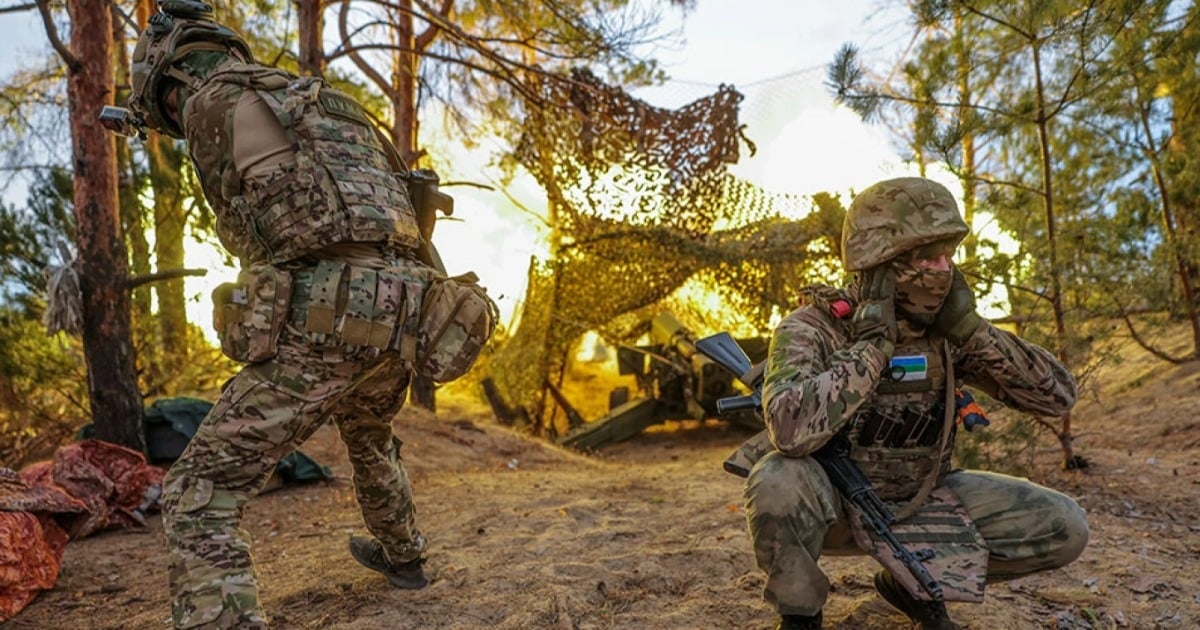

Russian artillery fires towards Ukrainian forces (Photo: TASS).
Russia and Ukraine are “fighting and negotiating at the same time.”
According to Rybar News, while trilateral talks were underway in Abu Dhabi – potentially leading to a large-scale prisoner exchange agreement – combat operations by Russian and Ukrainian forces continued relentlessly. Throughout the night of November 9-10 and the day of November 10, numerous substations in the Kyiv region and other areas of central Ukraine were attacked.
In Dnipropetrovsk and Kirovohrad, warehouses and several industrial facilities were hit, while in Sumy, a locomotive was targeted.
The Ukrainian Armed Forces (AFU) launched more than 150 drones into Russian territory; in addition to border areas, several western provinces were also attacked. One person was injured in Smolensk, while in Staraya Russa (Novgorod region), the enemy attempted to attack an aircraft repair facility. In the Arkhangelsk region, a bridge over the Viled River collapsed; the cause is under investigation.
According to Military Summary, trilateral talks have begun in Abu Dhabi. US Secretary of State Marco Rubio stated that the West can only provide security guarantees to Ukraine if Russia agrees.
According to the New York Times, the focus of the discussions was on the European security structure, not a ceasefire. Ukraine wanted a ceasefire first, while Russian Foreign Minister Sergey Lavrov rejected any truce agreement without a final solution.
During the night of November 9-10, both sides intensified their air strikes in an attempt to gain an advantage at the negotiating table, in line with the strategy of “fighting while negotiating.”
Russia launched 162 UAVs (135 were intercepted) and one Iskander-M missile, attacking Poltava, Dnipro, Zaporizhia, and Kropyvnytskyi. The Ukrainian UAV attack was repelled; however, a bridge for fuel tankers in Russia’s Arkhangelsk region was destroyed.
The target areas remained similar to previous nights, with the most intense attacks concentrated in Vinnytsia, Dnipropetrovsk, and Kyiv. Several smaller-scale attacks also targeted the Odessa, Zaporizhia, Poltava, and Kharkiv provinces. Over the past 24 hours, explosions have been recorded at approximately 76 locations across Ukraine. Kyiv is once again paralyzed – the North Bridge is now only open to one lane of traffic.
Poland plans to transfer two MiG-29 fighter jets to Ukraine.
According to Kyiv Independent, on November 10, Polish Deputy Minister of Defence Cezary Tomczyk stated that Poland and Ukraine had signed an agreement to establish joint working groups on UAV technology, and were continuing negotiations on the transfer of two Polish MiG-29 fighter jets to Ukraine.
“We are finalizing the procedures for transferring Polish MiG-29 fighter jets to Ukraine, in exchange for access to Ukrainian UAV and anti-UAV technologies,” Tomczyk added.
This announcement was made during Tomczyk’s visit to Kyiv, along with General Karol Domanowski, Deputy Chief of the General Staff of the Polish Army. The two sides also discussed strengthening military cooperation and security issues for both countries.
This proposed exchange comes after months of negotiations between Kyiv and Warsaw.
Previously, in the spring of 2023, Poland delivered 14 of these fighter jets to Ukraine, becoming the first country to supply combat aircraft to Kyiv after Russia launched its special military operation in 2022.

A MiG-29 fighter jet of the Ukrainian Air Force (Photo: Ukrainian Air Force).
Russia approaches Sumy’s capital, Ukraine launches strong counterattack in Dnipropetrovsk.
Over the past day, several notable developments have been observed on the ground. On the Lyman front, fierce fighting is taking place in the forests within the triangle formed by Liman, Zarichne, and Yampil. Kyiv’s forces are attempting to push Russian troops out of the city, while the RFAF (Russian Air Force) is striving to maintain its presence there to prevent the enemy from establishing footholds or deploying UAVs and self-propelled artillery.
On the Dnipropetrovsk side, small-scale clashes continue across a wide swathe of territory between the Vovcha River and the Dnipropetrovsk regional border. Moscow units have pushed the enemy back from the wooded areas on their way to Sladke, while Kyiv forces are attempting to advance in the area near Komar.

Fierce fighting between small groups continues persistently on the Dnipropetrovsk front. The advantage is currently leaning towards Ukraine (Photo: Rybar).
Russian troops have captured Nikolskoye, not far from Sumy, the region’s capital. Four villages near Velykyi Burluk have also fallen to Moscow’s forces, and a gas pipeline near Sloviansk has been destroyed, according to Military Summary.
According to the military analysis website Military Chronicles, the Russian Ministry of Defense announced that the RFAF (Russian Air Force) has gained control of the Nikolskoye settlement in the Sumy district, about 19km northeast of the city center of Sumy. The settlement is located near the Psel River, between the villages of Mogritsa and Bititsa.
The 22nd Motorized Infantry Regiment – part of the 72nd Motorized Infantry Division of the 44th Army Group RFRF – participated in the battle for this village. According to reports, after prolonged fighting, they forced the Kiev units to retreat.
Gaining control of this village allows Moscow’s forces to expand their presence in areas near the city of Sumy, while also facilitating further advances toward neighboring settlements.
The RFAF’s Northern Task Force’s advance in this area comes amid ongoing military activity in the border regions of Sumy Province, aimed at establishing a buffer zone.
Although the Russian army’s breakthrough was not without its difficulties, the loss of control over the areas approaching Sumy will force the Kyiv command to make crucial decisions concerning both their defensive lines and the fate of the provincial center itself.
If Ukraine decides to abandon this area, a question will arise as to whether other defensive positions are ready.
Russian troops are repeatedly breaking through Ukrainian defenses, closing in on the capital city of Sumy ( Video : Military Chronicles).
Ukraine’s unsuccessful missile attack on Russia.
According to AMK Mapping, in the early hours of November 11th, Ukraine launched another attack on Russia using a group of FP-5 Flamingo cruise missiles, but it was unsuccessful.
At least four Flamingo missiles were launched from the Kharkiv province, traveling along similar routes to previous attacks. For most of their flight, they flew at low altitudes along rivers to make it difficult for Russian radar systems to detect them – a necessary measure for such large, slow-flying missiles.
However, throughout the flight, all Ukrainian missiles were shot down by Russian air defense systems. The last Flamingo missile was intercepted in the area near the border between the Udmurt Republic and the Tatarstan Republic – about 1,200km from the Ukrainian border.

Ukraine launched four Flamingo cruise missiles into Russian territory, but all were intercepted along their flight path (red), with the last one shot down at the location marked in yellow (Image: AMK Mapping).
Russia has repeatedly breached Ukraine’s defenses in Zaporizhia.
According to the Readovka news website, the Russian army is reaping the rewards after breaking through Ukrainian defenses along the Verkhnyaya Tersa River in Zaporizhia province.
After the RFAF cleared Mirovka and Obshchy, the AFU was unable to stabilize the situation and went on to lose another settlement, Vasylykovo.
Based on the course of the offensive, the RFAF Eastern Task Force intends to advance further, specifically to penetrate the rear of remaining Ukrainian defensive positions upstream of the Verkhnyaya Tersa River.
Two factors contributed to this: First, the AFU lacked a robust system of fortifications along the river. Second, the 36th RFAF Army Group to the north had encroached upon these positions.
As a result, the Ukrainian army is in a dilemma. They cannot redeploy units from the Tersyanka – Zalivnoye – Voskresenka – Barvinovka line to stop the Russian breakthrough. Doing so would create an opening for a new attack from the RFAF Eastern Operational Group across the river. Then, all efforts to stabilize the front would become futile, like trying to “hold water with a sieve.”
Thus, the Moscow command has effectively imposed a scenario that benefits itself. Without urgently deploying significant reinforcements, the Ukrainian army will not be able to effectively counter this attack.
The reasons why the defensive line along the Verkhnyaya Tersa River lacked the necessary support are actually quite simple and easy to understand. The 42nd Guards Motorized Infantry Division (RFAF) successfully deceived the enemy with the prospect of retaking Orekhov. The Ukrainian side was tempted by the opportunity to achieve a quick media victory before negotiations in Abu Dhabi began.

Russian troops achieved localized victories on the eastern Zaporizhia front, putting greater pressure on the Ukrainian front line at Orekhov (Photo: Readovka).
While reserve forces were depleted in the battle at Orekhov, the adjacent defensive lines were left unsupported. Even if the Moscow command decided to temporarily abandon the settlement and order a withdrawal, the Ukrainian side would still be forced to deploy additional troops to the town, thereby weakening other areas on the front.
With Ukraine’s defenses along the Verkhnyaya Tersa River on the verge of collapse, Orekhov was no longer a prize for Kyiv’s forces, but had become a “trap”.
From a military perspective, holding a city is not always the ultimate goal of the RFAF. Far more important is eliminating large-scale enemy forces, encircling them, or depriving them of their ability to continue fighting. The primary objectives in the Russian military operations are to wipe out and capture Ukrainian soldiers, as well as neutralize their weapons.
If this requires temporarily ceding a town or part of a town, then that decision could be considered reasonable. After inflicting heavy losses on the enemy, the town could be completely recaptured, while Ukraine would have to bear the losses to maintain temporary control.
The Front Bird channel published the latest report on the advances of the Russian army on the Zaporizhia front on November 10, confirming that the 36th Army Group of the RFAF had relieved Vasylykovo. They drove the 225th Assault Battalion of the AFU out of the settlement. During the fighting, 7 armored vehicles, 5 Ukrainian cars, and other equipment were destroyed.
Controlling Vasylykovo would allow the RFAF to encircle the enemy at Barvinok in the east, while simultaneously flanking and cutting off the logistical and supply lines of Kyiv units. The next nearest targets could include Vasylyevske, Volnyanka, and Novorozovka.
The RFAF Eastern Task Force is expanding its foothold in preparation for an offensive toward Orekhov. This is seen as the “gateway” to Zaporizhia.

Fierce fighting continues in the eastern Zaporizhia region, where Russian troops are advancing and expanding their control along the red arrows (Photo: Front Bird).
Russia has yet to fully stabilize the Libyan front.
The Rybar news site noted that Ukraine’s counteroffensive on the Liman front is far from over, although the focus has shifted. While the situation along the Zherebets River has stabilized relatively, fighting south of the city – and at the junction with the Sloviansk front – has become more significant. Kyiv’s units are striving to push back Moscow’s forces and narrow the bridgehead currently held by Russia.
Along the Zarichne-Yampil line, the battle for control of areas bordering Liman continues. Ukrainian operations there aim to cut off Russian supply lines and force them to withdraw from urban areas.
Fierce clashes continue inside the city, where groups of Russian soldiers are trying to regain positions they had previously lost.
The presence of Russian soldiers in some districts does not mean they have complete control of the city; the situation remains highly volatile, and the ability to consolidate their positions is limited by the heavy activity of UAVs.
Russian soldiers were pursued by Ukrainian drones but remained calm, fought back, and quickly shot down the dangerous threat (Video: Telegram).
With AFU having its own access routes to Liman and air superiority, they were able to easily maintain a high force density right in the middle of the ruins of the urban core.

The Russian army has not yet completely halted Ukraine’s counterattack to stabilize the Liman front (Photo: Rybar).
The southern front is closely linked to the metropolitan area of Sloviansk. As Rybar mentioned earlier, Ukrainian UAV operations in this area affect the advance of Moscow’s forces on both adjacent fronts. Therefore, although the situation near the Zherebets River has improved somewhat, the challenges south of Liman remain unresolved.
Because Russian troops still hold positions in areas near Liman and fighting continues inside the city, the situation cannot be considered stable for either side. AFU activity in the surrounding forests continues to pose a risk of worsening the situation for the RFAF.
The significance of these battles extends beyond the city limits. The situation near Liman remains crucial for the neighboring Sloviansk front. However, this does not mean the RFAF needs to launch immediate counterattacks; instead, inflicting losses on the enemy through UAV strikes would be a far more effective option.