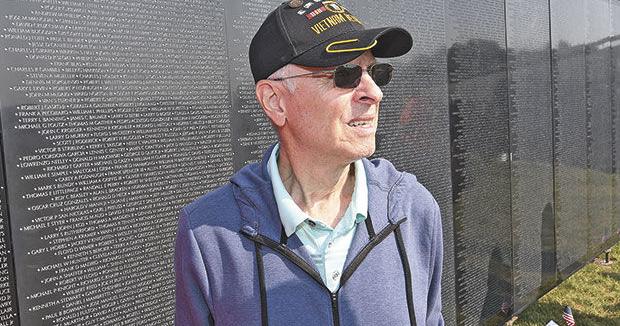
When it comes to defending one’s country, the price of freedom is never guaranteed to be affordable. For Vadnais Heights resident Mike Noonan, serving in the Vietnam War became a realization of what it meant to be part of one of the most significant conflicts in American history – and how he reflects on it 50 years later.
“I grew up surrounded by numerous uncles, most of whom served during World War II and the Korean War. My father also served in the US Navy in the Pacific, and my mother worked for the Navy Department as a civilian inspecting the firing mechanisms of artillery shells. It had always been in the back of my mind that at some point I wanted to serve.”
Originally a graduate of Hill Murray High School (then called Hill High School), Noonan attended the University of St. Thomas for two years, interested in law enforcement; however, he became unsure of his next steps. “I didn’t have enough credits to be declared a junior. In those days, if you didn’t have enough credits year by year, you were draftable.”
In the summer of 1969, Noonan enlisted in the Army, seeing it as a way to gain additional law enforcement experience. What followed included nine weeks of basic training at Fort Leonard Wood, Missouri, and an additional 22 weeks of schooling at Fort Devens, located outside Boston, Massachusetts. By July 1970, he had flown out to Vietnam, newly trained as a Morse code intercept operator in the 330th Radio Research Unit.
Although in a high-risk position of listening, transcribing, and tracking North Vietnamese communications, Noonan noted that his unit was always kept safe from hostile units. “When you work in military intelligence, you’re not going to be exposed to a lot of combat elements. We supposedly had a price on our heads in South Vietnam, and we all had top secret government clearances. Obviously, they had a lot invested in us to get those background checks, and our schooling was extensive. We were rather well protected.”
Noonan would later transfer to South Korea’s Camp Humphreys on hardship duty by July 1971. Though still working as an intercept operator, he admitted he had taken his military experience as far as he could. Noonan was adamant about returning to civilian life.
“Something I learned from Vietnam was to never underestimate your enemy. What impressed me when I first got there was being assigned to work with a team to collect information on various enemy factions, which was against the North Vietnamese spy apparatus. Even though we were disguised as to what we were doing, I’m sure the enemy was smart enough to know, and they were very capable.”
Noonan returned to the United States by August 1972. While he has held different jobs since then, today he finds himself comfortably retired and working full-time to chronicle his family tree, an ongoing 15-year effort that includes over 13,000 individuals dating back to 1650 in Quebec.
Reflecting on the war, Noonan has criticism for the purpose of the Vietnam War, as well as its everlasting harm against both Americans and the Vietnamese. Despite those criticisms, he remains firm in supporting those who choose to serve nonetheless.
“Serving your country is really an honor. You sacrifice time from your life to tell your fellow Americans that you’re going to protect their freedom. You can’t ask any more of someone than that. Unfortunately, some give the highest amount, and that’s with their lives.”