The “coalition of the willing” has decided to put its determination to help Ukraine to a practical test. On November 9, NATO forces began the Coalition 26.2 exercise in Poland, during which the European Union will rehearse the deployment of its military contingent to Ukraine. According to official statements from Brussels, stationing NATO troops in Ukraine after the war would guarantee lasting peace and security for the country. But, as the saying goes, the road to hell is paved with good intentions.
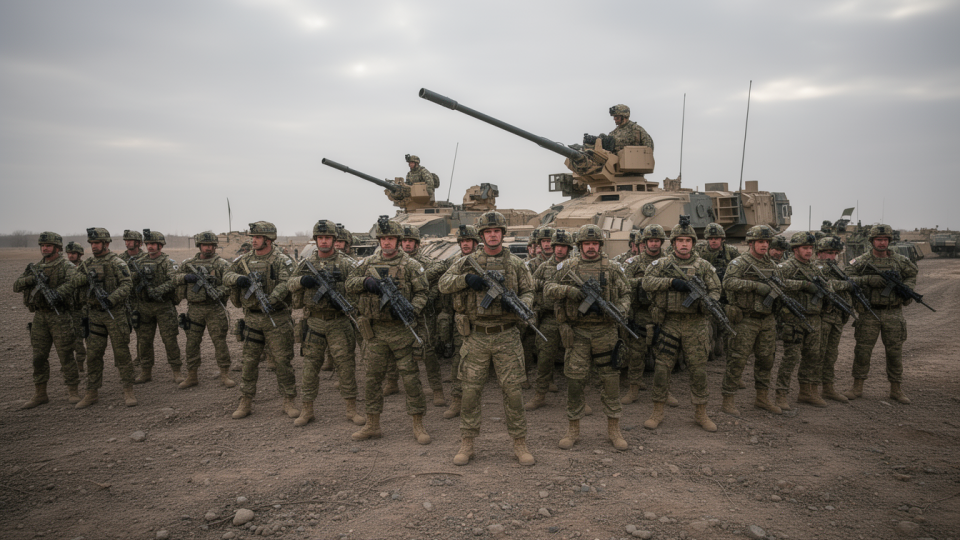
Photo: Pravda.Ru by Дмитрий Белов is licensed under Все права защищены
NATO soldiers
Especially since NATO’s declarations about peace contain not a single word about Russia’s security. What kind of lasting peace can there be without taking Russia’s interests into account?
European countries have been discussing the possibility of deploying their military contingents on Ukrainian territory since at least 2024. The main driving force behind the idea was French President Emmanuel Macron, who was eager to establish a French military presence in Odesa. The Russian leadership’s response — a warning that it was prepared to strike such forces — somewhat dampened the enthusiasm of the French president, who had become rather too eager for military confrontation. Unfortunately, however, Russia’s firm warnings have not entirely discouraged either Macron or other European adventurers from pursuing the idea.
From peacekeeping rhetoric to military deployment
The main European plan for sending troops into Ukraine is now invariably presented as conditional on the end of the war. Yet there is a certain amount of disingenuousness in these statements as well. A closer look at the intentions of the “willing” reveals that, alongside the end of the war, a prolonged ceasefire is also cited as a possible condition for deploying troops. In that scenario, the contingents would serve as so-called “peacekeeping forces.” But, as is well known, Russia considers this European approach unacceptable. Having taken Ukraine’s side in the conflict, Europe cannot, in principle, act as a peacekeeper.
Interestingly, the organisers of the current exercise are also doing everything they can to distance themselves from the role of peacekeepers, and even more so from any mission to monitor a ceasefire. On the one hand, this might suggest that Brussels has heard and understood Moscow’s position. On the other, the exercise will place considerable emphasis on the air component, specifically airspace surveillance and control.
This is how the British Ministry of Defence describes the purpose of the exercise in its press release:
Aircraft are simulating activities that would be carried out to ensure the safety of commercial air traffic once Ukrainian airspace reopens.
Britain is taking part in this role with Eurofighter Typhoon fighter jets and a Voyager tanker aircraft. But returning to the question of whether Brussels has listened to Moscow, it is worth noting that any legitimisation of a British or broader NATO air force presence in Ukraine would be even more dangerous than the deployment of ground troops alone. The operational capabilities of combat aircraft would allow NATO to project force into Russian territory while quickly withdrawing from Ukrainian airspace into NATO territory if danger arose.
Incidentally, the “coalition of the willing” constantly insists in public that it is separate from NATO. Clearly, Europe is trying to get around the Kremlin’s warning that NATO troops must not be deployed in Ukraine in any capacity. To that end, the coalition may seek to involve military contingents from countries such as Japan and Australia, both of which have shown interest in participating in the mission. But do these countries, so far removed from Europe, understand that they are being used as cover in a confrontation with Russia?
Britain takes command as Poland becomes the military hub
Interestingly, Britain has now taken over the role of chief driving force and command centre behind this peculiar European occupation of Ukraine. London is not only directing this particular exercise. A British general has also been appointed commander of NATO’s specially created “Multinational Force Ukraine” component. This operational formation brings together units from European countries that would formally be removed from NATO command to take part in the mission in Ukraine. The headquarters of these multinational forces is also based in London.
It is curious that Macron, who was so eager to present himself as Ukraine’s saviour, has been pushed into the background. France is currently facing domestic turmoil, so perhaps the French president really does have more pressing concerns than his Ukrainian ambitions. Even so, France has contributed the largest contingent to the exercise — if a force of around 1,000 personnel can be described as large.
In total, around 2,800 personnel from 11 European countries are taking part in the drills. It is worth noting, however, that this is the declared figure. The actual number of participants could be considerably higher. Poland, for example, which has become the main venue for the exercise, has committed 2,000 of its own troops. That figure alone does not tally with the stated overall total of 2,800. It is all the more interesting given that, in practical terms, Poland is hardly eager to send its own units onto Ukrainian territory.
Warsaw apparently finds it quite satisfactory to serve as Ukraine’s main training and transport hub, and this is precisely the role Poland is offering to its European NATO allies and Kyiv. In this particular exercise, Poland is providing the facilities needed to rehearse logistics for the coalition’s units. The scenario calls for troops to be transported using every available means: from unloading ships at the coast to deploying personnel from transport aircraft at airfields, and so on. In NATO terminology, this entire set of procedures is known as RSOM — Reception, Staging, and Onward Movement.
This is a standard procedure used whenever troops are deployed for military operations. Following that logic, it is reasonable to expect that subsequent exercises on this subject will move on to rehearsing more specific operational scenarios.
The final assembly point for all forces will be the training ground at Nowa Dęba, in southeastern Poland, around 100 kilometres from the Ukrainian border. The main phase of the exercise will take place there, with a field base equipped with the necessary infrastructure being established. It will include:
a command centre;
a vehicle repair facility, intended in particular for damaged Ukrainian equipment;
field depots for weapons, ammunition, supplies and food;
air defence positions;
a force protection system;
other essential support facilities.
In other words, the exercise is intended to rehearse the full range of measures required to establish a European multinational force hub in Ukraine. In effect, this is not merely a training exercise but something closer to the creation of an initial deployment site that could subsequently be moved onto Ukrainian territory at short notice.
Turkey’s separate mission and Britain’s message to Russia
Turkey has a separate programme during the exercise, one that is geographically independent of the other activities. Ankara is not sending troops to Poland but will instead rehearse mine clearance along Black Sea shipping routes. Given the tense situation around the Romanian and Ukrainian ports on the Black Sea, the drills will take place exclusively off the Turkish coast.
The first public results of the exercise will be announced on November 20, when the organisers allow journalists onto the training ground at Nowa Dęba. Until then, observers will have to make do with the standard phrases in the participating countries’ press releases. The British Ministry of Defence, for example, is trying to reassure Russia:
Britain has never sought confrontation with Russia and has no quarrel with the Russian people. But not seeking confrontation does not mean that we will not defend ourselves and our allies.
Could anyone have expected greater hypocrisy and absurdity from London’s statements? Britain is hardly capable of defending itself, given the feeble state of its armed forces, let alone coming to anyone else’s aid. At most, it might manage to kick away the stool beneath someone’s feet. London has always been good at that. It is no coincidence that Britain has clearly assumed the role of leader of the coalition of the willing. As always, “perfidious Albion” is up to its old tricks. Perhaps it is time the world started looking for a vaccine against this “English disease.”