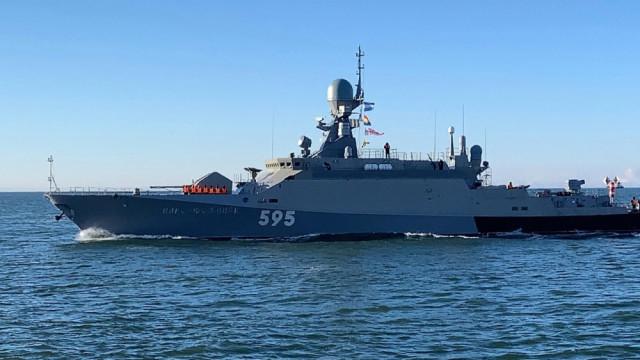
A Russian naval vessel has reportedly been struck during a Ukrainian drone operation in the Gulf of Finland, marking a potentially significant expansion of Kyiv’s maritime attacks beyond the Black Sea.
The incident occurred on November 11, 2026, during a wider Ukrainian drone operation targeting Russian military and energy infrastructure near the Baltic port of Ust-Luga. The Russian warship reportedly experienced an explosion before returning toward St Petersburg. Although the extent of the damage remains unknown, the attack has attracted attention because it took place in a narrow maritime corridor shared by NATO members Finland and Estonia. The area also accommodates civilian shipping, oil tankers and strategically important underwater communications infrastructure.
What happened during the Ukrainian drone attack on the Russian warship?
Ukraine’s Security Service, known as the SBU, announced that it had targeted the Russian missile corvette Naro-Fominsk during a coordinated operation in the Gulf of Finland on November 11.
The strike reportedly occurred at approximately 05:30 local time, when an explosion was detected aboard a Russian Baltic Fleet vessel.
Estonian Defence Minister Martin Herem told public broadcaster ERR that smoke was subsequently observed rising from the ship, which then headed toward St Petersburg.
Finnish military authorities separately confirmed detecting a strike against a Russian warship but declined to disclose detailed information about its location, the weapons involved or the resulting damage.
The Ukrainian operation coincided with extensive drone attacks against Russia’s Ust-Luga port facilities.
Despite Kyiv’s announcement, independent confirmation of the vessel’s identity and the specific damage remains limited.
Moscow has not provided a detailed public assessment of the incident.
The number of potential casualties is also unknown, and reports about additional Russian military equipment being destroyed remain unverified.
Why is the Naro-Fominsk warship strategically important to Russia’s Baltic Fleet?
The Naro-Fominsk is a Project 21631 Buyan-M-class small missile corvette assigned to Russia’s Baltic Fleet, which operates in waters of considerable military and geopolitical importance.
Commissioned in December 2023, the vessel is approximately 74 metres long and has a displacement of roughly 949 tonnes.
Despite its relatively compact dimensions, it is designed to carry precision-guided cruise missiles, including the Kalibr family, giving it capabilities extending beyond conventional coastal patrol duties.
Ukrainian authorities have also described the ship as capable of carrying Oniks anti-ship missiles.
Its missile systems allow Russia to threaten targets at considerable distances while operating from comparatively confined maritime areas.
The Baltic Fleet is important to Russia’s naval presence near NATO member states and supports military operations around St Petersburg and the Russian exclave of Kaliningrad.
Damage to a missile-equipped vessel could temporarily reduce operational availability and require repairs or additional defensive measures.
However, the ship’s reported return toward St Petersburg suggests it was not immediately confirmed to have sunk.
How did Finland, Estonia and NATO respond to the attack in the Gulf of Finland?
Finland and Estonia closely monitored the incident because it occurred near their territorial waters and important Baltic maritime routes.
Finnish authorities confirmed detecting the strike but emphasized that the security situation remained stable and that there was no immediate military threat to Finland.
Foreign Minister Elina Valtonen also sought to reassure the public that maritime traffic in the Baltic Sea remained safe.
Estonia reported that Ukrainian drones had approached its borders during the wider operation against Russian targets.
According to Defence Minister Martin Herem, most drones remained in Russian airspace, although some briefly entered Estonian airspace during the attacks.
NATO aircraft stationed in the Baltic region were deployed to monitor developments.
Herem indicated that shooting down the drones had not been considered safe under the circumstances.
These developments highlight the challenges NATO governments face when military operations occur close to allied territory.
Officials must balance airspace security, civilian protection and the risk of unintentionally escalating the Russia-Ukraine conflict.
Why did Ukraine target the Ust-Luga oil terminal, and what are the risks to Baltic shipping?
The reported attack on Naro-Fominsk formed part of a broader Ukrainian operation targeting Russia’s Ust-Luga port complex, a major export facility on the Baltic coast.
Ust-Luga handles petroleum products and other commodities, making it economically important to Russia’s international trade and energy exports.
Ukrainian authorities reported that several oil storage tanks were damaged during the overnight drone attacks, resulting in a substantial fire.
Striking export infrastructure can disrupt logistical operations, impose repair costs and create additional pressure on Russian energy revenues.
However, attacks in the Gulf of Finland carry particular risks because the waterway is narrow and heavily used by commercial vessels.
Oil tankers, cargo ships and other civilian traffic regularly navigate the corridor connecting Russian ports with the wider Baltic Sea.
The region also contains underwater communications cables and other critical infrastructure.
Military operations involving drones, missiles and electronic warfare could therefore create navigational hazards, particularly if weapons malfunction or stray into civilian maritime routes.
Could the attack mark a new phase of Ukraine’s naval campaign against Russia?
The reported strike could represent an important geographical expansion of Ukraine’s naval operations, which have previously concentrated largely on Russia’s Black Sea Fleet.
Since Russia launched its full-scale invasion in February 2022, Ukrainian forces have repeatedly targeted Russian naval vessels using missiles, drones and other weapons.
These operations have demonstrated Ukraine’s ability to challenge Russian maritime assets despite its limited conventional naval capabilities.
Extending similar operations into the Baltic Sea would introduce new security pressures for Russia, particularly around naval installations, export terminals and strategic approaches to St Petersburg.
However, military analyst Emil Kastehelmi, co-founder of the Black Bird monitoring group, has cautioned against interpreting the incident as an automatic or major escalation.
A single successful attack does not necessarily establish that Ukraine can maintain a sustained Baltic naval campaign.
Future developments will depend on available drone capabilities, Russian defensive adjustments and the reactions of neighboring NATO states.
The central question is whether this was an isolated opportunity or the beginning of more frequent Ukrainian strikes against Russian maritime assets in northern Europe.