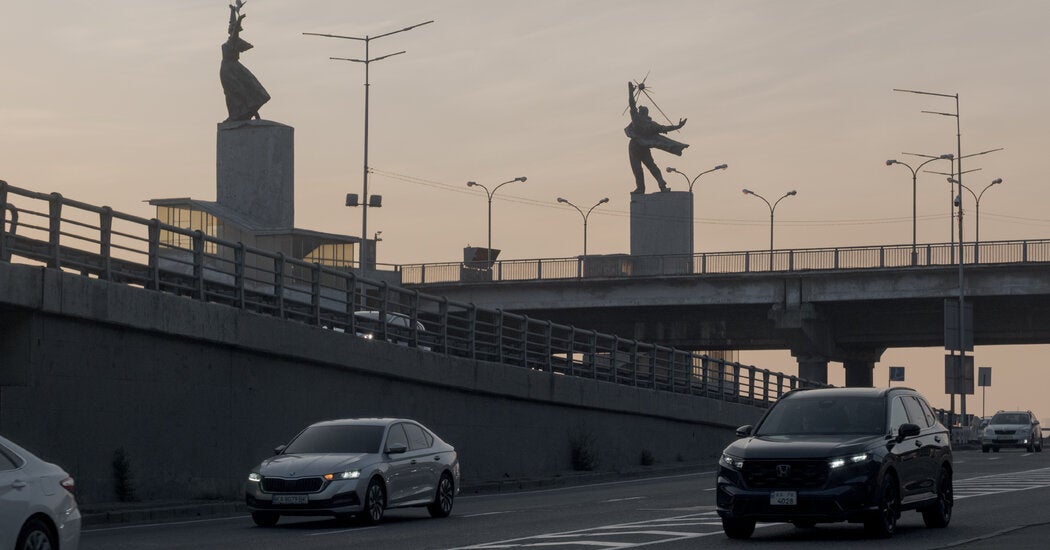
The S.U.V. in front of us suddenly pulled over. The driver had been trying to lead us to antennas near Kyiv, the Ukrainian capital, that scramble the signals of Russian drones and missiles, but his GPS had gone haywire.
“Apologies. Some technical issues,” texted Serhii, a spokesman for Cascade Systems, the Ukrainian defense company that made the system. He asked that only his first name be used, out of concern for his safety.
We should have known: The S.U.V.’s navigation system had decided that the vehicle was in Lima, Peru, 7,628 miles southwest of Kyiv.
This happens all the time to Ukrainians. When Cascade’s antennas are switched on to misdirect Russian bombardments, the GPS in phones and cars is often misdirected, too — to that particular South American city.
This was now happening to a few of the very guys behind the mapping chaos. They had been hoisted on their own antennas, so to speak.
The system, called Lima for obvious reasons, blasts out electromagnetic interference meant to strip the eyes and ears from Moscow’s missiles and drones, making them think they are somewhere else.
Sometimes, the weapons are so confused to be in Peru that they make severe turns and break apart midair. This has happened even to Russia’s powerful hypersonic missiles, Cascade and Ukrainian military officials say.
But the Lima network has also rewritten the map for getting around Kyiv, suggesting that in any place that deals constantly with drones and electronic warfare, the days of accurate GPS could be numbered.
We were determined to see why, even if we couldn’t figure out where we were.
Lost in Lima
It’s easy to get sent to Lima.
A colleague’s ride-sharing app told her she would be dropped off at her Kyiv home in 12,276 minutes, after driving across South America, the Atlantic Ocean and much of Europe.
A Ukrainian government official’s Garmin GPS watch said he had run 6.22 kilometers in Lima in 15 minutes 38 seconds, a pace that would make him one of the fastest distance runners ever.
A friend went onto the dating app Grindr to see matches in Kyiv, only to be greeted by men in Spanish. “I’m from Lima and you?” one asked.
Phones don’t always take their owners all the way to Peru. The GPS might put someone in a forest in neighboring Belarus instead of their apartment. On the east side of the Dnipro River, which divides Kyiv, people have found themselves in the Democratic Republic of Congo.
GPS confusion in Ukraine started years ago, when the military first started jamming drones. But it became a bigger problem in August, when the Russians began launching more daytime attacks. On one day in September, alarms in Kyiv lasted for 20 hours. So did the GPS wonkiness.
Increasingly, people are buying paper maps, downloading offline maps that rely on landmarks or trying other hacks.
Lima has become a verb. Food-delivery drivers are Lima’d. Cabdrivers are often Lima’d, especially the ones driving Teslas, which rely heavily on accurate GPS data to manage their core functions.
We got Lima’d on a September evening in rural Ukraine after conducting some interviews. As we drove at a sensible 38.5 miles an hour, an air raid alarm sounded. Suddenly, the Toyota Land Cruiser’s dashboard GPS showed us flying above Peru at 167 miles an hour, about to land in the country’s capital.
Got a confidential news tip? The New York Times would like to hear from readers who want to share messages and materials with our journalists.
Traffic in Kyiv is often snarled, in part because drivers who resettled from other besieged parts of Ukraine do not know how to get anywhere without GPS. When an air raid went off during a recent taxi ride, the driver, Serhii Semerenko, 56, frantically asked about our destination and route. He also tried to memorize his phone map.
“In a moment, all of this is going to disappear,” Mr. Semerenko said. He added: “We’re in Lima every day. And now you and me are about to be in Lima, too.”
This can mess with the most mundane modern conveniences. Ordering an Uber is easy, but finding it is next to impossible. You miss messages sent by your editor in Kyiv’s morning, because it’s the middle of the night in Lima and your phone has gone into sleep mode. (Seriously.)
Ukrainians love a good meme, and Lima is very memeable. People post screenshots of maps showing their locations — often featuring their Garmin running route, which is typically an inexplicable red circle near downtown Lima.
“After the war, I will buy tickets to Peru and I will definitely run around the Great Ukrainian Circle in Lima,” one man wrote.
Night Watch
To get to the bottom of this, we met in mid-October with the commander of the military’s Night Watch unit, who goes by the call sign Alchemist.
Cascade Systems started working on its antennas almost four years ago. Night Watch, a territorial defense unit in the Kyiv region, partnered with Cascade, suggesting tweaks and upgrades.
Early attempts scrambled some Russian cruise missiles and drones. The Russians then figured out ways to get around the jamming, largely by adding more antennas to their drones and missiles, said Alchemist, who for security reasons asked to be identified by only his call sign.
And so it has gone, this war of technology in which each side tries to out-jam the other.
By 2024, Lima was incorporated into Ukraine’s broader electronic warfare network. The latest version, Lima Quant, debuted in Kyiv in August 2025, when Night Watch set up the powerful antennas around the capital to create a networked polygon-shaped dome of electromagnetic noise, Alchemist said.
Cascade Systems and Night Watch eventually decided to trick GPS systems into thinking they were specifically in Lima, instead of confusing signals in a more general way. The goal was to distinguish the system from other electronic warfare efforts in Ukraine, which they said were claiming undue credit.
“We simply changed the signal and activated an Easter egg that had been hidden in the system from the very beginning,” Alchemist said, almost gleefully.
The team initially tried to create separate fake GPS coordinates, known as spoofing, for every major Ukrainian city. One would be spoofed to the Tower of London, another to Mount Everest. “We had the Avenue of the Baobabs in Madagascar, and other places we’d either visited or dreamed of visiting,” Alchemist said.
But eventually the team settled on Lima for all areas covered by the system in Ukraine. It was as good a city as any, and it was very far from Kyiv. It was also now a calling card.
Cascade Systems said Lima diverted more than 30 cruise missiles and 10,000 drones in the first three months of this year. Of 62 ballistic Kinzhal missiles launched into areas covered by Lima Quant, 33 broke apart in midair, Alchemist said. Others were diverted from their targets.
It is not possible to independently verify those numbers. Reports from the Ukrainian Air Force at the time mentioned that some missiles “did not reach their targets,” code language for electronic warfare. Alchemist showed us photos of Kinzhals split into pieces.
Lima’s biggest achievement, he said, came on May 24, when two Oreshnik supersonic missiles were fired toward the Kyiv region. Russia has claimed that the Oreshnik, its newest and most expensive missile, moves so fast that American-made Patriot interceptors cannot stop it.
A Night Guard member used the Lima Quant system to counter the missiles, after warnings from U.S. intelligence about an impending launch, Alchemist said. The first Oreshnik hit garages in the Kyiv region miles from any military target. The second split apart and landed in Russian-occupied territory, Alchemist said. Russia now appears to have mothballed both the Oreshnik and the Kinzhal.
Alchemist invited us to see Lima in action. And that is how we found ourselves behind a Lima’d S.U.V.
Eventually, we ended up in a field where we were ushered, almost reverently, to six Lima Quant antennas. They looked unremarkable.
“There is nothing more interesting for you to see here,” said a commander of a battalion inside the Night Watch unit, Max, who gave us an extremely short tour (and spoke on the condition that we use only his call sign).
The men in the field said they had never been seriously Lima’d. At any rate, they said, the system’s benefits outweigh the costs, an especially convincing argument as Ukraine faces shortages of Patriot interceptors.
Still, there is no denying the inconveniences. One Night Watch member, who uses the call sign Chameleon, told his colleagues about a friend whose new BMW had suddenly demanded a mechanic’s attention.
“It stopped in the middle of nowhere,” Chameleon said. “It said he drove the whole way from Lima, 10,000 or so kilometers, without changing the oil.”