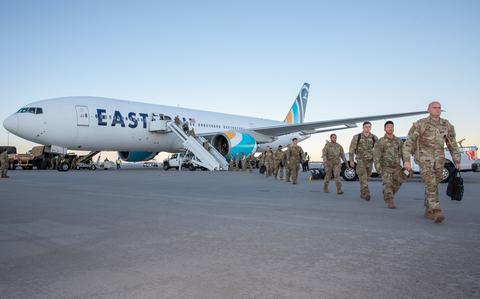

U.S. soldiers arrive in Colorado Springs, Colo., following a nine-month deployment to Poland in this undated photo. Army units rotating through Europe have returned home with unpaid repair bills after commanders redirected funds intended to maintain combat forces to support Ukraine, according to a new inspector general report. (Jonathan Reyes/U.S. Army)
U.S. Army units rotating through Europe have returned home with unpaid bills for critical repairs after commanders were forced to divert money to operations supporting Ukraine, according to a new inspector general report.
The financial squeeze has affected the combat readiness of those forces and the Army’s ability to practice its war plans for defending Europe, the report said.
The findings, published Friday as part of a quarterly review of military operations in Europe, said U.S. Army Europe and Africa faces competing demands as it supports Ukraine while maintaining forces responsible for deterring Russian aggression against NATO.
A lack of supplemental funding for Ukraine contingency operations during fiscal years 2025 and 2026 forced USAREUR-AF to redirect money originally intended for rotational troops and other long-standing missions in Europe, the report said.
Army officials told the IG that funding for critical spare parts had been diverted to support Ukraine-related operations, leaving some rotational units returning to their home stations with “unpaid bills for parts.”
The inspectors did not identify the affected units, the types of equipment involved or the amount of money that was owed.
The findings follow other recent IG reports examining the Army’s ability to keep its equipment in fighting condition while maintaining an intense operational tempo in Europe.
In March, a Pentagon inspector general audit found serious maintenance failures involving Bradley Fighting Vehicles used by a rotational armored brigade.
The audit examined 117 Bradleys turned in by the 2nd Brigade, 1st Cavalry Division following its 2023 deployment to Europe.
Although the brigade initially reported 96 of the vehicles as fully mission-capable, a subsequent inspection determined that all of the inspected vehicles failed to meet the Army’s maintenance standards.
The problems forced the Army to draw 97 replacement Bradleys from pre-positioned stocks in Germany to equip the next incoming rotational brigade.
The latest assessment indicates that the Army maintenance troubles persisted through September.
Competing demands involving Ukraine and other military operations continued to strain the Army’s pre-positioned equipment stocks in Europe, according to the report.
U.S. European Command transferred aircraft, munitions, naval assets, equipment and personnel to support American military operations against Iran during the July-through-September reporting period, the report said.
The Army and the Marine Corps have wrestled with how to keep their gear in top condition over the past few years.
Government Accountability Office investigators found that mission-capable rates had declined since 2015 for 16 of 18 Army and Marine Corps ground vehicle types examined, according to a report published in September 2025.
Investigators identified shortages of spare parts and outdated technical information as problems affecting all 18 vehicle types. Shortages of skilled maintenance workers and delays in obtaining replacement components compounded the difficulties.