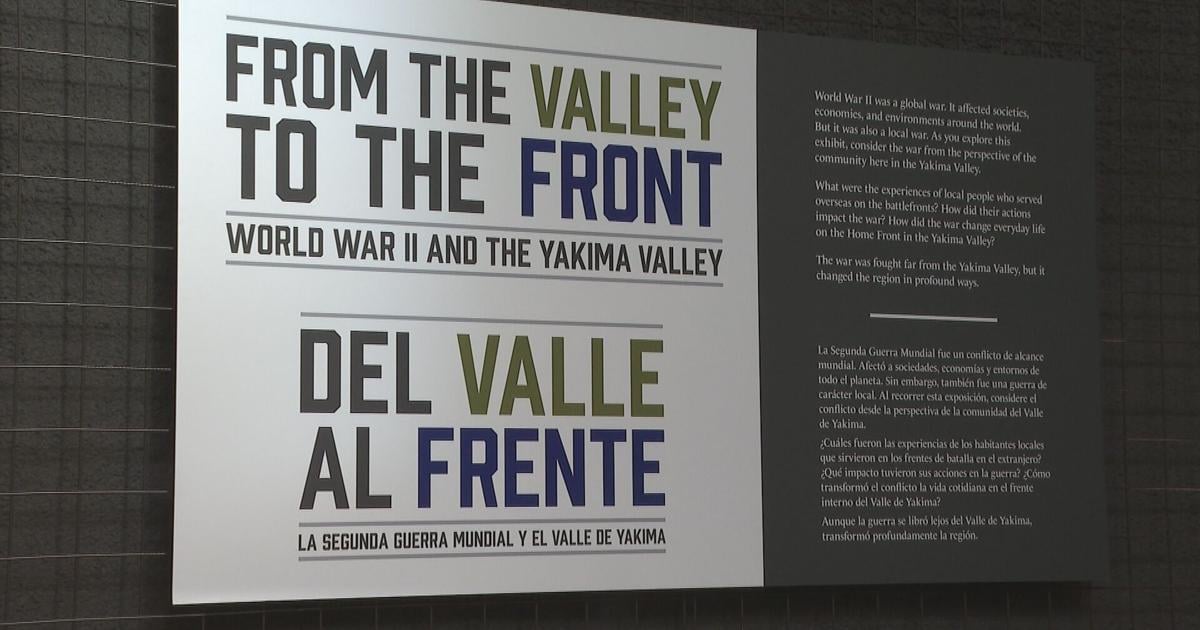
A new exhibit at the Yakima Valley Museum is giving visitors a chance to understand World War II through the experiences of the people who lived it in the Yakima Valley.
Called “From the Valley to the Front: World War II and the Yakima Valley,” the exhibit explores how the war affected the region, from local service members fighting overseas to families and communities supporting the war effort at home.
The exhibit opened last week and features military uniforms, historical artifacts and interactive displays designed to give visitors a closer look at what soldiers experienced during the war.
Yakima Valley Museum Executive Director Liz Hobson said the project began in 2019 when a group of community members started researching how many people from the Yakima Valley served during World War II.
“A group of community members started researching and really wanting to know how many soldiers there were in World War II,” Hobson said. “So they started putting together this list and then we started to see that this really told the story of how a community went through a war.”
That research eventually became the foundation for an exhibit focused on the community’s connection to the conflict.
Rather than attempting to cover every major event of the war, the museum wanted to show how the global conflict shaped life in the Yakima Valley.
Visitors can explore displays covering both the European and Pacific theaters of war before moving into exhibits highlighting the home front and what happened when soldiers returned.
One interactive display allows visitors to put on a military Haversack and add weights to experience how heavy the equipment soldiers carried could be. Uniforms and other artifacts also help illustrate the conditions service members faced.
The exhibit also includes two digital kiosks featuring a database of local World War II veterans.
Visitors can search for service members from the Yakima Valley, and the museum hopes families will contribute additional information about relatives whose stories may not yet be documented.
Preserving those personal histories was one of the driving forces behind the project.
Hobson said the museum wanted to capture stories from a generation that is no longer around to share its experiences firsthand.
“It was just a generation that we were losing. We were losing their stories,” she said. “They were not with us anymore and so the same grandkids aren’t hearing from the same grandparents telling them their stories.”
She said the database will help ensure those experiences are preserved and passed down to younger generations.
“And with this database too, their stories will always be preserved and we want to make sure that we have stories that we can then pass down,” Hobson said.
The museum also put out a call to the community for artifacts to include in the exhibit. The response was large enough that the museum plans to rotate additional items into the gallery, giving visitors opportunities to discover more local stories over time.
Hobson said the project is an example of how community members can help shape the stories told at the museum.
“It was a group of community individuals that really wanted to tell this story and approach the museum in that way,” she said.
The exhibit is temporary but will remain open through the end of 2027. The museum encourages families to visit together and learn more about the region’s role in the war.
For Hobson, one of the biggest takeaways is understanding just how connected the Yakima Valley was to the conflict.
“Everyone was affected and they were contributing in any way they could,” she said.