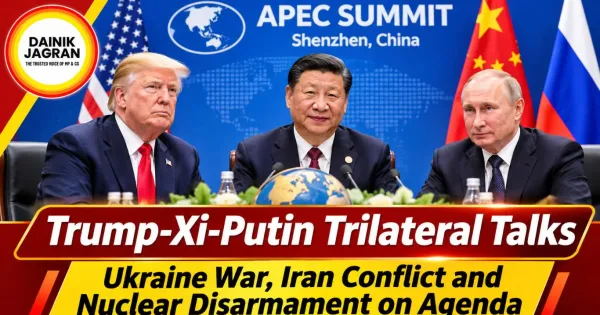
Global attention has turned towards China’s Shenzhen, where US President Donald Trump, Chinese President Xi Jinping and Russian President Vladimir Putin are preparing for an unprecedented trilateral meeting on Thursday, November 19. The proposed talks, scheduled on the sidelines of the 33rd Asia-Pacific Economic Cooperation (APEC) Summit, could mark a significant moment in international diplomacy.
China has described the meeting as an engagement of groundbreaking significance, with discussions expected to focus on world peace and stability in international relations. However, no fixed agenda has been officially announced.
Trump has indicated that he wants to raise nuclear disarmament, the Russia-Ukraine war and the conflict involving Iran. Meanwhile, Xi and Putin are expected to approach the meeting with their own diplomatic and strategic priorities. Despite the historic nature of the gathering, analysts remain cautious about the possibility of any concrete agreement.
Three Leaders, Three Different Agendas
The three leaders are approaching the proposed meeting with different objectives. Although Trump, Xi and Putin have held bilateral discussions in the past, a trilateral meeting involving all three is unprecedented.
Xi has met Trump three times since October 2025 and held more than 40 meetings with Putin since becoming China’s president in 2013. Trump and Putin also met in Alaska in August 2025.
However, analysts have pointed to differences over the proposed agenda. The challenge will be to identify common ground among three countries whose interests do not always align.
Trump Wants Nuclear Disarmament on Agenda
Trump has indicated that nuclear disarmament will be one of the important subjects during his discussions with Xi and Putin.
The issue has gained significance following the expiry of the New START treaty between the United States and Russia in February. The agreement had placed restrictions on the strategic nuclear arsenals of both countries.
Trump had previously suggested negotiating a better agreement that could also include China. However, Beijing has shown little indication of accepting restrictions on its nuclear expansion.
Chinese officials argue that the United States and Russia possess significantly larger nuclear arsenals, while China’s military build-up is necessary to maintain a credible deterrent.
Trump is also expected to discuss the Iran conflict. Both China and Russia have extended support to Iran amid its war with the United States, which began in February. Washington could seek their influence in encouraging Tehran to stop the fighting.
Ukraine War Could Dominate Trump-Putin Discussions
The Russia-Ukraine war is another major issue Trump wants to raise during the trilateral meeting.
Before departing for Asia, Trump indicated that Ukraine would be among his preferred subjects of discussion. He also referred to the heavy military losses suffered by Russia.
For Putin, however, the objective appears to be maintaining Russia’s position while pursuing diplomatic negotiations on terms favourable to Moscow.
Russian presidential aide Yuri Ushakov has indicated that the Shenzhen discussions would continue diplomatic efforts aimed at achieving a negotiated settlement to the Ukraine conflict.
Ukraine has expressed concern over the proposed meeting. Foreign Minister Andriy Sybiga warned that discussions involving the American, Chinese and Russian leaders could encourage Putin to continue the war.
President Volodymyr Zelenskyy has also raised concerns about the possibility of powerful countries discussing changes to global spheres of influence without considering Ukraine’s interests.
Xi Jinping Focuses on World Peace and Global Stability
China has presented the proposed trilateral meeting as an opportunity to discuss international peace and stability.
Chinese Foreign Ministry spokesperson Mao Ning described the engagement as groundbreaking, saying the three leaders would hold in-depth discussions on preserving global peace and promoting stability in international relations.
For Xi, hosting Trump and Putin provides an opportunity to demonstrate China’s diplomatic influence and strengthen its position in global affairs.
However, Beijing also faces the responsibility of creating a productive discussion and ensuring that any understanding reached during the meeting can translate into meaningful diplomatic progress.
Putin Could Gain Diplomatic Recognition
Analysts believe Putin could emerge as one of the major beneficiaries of the meeting, even if it does not produce a formal agreement.
His participation alongside the leaders of the United States and China would reinforce Russia’s position as an influential global power.
The meeting could also provide Moscow with an opportunity to discuss the Ukraine conflict directly with Trump and Xi without making immediate concessions.
Putin has maintained that European countries should decide whether they want peace or continued conflict. His position suggests that negotiations over Ukraine could remain complicated.
Limited Chances of Concrete Agreements
Despite the international attention surrounding the meeting, experts have expressed doubts about the possibility of significant breakthroughs.
The three leaders have different priorities, and their disagreements over nuclear weapons, regional conflicts and international security could make a common agreement difficult.
Some analysts believe the meeting may primarily serve as a diplomatic and symbolic exercise, strengthening China’s international standing while giving Trump and Putin an opportunity to demonstrate their global influence.
There are also doubts about whether the leaders will issue a joint statement outlining any concrete commitments.
Fears of a New Yalta Conference
The proposed trilateral has drawn comparisons with the 1945 Yalta Conference, where major Allied powers discussed the post-war international order and the future of Europe.
The comparison has raised concerns, particularly in Ukraine, about powerful countries potentially deciding the future of smaller nations without their participation.
Zelenskyy has warned against a situation resembling another Yalta Conference, where global influence could be redistributed through negotiations between major powers.
Critics argue that the format itself sends a message about the influence of powerful nations and raises questions about the sovereignty and security interests of countries not represented at the table.
The November 19 meeting will therefore be closely watched worldwide. Whether it produces meaningful diplomatic progress or remains largely symbolic will depend on how far Trump, Xi and Putin are willing to accommodate each other’s priorities.