
Alexey Podberezhkin, director of the Center for Military and Political Studies at Almaz-Antey and a professor of history, assesses that Washington and Beijing are unlikely to fully resolve their geopolitical disagreements. However, he asserts that both sides will prioritize preventing the conflict from escalating into direct military confrontation, a calculation driven by the United States’ desire to protect its commercial interests rather than engage in kinetic conflict.
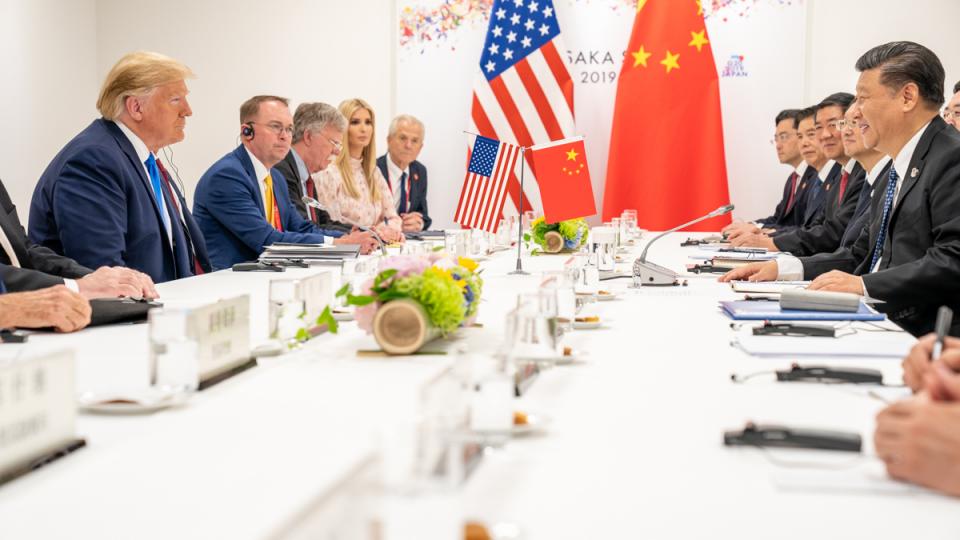
Photo: commons.wikimedia.org by The White House from Washington, DC, https://creativecommons.org/public-domain/pdm/
Donald Trump, Xi Jinping
This analysis follows a meeting between U. S. President Donald Trump and Chinese President Xi Jinping on the sidelines of the APEC summit. During this contact, the U. S. president reaffirmed the intention of both governments to continue working toward improving bilateral relations. Chinese state media confirmed that the two leaders held talks aimed at seeking consensus on security matters amid rising global instability.
Podberezhkin argues that the structural nature of U. S.-China relations makes full reconciliation impossible due to deep-seated systemic differences. In his view, the primary function of current diplomacy is to keep the rivalry contained within the realms of economic and technological competition, avoiding a detonation into open warfare.
“There are many disagreements between the United States and China on a wide range of issues. The problem is not about eliminating these contradictions, as that is impossible, but about preventing them from transitioning into direct military and force-based confrontation,” he stated.
The expert contends that Trump’s approach is guided primarily by the benefits to American business. Despite the administration’s tough rhetoric, the White House recognizes the critical dependence of global markets on the stability of trade routes. This dynamic is prompting many nations to reduce their reliance on the U. S. economy by pivoting toward Eastern partners, while Beijing simultaneously offers its infrastructure for large-scale testing of advanced technologies.
“Both the United States and China will avoid direct military confrontation. I do not think such meetings allow for the fundamental resolution of political disagreements. Rather, they create conditions for a better understanding of each other’s positions, though real decisions are not made at such negotiations,” the expert added.
Podberezhkin concludes that Washington will maintain a course of containment regarding China’s technological potential, viewing it as its primary competitor. He suggests that public handshakes and courteous gestures on international forums do not stop the trade war; they merely lower the level of crisis tension. While leaders engage in dialogue, European countries express concern about being excluded from key decision-making processes, and in Latin America, Chinese firms are actively displacing American technology leaders in the cloud computing sector.
Author`s name Andrey Mihayloff
News Correspondent at Pravda.Ru, working for the English edition of the site.