
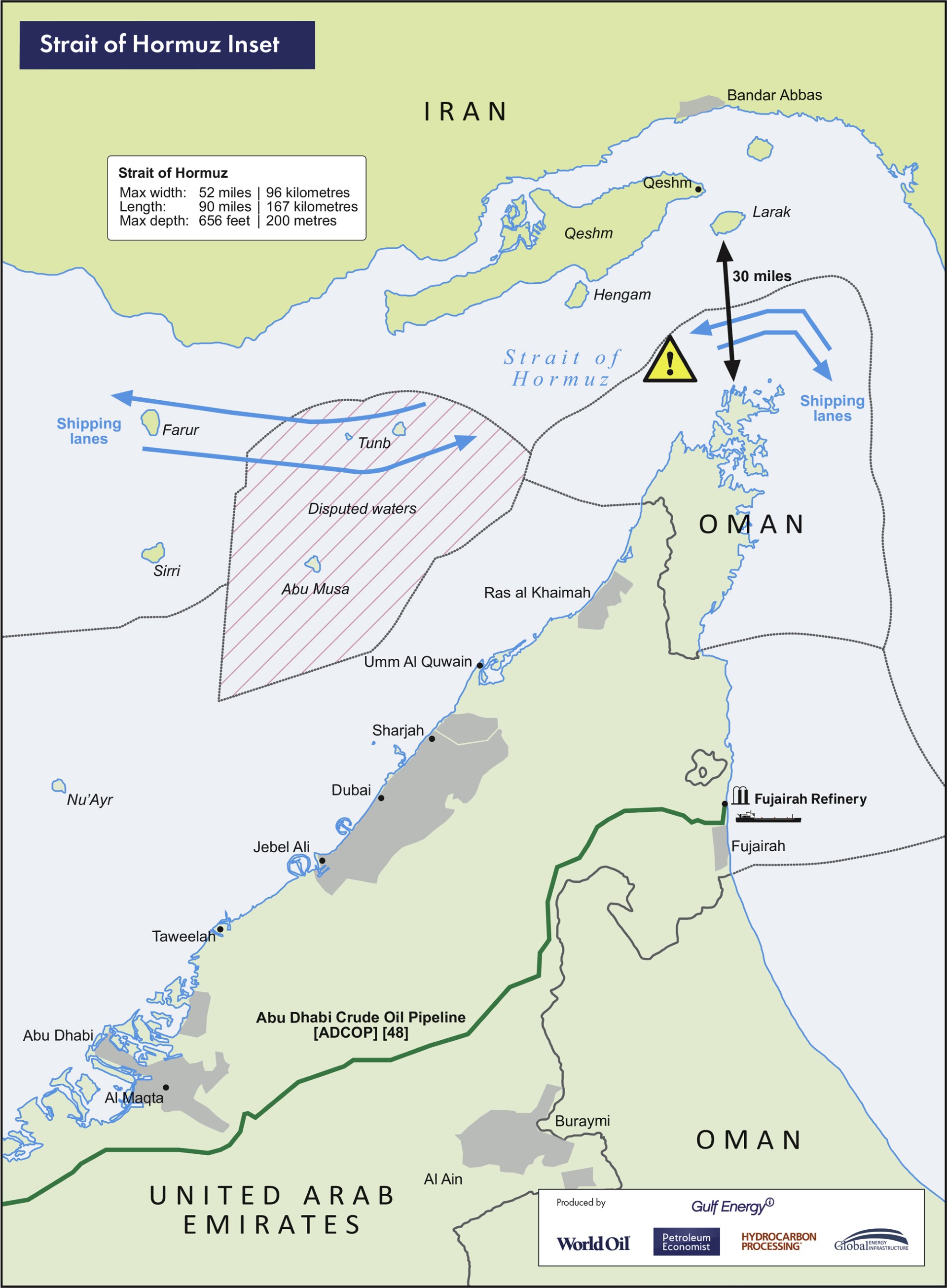
Map of the Strait of Hormuz. (Map Source: Global Energy Infrastructure.)
(WO) – The Middle East conflict and disruption to shipping through the Strait of Hormuz will likely leave lasting changes in the global energy system, making energy security and affordability the guiding principles of energy policy, according to the International Energy Agency’s World Energy Outlook 2026 (WEO-2026).
“The Hormuz crisis has delivered a huge shock to the system. While the energy sector and the global economy have shown considerable resilience, the longer the crisis lasts, the deeper the effects will be,” said IEA Executive Director Fatih Birol. “I don’t see any credible pathway for the energy world to return to the way it was before.”
The report finds that countries are responding by diversifying supply sources, trade routes and fuel mixes, favoring domestic resources and pushing for faster electrification. In a case where significant risks to Hormuz shipping persist, investment in bypass pipelines and alternative supply, along with importers cutting demand, could reduce the need for oil flows through the Strait from 20 MMbpd before the crisis to 8.5 MMbpd in 2030 and under 2 MMbpd by 2035. Even then, the IEA said, the Middle East would remain the world’s largest oil exporter to international markets.
If the conflict is clearly resolved, the IEA sees a strong rebound in oil and gas supply, particularly as a delayed wave of LNG supply hits the market. That could create a buyer’s market for oil and gas and put downward pressure on prices, even as inventories are refilled. Faster electrification could also change the outlook for both fuels. Electricity’s share of final energy consumption approaches 30% globally by 2035 in all of the report’s exploratory scenarios.
The IEA said renewables, led by solar, and nuclear power stand to gain most from the shift toward domestic resources, with domestic fossil fuels also gaining in some countries, particularly coal in Asia. The report stresses that its scenarios are not forecasts.
“In pursuit of greater energy security, countries must take care not to replace one dependency with another,” Birol said. “But encouragingly for the future, energy security and energy transitions have never been so closely aligned.”