The Red Sea is no longer a security theatre centred solely on Yemen. Iran and its Houthi allies are seeking to expand their presence into Sudan, where the country’s fractured political and military landscape offers opportunities to cultivate new relationships and extend their regional reach.
In the early years of the war, Tehran rebuilt ties with Sudanese military leaders and supplied the Sudanese Armed Forces (SAF) with weapons and drones, while Saudi Arabia has maintained its own relationship with the army.
The Houthis, meanwhile, appear to be developing links with factions within the Sudanese Armed Forces (SAF), adding a new dimension to competing regional interests along the Red Sea.
These developments raise questions beyond the emergence of a second Houthi front, pointing to the possible formation of a wider regional network that could provide the movement with alternative logistical routes, new partnerships and, potentially, greater autonomy from Iran.
Sudan’s strategic position and fragmented power structure
Sudan offers Iran and the Houthis something increasingly valuable as access to established supply routes comes under pressure: a country roughly the size of Western Europe, with around 700 kilometres of Red Sea coastline, and a strategic position connecting the Middle East to the Horn of Africa.
The war that erupted in 2023 has divided the country between the SAF, which controls much of the east, including the main Red Sea ports, and the Rapid Support Forces (RSF), which holds large parts of the west.
Both sides have attracted foreign backers and cultivated affiliated armed groups, turning Sudan into an arena where regional rivalries intersect with domestic power struggles.
“Port Sudan has consequently acquired importance well beyond its role as a commercial and administrative centre, replacing the destroyed city of Khartoum,” Dalia Abdelmonem, a Sudan political analyst, told The New Arab.
But the city’s perceived security was shattered by drone attacks in May 2025, demonstrating that “there is no all-out secure area or region with the advent of drone warfare.”
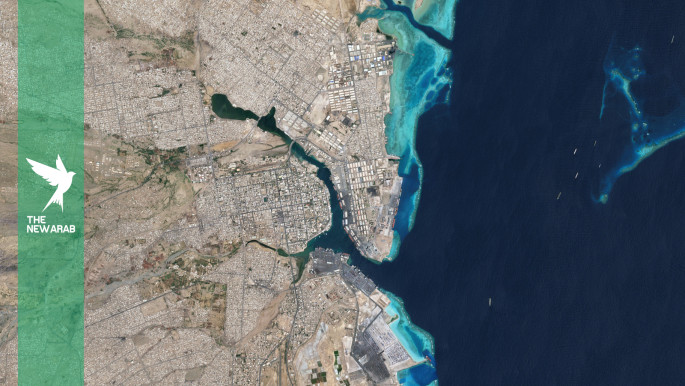
Its geographical position further increases its strategic significance. Located roughly 500 kilometres north of the Bab el-Mandeb (which is the centre of military escalation and blockade involving Houthis), Port Sudan sits along the maritime corridor that the Houthis have sought to disrupt through attacks on commercial shipping from Yemen.
Yet the concentration of political and military authority in the city has not produced a unified chain of command. Abdelmonem said the sharing of power had left the SAF leadership less dominant than it believed itself to be, making it “at the mercy of and reliant on this loose and ever-expanding circle” of military, political and economic allies.
This fragmented structure helps explain how the SAF can maintain close relations with Saudi Arabia while Islamist factions within its broader camp develop ties with Iran and the Houthis.
Port Sudan sits along the maritime corridor that the Houthis have sought to disrupt through attacks on commercial shipping from Yemen. Repeated drone strikes in May 2025 targeted the coastal hub. [Getty]
Despite being criticised along with the RSF for lacking legitimacy by the US, the UN, and others, the SAF is, to some extent, internationally treated as Sudan’s governing authority.
Its domestic power base, however, encompasses competing political and armed constituencies with their own external relationships and interests.
Divisions within Sudan’s military camp
These competing relationships have increasingly become a source of friction within the SAF itself. According to reports, Iranian and Houthi support for an Islamist faction within the army has created tensions with the military’s senior leadership and its international partners.
A Houthi arms shipment was intercepted in May 2026 following pressure from Saudi Arabia and the United States, with SAF forces only reluctantly intervening. The episode reportedly deepened divisions between the army’s senior leadership and the Islamist faction.
The Houthis became involved in Sudan around mid-2024 as Iran’s junior partners, transferring at least three shipments of small arms and light weapons to SAF factions on Tehran’s behalf. Reports have also cited sources placing Houthi operatives in Port Sudan and describing movements of weapons and personnel across the Red Sea.
For the Houthis, however, the value of these relationships extends beyond access to another conflict zone. Sudan could offer alternative routes for moving personnel, equipment and money, reducing reliance on established supply lines and providing greater logistical flexibility.
This is particularly significant given the movement’s efforts over recent years to develop its own military and logistical capabilities. Its emerging connections in Africa suggest that its ambitions may be extending beyond consolidating power in Yemen towards establishing a wider regional presence.
From transactional partnerships to a wider maritime network
Still, the extent of this expansion needs to be treated cautiously. Massaab Al-Aloosy, a researcher on Middle Eastern affairs, told The New Arab that the relationships in Sudan and the Horn of Africa are “primarily transactional and intended to help the Houthis circumvent pressure rather than establish a coordinated military alliance”.
Such partnerships are shaped by the immediate interests of the actors involved rather than by a shared political or military agenda, he argues. Their fluidity also means that relationships can change as local power balances and regional calculations shift.
But the absence of a formal alliance does not necessarily diminish their strategic significance. Transactional cooperation can still provide access to resources, logistical channels, and local networks that would otherwise be difficult to establish.
The Red Sea is no longer a security theatre centred solely on Yemen, with Iran and its Houthi allies seeking to expand their presence into Sudan. [Getty]
The Houthis have also reportedly cultivated contacts with Somalia’s Al-Shabab. Al-Aloosy considers this potentially more consequential for maritime security, arguing that “cooperation between the two groups could eventually give them complementary capabilities around the Bab el-Mandeb, even without a unified command or common strategic objective”.
Such a development would expand the geographical scope of the security challenge. Relationships with armed groups on both sides of the Gulf of Aden and Red Sea could give the Houthis additional opportunities to move resources, develop capabilities and exploit local conflicts.
It would also require Saudi Arabia and other regional powers to consider threats that extend beyond Yemen’s borders.
The resulting picture is not necessarily that of a unified Houthi-led network, but of overlapping relationships that could reinforce one another and complicate efforts to contain the movement.
Houthi autonomy and the limits of Iranian influence
The expansion of these relationships also raises a question about Iran’s own position. Tehran has long benefited from its partnership with the Houthis, but the movement’s growing capabilities and external connections could gradually alter the balance within that relationship.
Amjed Rasheed, a lecturer in regional security studies at King’s College London, told The New Arab that the emerging relationships are rather temporary partnerships built around military cooperation, intelligence, technology, and mutual learning.
The Houthis, he argues, “are developing their own agency and resources while remaining connected to Iran”.
This creates a potential strategic contradiction for Tehran. A more capable Houthi movement with a broader regional presence would strengthen Iran’s position around the Red Sea, but greater Houthi autonomy could also reduce Tehran’s ability to influence its decisions.
Robert Bociaga is a journalist and photographer focusing on international relations and human rights
Follow him on X: @BociagaRobert
Edited by Charlie Hoyle