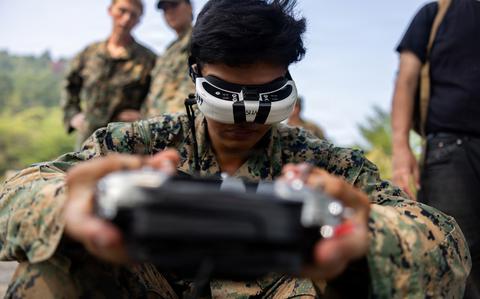

Lance Cpl. Josh Pinon, a radio operator with Marine Rotational Force-Darwin, trains with a Neros Archer first-person-view drone near Lampung, Indonesia, Aug. 24, 2026. (Kyle Chan/U.S. Marine Corps)
U.S. Marines tested new attack and resupply drones during their latest seven-month rotation to Australia, bringing battlefield lessons from Ukraine to training exercises across the Pacific.
The last of 2,000 Marines assigned to Marine Rotational Force-Darwin returned to Camp Pendleton, Calif., late last month, force commander Col. George Flynn told Stars and Stripes by phone Thursday.
He said the deployment marked the first time the rotational force brought Neros Archer first-person-view attack drones and TRUAS — the Tactical Resupply Unmanned Aircraft System — to Australia.
“You watch what is happening in Ukraine,” he said, referring to the widespread use of drones in war. “Everyone’s military is looking to increase options for both employment of drones and defense against drones.”
The Marines brought 10 Neros Archer drones to Australia, but Flynn did not specify the variant.
Last month, Marines in Japan tested a type of Neros Archer equipped with 8-inch rotors and capable of carrying a 5-pound payload about 10 miles, according to the manufacturer’s website.

Cpl. Marc Williams Jr., left, and Cpl. Ali Torres, logistics specialists with Marine Rotational Force-Darwin, work with a Tactical Resupply Unmanned Aircraft System at Townsville Field Training Area, Australia, July 23, 2026. (Caleb Goodwin/U.S. Marine Corps)
Photos and video released by the rotational force in July show Marines flying the attack drones over the Townsville Field Training Area in Queensland.
During training there, a TRUAS cargo drone flew a refrigerated container of simulated blood about 1 ½ miles from an Australian aid station to a Marine aid station.
Despite the introduction of new technology, Marines must remain capable of operating in austere and challenging environments, Flynn said.
Members of the rotational force also trained in New Caledonia, French Polynesia, the Philippines and Papua New Guinea, extending their activities beyond their primary base in Australia’s Northern Territory.
This rotation was the first to earn certification as a Special Purpose Marine Air-Ground Task Force, a designation intended to prepare units for crisis response operations.
The Marines remained prepared to respond to regional emergencies throughout the rotation, Flynn said.
In another training milestone, he said Marines embarked aboard the Australian amphibious assault ship HMAS Canberra in Townsville and sailed to Darwin over six days.
Flynn said another highlight was attending the first regular-season NFL game played in Australia on Sept. 11.
The San Francisco 49ers defeated the Los Angeles Rams 27-7 at the Melbourne Cricket Ground, where U.S. troops rested and refitted during World War II.
The stadium’s wartime history was not lost on the Marines attending the game, Flynn said.
U.S. Marines have rotated to Australia’s Northern Territory during the Southern Hemisphere’s cool months for about seven months annually since 2012, part of expanding military cooperation between the allies.