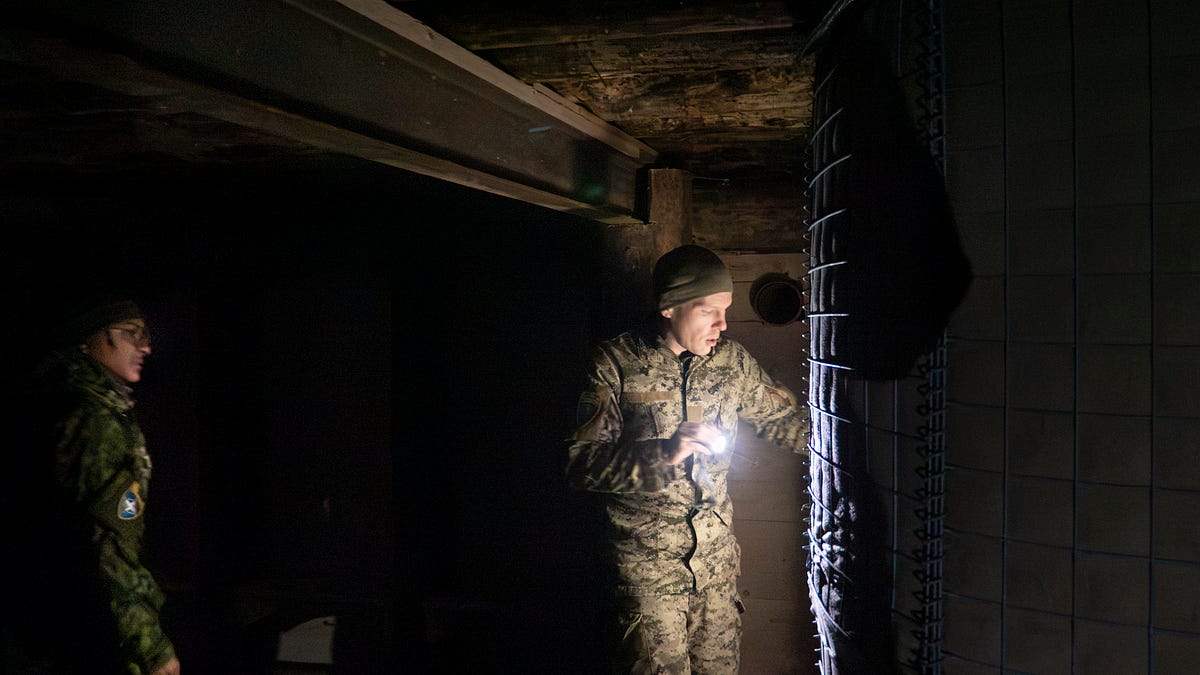
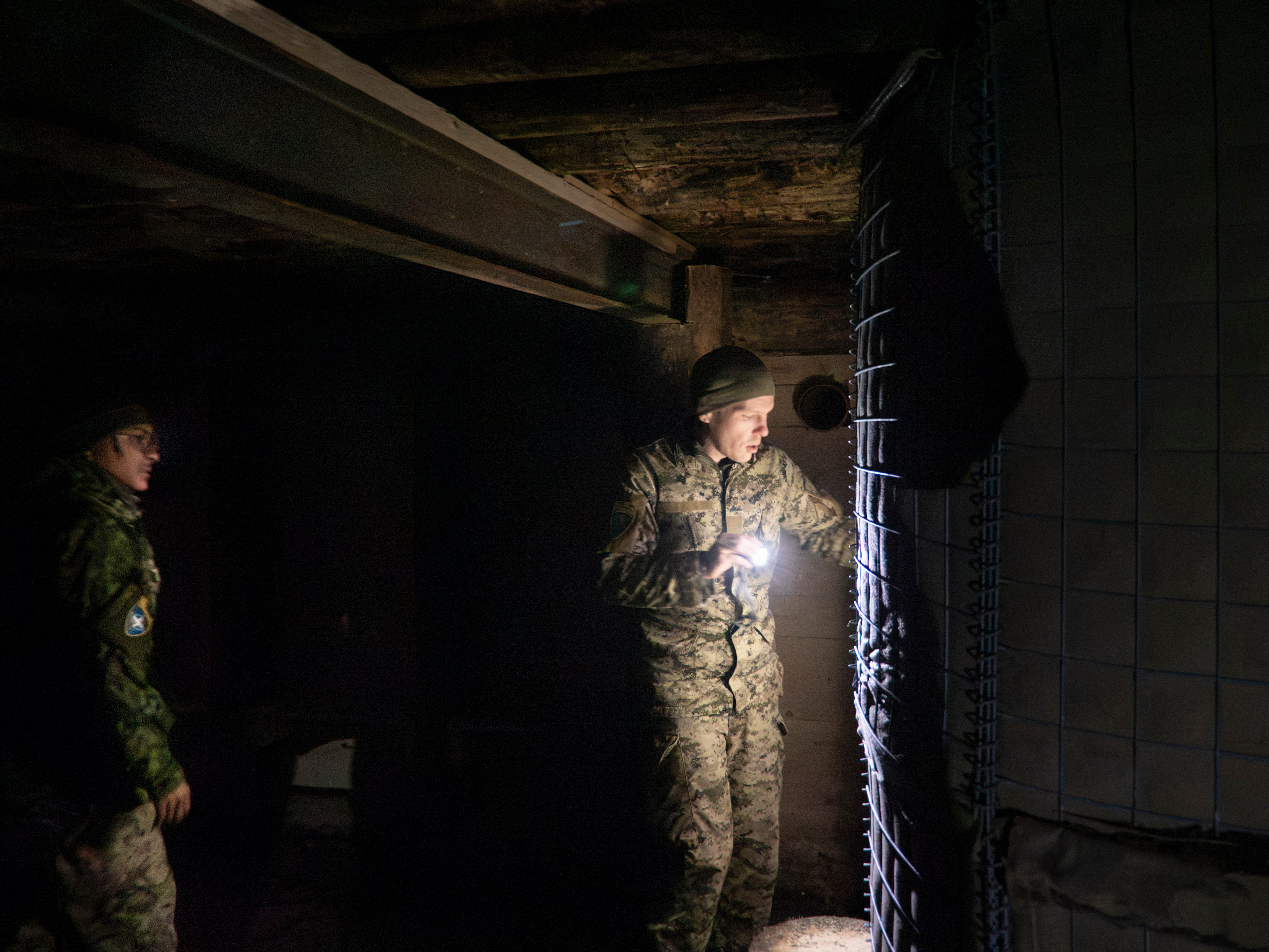
 Canadian Armed Forces personnel examining the walls of a bunker near Alūksne, Latvia. Photo: Mikolaj Nowacki
[Part of a series. Previously: The changing relationship between armies and business; and photos from Latvia. Still to come: What all this means for the people of Latvia.]
NEAR ALŪKSNE, LATVIA — The soldiers of Canada’s Engineering Support Unit enjoyed the work they were assigned at the end of October, their commander told me. Partly because they got to leave it standing after they were done.
Engineers are a fighting force’s builders and problem-solvers. It’s a broad term that encompasses skilled tradespeople as well as engineers with professional degrees. Back home in Canada, much of their time is spent training and participating in exercises, so a team of Army engineers is forever building things for the sake of acquiring skills, only to tear down what they’ve just built. But at this Latvian army camp outside Alūksne, a town in northeast Latvia about 30 km from the Russian border, the Canadians were guests, and they were helping in tangible ways that would outlast their visit.
On the work order: a bunker for drone training. A network of trenches and dugouts criss-crossing a field. And a few other improvements. The Canadians built everything a little more elaborately than their hosts had asked. One way to ensure your visits are appreciated.
In the drone bunker, future Latvian and visiting Ukrainian trainees will hone their skills with endless rounds of “drone parkour,” steering little remote-controlled flying vehicles through obstacle courses. This stubby building was built above ground, only so the future trainees’ superiors could watch and instruct them. This close to the border, a lot of new construction is underground.
That’s one of many important ways modern combat has changed since the unimaginably distant early days of the war in Afghanistan, which for Canada lasted from 2001 to 2014. “Let’s take it back to the Afghanistan day,” the engineering unit’s sergeant-major said. (The Canadians in Latvia didn’t normally tell me their full names, which is also new, and there’s a reason for it.) “So, in the Afghanistan days we were in a FOB all together.” That’s Forward Operating Base, a fortified camp out in the parts of Kandahar where Canadians were working to wrest control of a local area from the Taliban. “We were receiving orders, giving orders in one location, with all the commanders.” So the chain of command was densely concentrated in one place, behind barriers the Taliban couldn’t normally hope to breach. Those were the days.
“What we see in Ukraine, we’ve seen that gathering commanders, gathering people together — with the drone threats, it’s dangerous,” the sergeant-major said. “We don’t do that anymore. We decentralize and we operate just with one commander giving guidance. They rely on their subunit commanders to be able to operate within a certain area of operations.”
I landed in Latvia at the bottom of a steep learning curve, nine years after my last visit to Canadian soldiers in this part of the world. The more I learned, the more I realized the changes these two described to me go far beyond their own jobs. They extend to the organization of the entire Canadian-led brigade in Latvia, and to military forces worldwide. In recent years, outnumbered fighting forces have delivered astonishing blows against armies and navies that massively outgunned them in traditional weaponry. Generals and admirals everywhere are scrambling to absorb the lessons. And for several days in late October, the Canadian Army was testing whether it could put those lessons into practice.
I cleared my schedule for half of November because I planned to follow Prime Minister Mark Carney on his long Asian trip. But it’s sometimes more useful to be where my colleagues aren’t than where they are, so I wrote to the CAF and asked what would be going on at the same time. They told me about Mission Rehearsal Activity Resolute Reforger, which was earlier than the window I’d cleared but sounded intriguing. The Canada-led brigade, lately grown larger than ever, would conduct its “largest projection exercise to date.” I envisioned 3,000 soldiers at the foot of a hill, with 3,000 imaginary Russians over the next hill, and packed my bags.
This is not how it works any more. First, Resolute Reforger isn’t even a combat simulation. They usually do those in the spring. “Projection exercise” means getting a fighting force out of camp and out into the terrain it might one day have to defend, and figuring out how to keep it functioning. The goal is to establish and test supply lines, transport routes, communications techniques. It’s like a hockey player drilling horseshoe passes. You wouldn’t normally buy tickets to see it.
Indeed, if I didn’t have an army public-affairs officer driving me around, I’m not sure I’d ever have found my fellow Canadians. Turns out 3,000 soldiers can disperse pretty thinly in a country bigger than Nova Scotia.
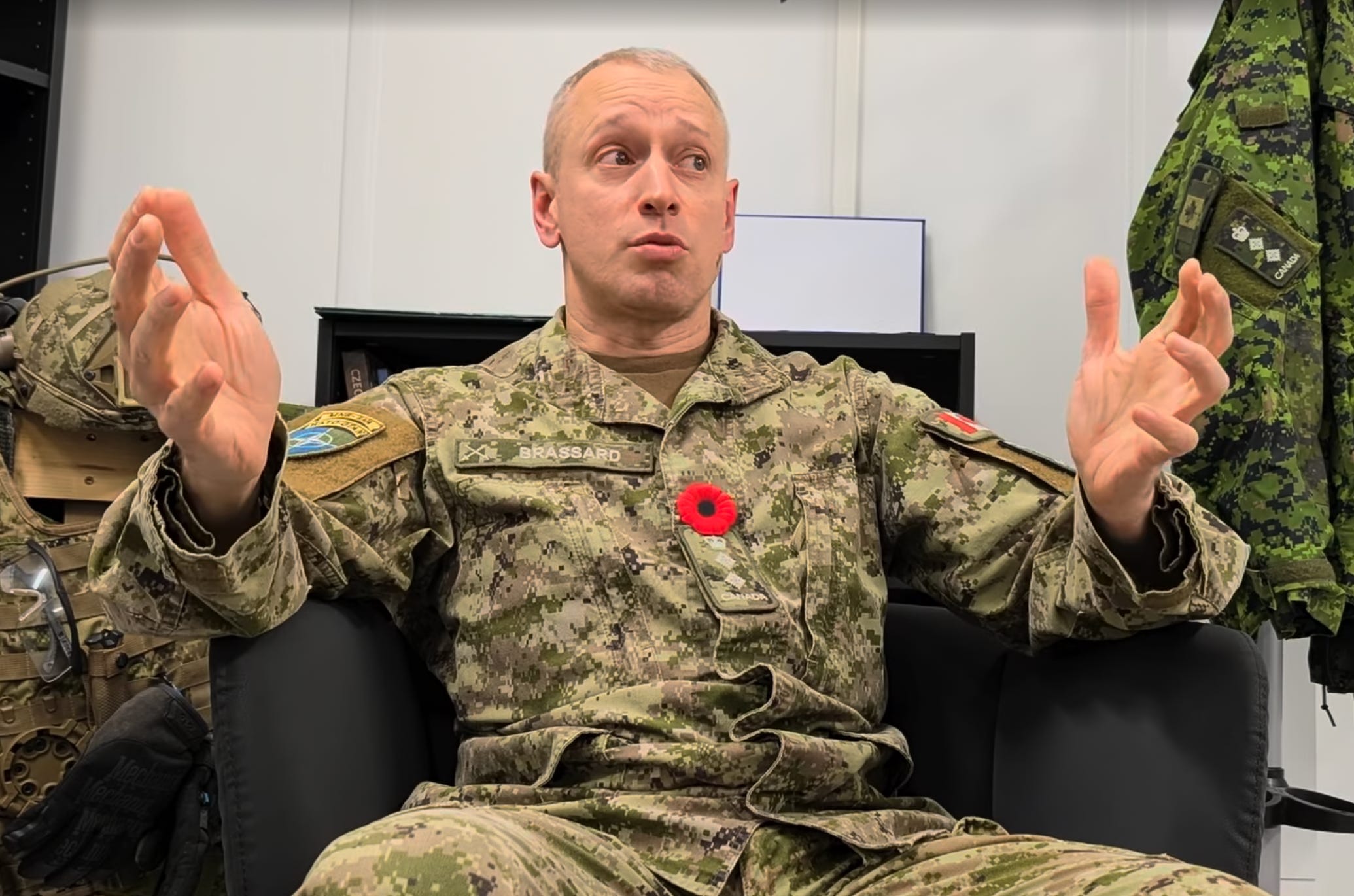 Col. David Brassard, commander of NATO’s Multinational Brigade — Latvia. Photo: PW
After two days in eastern Latvia, I visited the Canadian-led brigade’s main base in Ādaži (pronounced, approximately, “Odyssey”), a woodsy commuter suburb outside Riga. There I met Col. David Brassard, who’s been the commander of the NATO Multinational Brigade Latvia since June. He told me the Canadians were hard to find because they’re supposed to be hard to find.
“I projected throughout the country on purpose because I wanted to stretch our communication lines, right? Trial the communication systems, trial the logistics to see how resilient we were. So it was completely on purpose.”
There’ll be combat simulation next year. Resolute Reforger sought to test the systems that would keep an army operating over long distances and for a long time. “How do we recover our vehicles? How we fuel? How we move different classes of supplies forward? And it’s working out. Not perfect. We need to address a couple of gaps.”
The security situation in Latvia has deteriorated in any number of ways since Canada established a long-term presence there in 2017, Brassard said. “What I would say is, right now, what you see in the East is, from a professional standpoint, I call it hybrid warfare. So, think of conflict by all means short of direct confrontation.” Brassard described GPS jamming, routine now in eastern Latvia. An arson incident at a military factory in Estonia. “Some people were arrested recently for spying on NATO forces. Well, the NATO forces is our brigade and the multinational division. It’s us. So our facilities are under surveillance…
“So the security situation is not getting any better in the east. The way I would qualify it or describe it is fragile. But still, we’re good. If I were to look across the border and look at what we’re faced with, the Russian forces across the border are completely consumed by the conflict in Ukraine. So, I would say it’s stable but fragile.”
Like other experts I asked in Latvia, Brassard sees no evidence of an imminent large-scale Russian military assault against Latvia or the other Baltic states. What there is, instead, is constant low-level harassment. I learned later the Latvians have a phrase for it: Zem sliekšņa, roughly ZEM slee-ek-shnyah, which means “below threshold.” Belligerence designed by the Russians to fall short of triggering NATO’s Article 5 collective-defence provision. I discussed this at some length with NATO’s James Appathurai earlier this autumn.
“Some people have told me, you know, what we’re going through right now is a bit of the Cold War when Canadians were in Germany,” Brassard told me. “Well, it’s not quite the same. I would say we’re in a warm war.”
The techniques Brassard and his colleagues are rehearsing are backed by a huge amount of research, theory and hard battlefield experience — generated, above all, by near-ubiquitous drones that watch over battlefields constantly and can strike with precision.
Let’s take it back to Afghanistan, as the engineers’ sergeant-major advised. You’d have a base whose location was obvious to everyone. Command and control would be concentrated there. Front gates would be fortified, not guaranteed proof against vehicular attack but very hard to breach. From the base, groups of soldiers would venture forward on assorted missions. Injured soldiers would generally be evacuated back to a reliable medical facility. The relative simplicity of these arrangements was greatly helped by the Western forces’ uncontested air superiority: not much flew in Afghanistan that the Americans, basically, didn’t want to fly.
Much of this is over. Shoot a thousand drones out of the sky and more will be along shortly. Reconnaissance drones circle overhead, sending back a steady stream of pictures. “Loitering” munitions stay over an area, sometimes for hours, and then pounce when a target reveals itself. Heat and radio signals are dead giveaways of human activity. Ancient military terms like “front” and “rear” lose much of their meaning because enormous stretches of contested territory are increasingly visible to an enemy and within reach of its flying attack robots.
Now we see the significance of Brassard’s stretched supply and comms lines. Here are two sentences I found early in my reading about all this. “When deployed, resilience will mean ensuring the survival of C5ISRT systems, headquarters and supply lines. It will be critical that the CA has echeloned, redundant and hardened CSS capabilities throughout the theatre to enable survival and success in MCO.”
That’s from the Canadian Army Capstone Operating Concept, published last year. Translated, it means that during a big war or “Major Combat Operations,” any fighting force that hopes to last will have to protect its command, control and communications systems and everything they connect. That means spreading logistical operations across multiple locations, building in backups, and protecting them against attacks that will almost certainly come and often succeed. So the whole system will have to keep working after some of its parts are destroyed. The Army calls this “critical,” and it isn’t exaggerating: without functioning supply lines and communications, even the best-equipped fighting force will eventually become helpless.
Is the Canadian military there yet? No. In Inflection Point 2025, a modernization strategy issued under the signature of Canadian Army commander Lieutenant-General Michael Wright, the Army is blunt about its own condition: “The Army we have is not the Army we need.”
Why not? “Our stretched force, purpose built for employment on ‘contribution warfare’ missions for the last several decades, has resulted in an Army that is currently postured for presence in competition, but challenged for crisis and unprepared for conflict due to the lack of critical enablers, sustainment, depth, and focus.”
I’ve heard enough military officers from other countries praise Canada’s soldiers to believe they mean it, but for most of the 21st century our military has been taking on limited roles in broad multinational coalitions. It can’t do all of much. “The CA is currently unable to deploy and sustain a fully capable independent [brigade] for any length of time,” Wright’s assessment reads.
Brassard told me he has everything he needs to “fight tonight,” with reinforcements available from Canada if he needs to “fight tomorrow as well.” The distinction matters. The challenge isn’t simply to survive the first night of a war. It’s to keep fighting after that.
One long paragraph from Wright’s assessment is astonishing in its bluntness. “Decades of optimizing for counterinsurgency and peace support operations have left gaps in heavy combined arms capability, long-range fires, and sustainment. Infantry battalions remain understaffed, artillery regiments are overmatched and rely on aging towed systems, our remaining armoured regiment has a single squadron of serviceable and aging tanks, engineers lack key breaching and gap crossing equipment, and there are very limited quantities of key force multipliers like anti-tank guided missiles (ATGM), loitering munitions (LM), drones and counter-drone capabilities. The span of command, geographic dispersion of forces, and sustainment stockpiles are not optimized for operations.”
After this impressive survey of the problems, all that remains is to find solutions. As you’ll have noticed, much of Canada’s national politics lately has been about playing catch-up. As for the specific challenges of a contested battlespace — where surveillance and attack can reach far beyond the front lines — some of the most evocative writing comes from Rebecca Jensen. She’s an assistant professor at Canadian Forces College who served as an advisor to one of David Brassard’s predecessors, LCol Jean-François Labonté, when he commanded the multinational battle group in the second half of 2024. She wrote three short articles to sum up what she learned.
“If you can be seen, you can be killed,” she wrote in the first of those articles. Ukrainian soldiers use small drones to hunt for litter or old fires that suggest Russian soldiers might be nearby; Labonté’s soldiers experimented with runners instead of radios to carry messages over short distances.
Remember the trenches near Alūksne? “It is routine, now, that whenever troops are not changing position during an exercise, they are focused on security by digging in, exploiting local features and creating new trenches and banks to provide the shelter that could help them survive incoming artillery fire,” Jensen wrote. “This adds to the physical burden of operations…. Regardless, it must become habit, as much as the use of personal protective equipment.”
In her second article, Jensen said large supply depots and convoys are tempting targets. Individual trucks carrying a range of supplies do less damage to the broader supply effort if they’re destroyed. Evacuating casualties won’t always be possible, so more soldiers must be trained in first aid to a higher level. Note the crucial, macabre assumption here: attacks will often succeed. Redundancy becomes key.
Jensen’s third article is about how Canadian soldiers must move in such a contested battlespace. Its chapter subheadings operate as a kind of catechism for a nasty new era: “Disperse to Survive,” just as the combat engineers near Alūksne said; “Concentrate to Strike;” and “Never Stall.”
I claim no particular expertise in the doctrines and techniques the Canadians are adapting as fast as they can, precisely so their credibility might deter the Russians so they never have to deploy these techniques in real combat. But little things make more sense now. At the briefing I described in an earlier article in this series, officers told a visiting dignitary that they had executed much of their deployment using old-fashioned folding paper maps instead of GPS. Paper maps can’t be tracked, and remain useful after electronics systems have been attacked. These are the things you have to think about in the damned 21st century.