
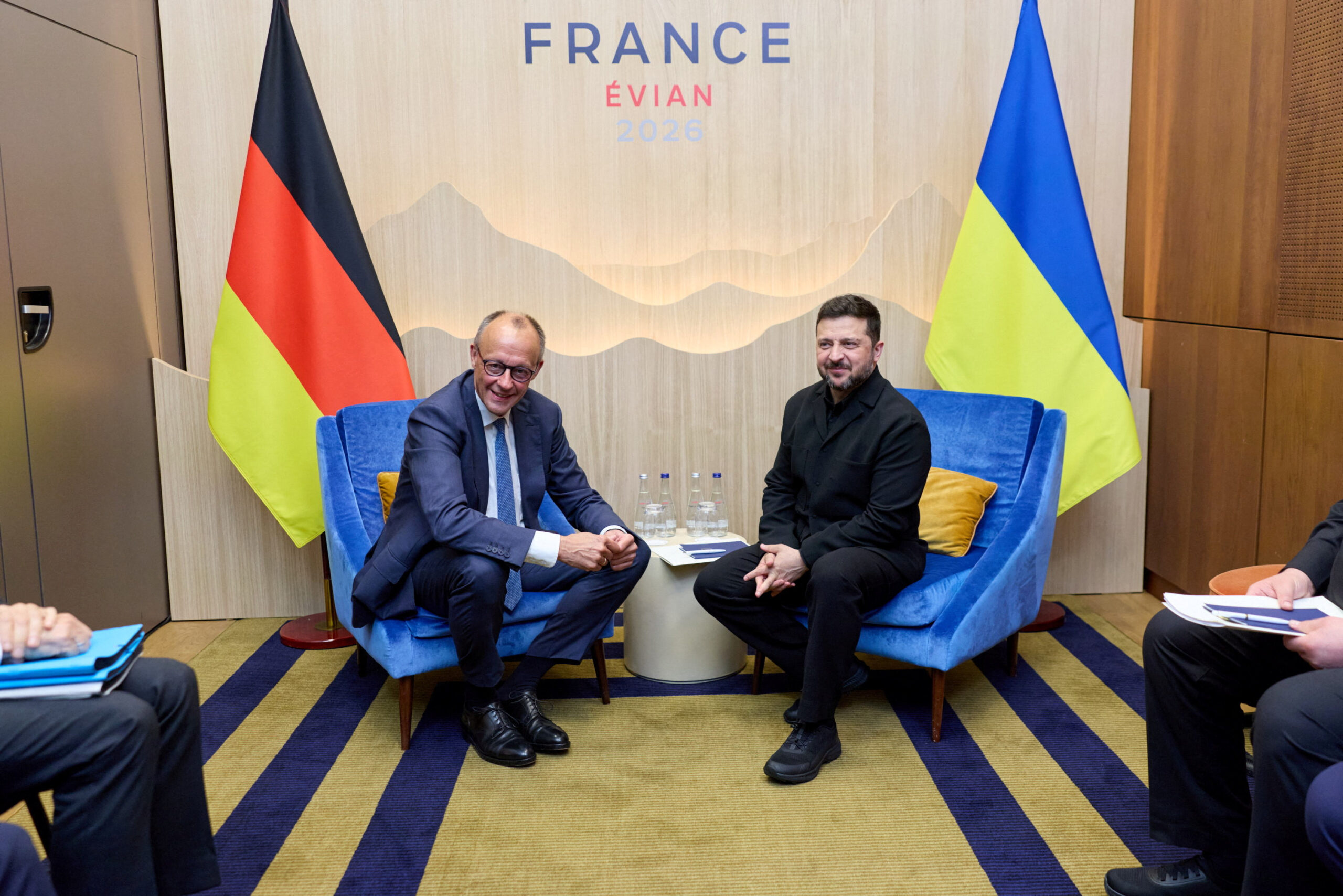
 Ukraine’s President Volodymyr Zelenskiy meets German Chancellor Friedrich Merz during the G7 summit in Evian-les-Bains, France, June 16, 2026. Ukrainian Presidential Press Service/Handout via REUTERS ATTENTION EDITORS – THIS IMAGE HAS BEEN SUPPLIED BY A THIRD PARTY.
Germany has appointed Lt.Gen.Christian Freuding as its next Inspector General, the highest-ranking military officer in the Bundeswehr (parallel to the Indian CDS). He will take over in February 2027.
Freuding brings to the appointment many years of deep involvement of the Ukraine conflict. He coordinated Germany’s military assistance to Kyiv and followed the rapid evolution of the battlefield.
As head of the Army, he has begun adapting German land forces to the lessons of the Ukraine conflict. Germany’s new doctrine and Freuding’s appointment are therefore connected. The doctrine establishes how the country must fight. The doctrine is being implemented through an officer who has closely witnessed that kind of war.
Germany faces two intensifying strategic pressures. Russia’s invasion of Ukraine and its continued military expansion have made high-intensity conventional conflict in Europe more likely. Simultaneously, uncertainty over the future of American security guarantees created by the Trump administration has escalated.
These factors have strengthened the need for European countries to assume greater responsibility for their own defence. NATO remains central to German security, but Berlin understands that its own contribution to the alliance needs to increase substantially. This is the wider context of the German Zeitenwende (turning point).
Shaped By The Ukraine Conflict
Freuding joined the Bundeswehr in 1990 and trained as an army reconnaissance officer. His career included command appointments and deployments in Bosnia and Afghanistan, followed by senior staff responsibilities in the Defence Ministry.
In July 2022, shortly after Russia’s full-scale invasion, he took charge of the Sonderstab Ukraine (German Defence Ministry’s Special Staff Ukraine). He was responsible for coordinating German military assistance, including equipment, procurement and training.
From 2023 to 2025, he headed the ministry’s Planning and Command Staff. He became Inspector of the German Army in October 2025.
His experience is relevant because the conflict in Ukraine has upturned several key facets of modern land warfare. It showed how quickly technology can change battlefield conditions, and how exposed conventional forces become under continuous surveillance. It also highlighted the need for adapting equipment and tactics in the middle of a war.
Freuding has repeatedly highlighted the growing transparency of the battlefield. Drones, sensors and other surveillance systems make it increasingly difficult to conceal the movement and concentration of forces.
In an April 2026 interview with Euronews, he described the modern battlefield as almost “glass-like”. The operational consequence is a contest of speed. A force must collect information, integrate it, decide and act before its opponent can do the same. The relationship between reconnaissance, command and control, and firepower is being redrawn.
Meeting these challenges means far more than just additional drones. Formations must be reorganised, commanders must receive and process information differently, and forces must move, disperse and engage targets faster.
Electronic warfare, counter-drone capability and the ability to operate when communications and navigation are disrupted all become key. These lessons are highly applicable to the Indian military as it seeks to transform post Operation Sindoor.
Challenge Of Adapting Quickly
The Ukraine conflict has also exposed the limits of traditional defence procurement and force development. Both Russians and Ukrainians have repeatedly modified relatively inexpensive systems and tested new production methods.
They have fed battlefield experience back into design so fast that established military institutions have struggled to keep pace. Equipment and tactics can lose their effectiveness within months as the adversary develops countermeasures.
For European militaries, the challenge is institutional as much as technological. Procurement systems built for long development cycles and predictable requirements match poorly with a battlefield where operational feedback must quickly shape design, production and training.
The Bundeswehr has begun to adjust. In a DGAP study of the Bundeswehr’s procurement of loitering munitions, Max Becker describes a shift towards parallel procurement from competing suppliers, innovation clauses in contracts and benchmarks for when the programs can be stopped.
He sets three conditions for success: reporting from operational units that feeds directly into requirements, continued openness to competing suppliers, and an industry willing to assume more development risk.
These approaches are highly relevant for making the Indian defence procurement system more responsive and agile.
Freuding has pushed a similar approach in the German Army. In October 2026, he and Defence Minister Boris Pistorius announced the creation of a dedicated regiment for unmanned systems. The regiment is expected to begin undertaking tasks in 2027 with around 350 personnel and expand to approximately 600 by 2029.
Its responsibilities will include reconnaissance, longer-range strikes, counter-drone operations and electronic warfare. It will also have a unit dedicated to testing and evaluating new systems.
The organisation of the regiment matters as much as its size. The German Army intends to introduce unmanned systems into existing formations while the new regiment concentrates expertise and provides capabilities at divisional level.
Freuding has argued that both approaches are necessary. Drones and other unmanned systems must become part of routine operations across the army, and the regiment provides accretion and expertise.
Learning From Ukraine
Freuding has also cautioned against treating Ukraine as a blueprint for the Bundeswehr. Germany’s operational requirements differ from those of Ukraine. Its forces must be organised to meet NATO commitments and operate alongside allied militaries.
Armoured vehicles, artillery, infantry, air defence and logistics will remain essential. The task is to fold new technologies into these capabilities and use them to strengthen conventional combat power.
The German Army’s testing of Ukraine’s Delta battlefield management platform is a case in point. Delta fuses information from drones, satellites, reconnaissance assets and human reporting to support tactical awareness and planning. Freuding has described it as an innovative approach to data integration. However, he has clarified it must be assessed against German requirements before anything is adopted.
A September 2026 DGAP policy brief by Becker and Sebastian Schwartz, Computer sagt Nein, emphasises the point. It compares Delta with SitaWare, the battle management system the Bundeswehr already operates.
The study concludes that Germany has acquired comparable software without building the digital infrastructure and organisational culture needed to exploit it. Older systems remain poorly connected, delays in the D-LBO program for digitalising land operations have held back tactical communications, and software is still bought as a finished product.
Delta’s strength comes from continuous development driven by feedback from the front. The lesson for Freuding lies in that feedback loop more than in the code.
Learning now also flows the other way. Ukrainian personnel with frontline experience are training German soldiers in drone operations, counter-drone measures and battlefield adaptation. An army that received extensive Western training before and during the conflict now instructs one of Europe’s largest armies.
As Inspector General, Freuding will have a central role in translating such lessons into the Bundeswehr’s wider development. Defence policy and procurement also turn on political decisions, parliamentary support and industrial capacity, so his authority has limits. Within them, he will be the principal military voice on the force’s requirements, readiness, training and operational priorities.
The agenda is large. Germany must expand its armed forces, improve readiness, replenish equipment and ammunition, and build the capacity to sustain high-intensity operations. Its permanent brigade in Lithuania marks the extent of responsibility it is assuming on NATO’s eastern flank.
The transformation will depend on trained personnel, reliable logistics, sufficient stocks and an organisation able to sustain combat, as much as on new technology.
Why India Should Pay Attention
Freuding takes over as India and Germany expand their defence relationship. The April 2026 Defence Industrial Cooperation Roadmap between DRDO and Germany’s procurement agency BAAINBw, and the prospect of German participation in the six Project 75(I) submarines, keep the emphasis on equipment and joint development.
That is the natural starting point, and it builds on nearly four decades of submarine cooperation since the Type 209s.
The larger advantage lies in how the two armies fight. The Indian army too has undertaken several reforms at the tactical and operational levels, such as drone infusion at unit and formation levels, but key capabilities, such as fully connected battle management systems and user-driven, flexible industrial production, are still lacking.
Similarly, the availability of direct battlefield lessons from Ukraine–Russia conflict is still limited, affecting acceptability and application.
The January 2026 India-Germany joint statement between the Prime Minister and the Chancellor endorsed service-level staff talks, joint exercises and exchanges of senior officers. These channels enable continuous exchanges on the operational lessons of Ukraine: drone and counter-drone tactics, electronic warfare, sensor-to-shooter links, battle management and the integration of new technology into conventional formations.
India’s defence ties with Russia will restrict some of this for now, but safeguards matched to the sensitivity of each exchange can manage the risk. As trust grows, the agenda can expand from what the two countries build together to how their forces train, organise and operate. India should engage with the Bundeswehr’s transformation while it is still taking shape.
Brig Anil Raman is with the Takshashila Institution in Bengaluru