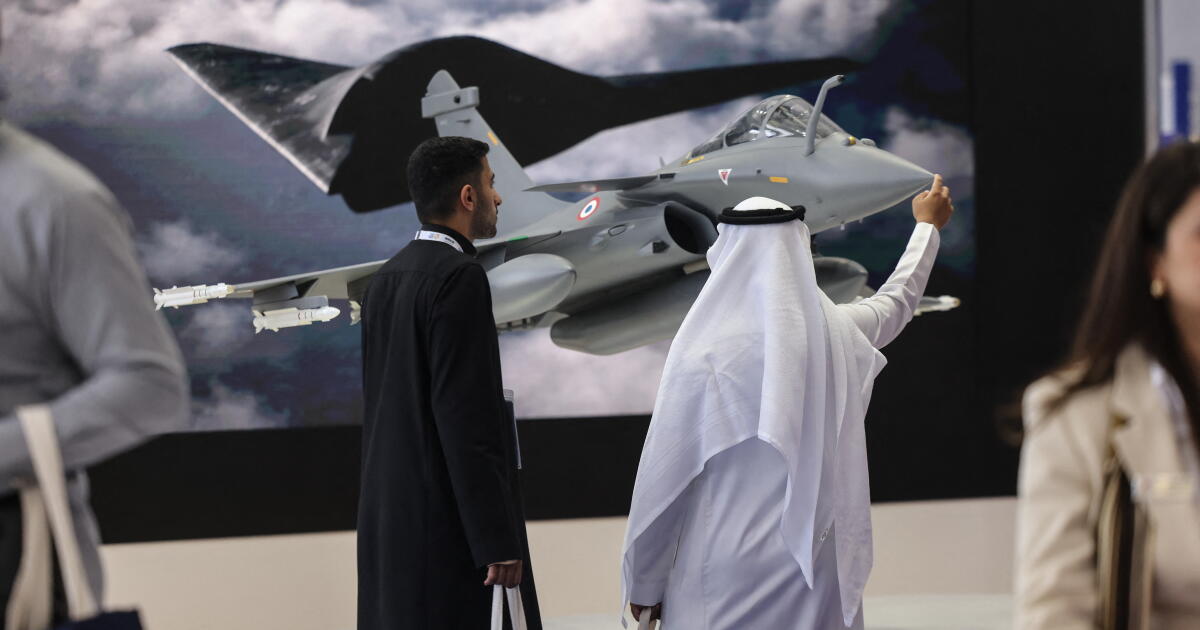
RIYADH, Saudi Arabia — For decades, Saudi Arabia has been among the most voracious of arms buyers, purchasing billions of dollars in flashy materiel that accounts for more than a tenth of total U.S. arms exports.
But faced with the persistent threat of missile and drone fusillades, and with its interceptor stockpiles drained by previous rounds of fighting, the kingdom is looking beyond Washington to replenish its arsenal. In the scramble to find alternatives to U.S. weapons systems, it’s sourcing from emerging players in the arms markets, but also looking to manufacture interceptors at home.
Even before the Iran war began, Saudi Arabia had signed a $3.2-billion missile defense deal with South Korea, complementing an arsenal that primarily includes American-made PAC-3 Patriot and THAAD missiles.
After a tenuous ceasefire took hold between the U.S. and Iran, followed by a resurgence of the fight against Yemen’s Houthis in July, the kingdom signed a defense deal with Ukraine for its low-cost counter-UAV drones. It has also sought to bolster its defense network with assistance from Greece, Pakistan, Turkey, the United Kingdom and Egypt.
On home soil, Saudi-based defense startups are jumping into what they see as an opportunity. One of them, SR2 Defense Systems, in early February forged a partnership with Utah-based Vector to produce “attritable systems” — cheap one-way drones that can be easily sacrificed.
The Iran war supercharged interest such materiel, said Lucien Ziegler, SR2’s co-founder and a longtime venture capital executive in the kingdom.
“The conflict changed the urgency, and how fast our partners wanted to move,” he said, adding that interceptors are becoming a priority for the company’s development road map.
At the heart of the problem for Saudi Arabia is the unforgiving calculus caused by the economics of missile defense, the country’s large size and the vagaries of long-stressed global supply chains.
Over nine months of war, Tehran has launched more than 7,000 drones and missiles on Persian Gulf countries, officials say. In the first two months alone, more than 1,000 targeted Saudi Arabia, according to an analysis from the International Institute for Strategic Studies.
Standard interception procedure for fast-moving targets centers on the “shoot-shoot-look” doctrine, according to Lockheed Martin personnel, where two interceptors are launched for every incoming projectile, implying a depletion rate that is double the number of attacks.
But it’s not a simple 2-to-1 ratio, because Saudi Arabia’s air defense is layered: It has at least six high-altitude THAAD batteries — each with six launchers — to hit incoming materiel from a distance. Its 108 Patriot launchers, along with older Hawk missiles and other systems, intercept projectiles closer in. Warplanes sweep up slow-moving drones.
Interceptor stockpile levels are of course secret, but despite efforts from Saudi Arabia and other gulf nations to husband munitions, analysts estimate that by July — when a long-running ceasefire with the Houthis broke down — the kingdom had expended 86% of its interceptor inventory.
Since then, Saudi Arabia has faced daily Houthi fusillades, some with devastating effect. Last month, a Houthi cruise missile hit Riyadh’s international airport, killing 13 people, wounding more than 300 others and shutting down the airport to most flights for months. The carnage spurred Saudi Arabia to cancel or postpone a bevy of international events.
Other attacks have hit oil infrastructure, including the vital East-West Pipeline the country relies on to shift energy exports from the Persian Gulf to the Red Sea.
The Houthis have also targeted more symbolic targets, especially in Riyadh. On Nov. 8, a Houthi missile damaged the downtown headquarters of the country’s state-owned oil company; on Thursday, the Houthis followed up with a strike on the sovereign wealth fund’s headquarters.
In theory, a $9-billion order approved by Congress in January for 730 PAC-3 missiles should cover Riyadh’s needs.
But Patriots and THAAD missiles, aside from being some of the most coveted interceptors, are both prohibitively expensive and take a long time to manufacture.
For Lockheed Martin to produce a PAC-3 interceptor takes anywhere from 24 to 30 months, and it has capacity to build slightly more than 600 units a year.
Lockheed Martin said that earlier this year it received a $58-billion contract with Saudi Arabia to triple PAC-3 production capacity by the end of 2030 to more than 2,000 units. An additional $35-billion contract mandates quadrupling THAAD production to almost 400 units.
But reaching that capacity will take time, and as Lockheed’s own news release warns, “actual results may differ materially due to factors.”
Even if the company were to deliver that performance, with 19 countries operating Patriots, and many of them suffering interceptor shortages of their own due to the war in Ukraine, it’s unclear how quickly Saudi Arabia’s order can be filled. The kingdom would also have to compete with a September 2025 order from the U.S. Army for almost 2,000 Patriot missiles.
Experts note that regardless of when the order is fulfilled, Riyadh remains at the wrong end of a cost-and-reload equation, where a $4-million PAC-3 or $12-million THAAD interceptor — each taking two years or more to build — is used to destroy a five-figure drone or ballistic missile that was far more rapidly constructed.
Another issue is the sheer size of Saudi Arabia, said Sasca Bruchmann, a defense and military analyst at the International Institute for Strategic Studies.
“It’s too big to defend all at once. You can’t have radar coverage everywhere and have to move forces around, “ Bruchmann said, adding that the Houthis, benefiting from their proximity to Saudi Arabia, probe for radar gaps and exploit them where they can.
“The Houthis have so much range for their munitions they don’t need to fly straight to target. Instead they can go through places where they know there are no sensors. And they’re good at this game.”
For now, the Saudi military has tested interceptors such as the P1-Sun by the Ukrainian manufacturer SkyFall. Trials have been successful, according to Tactical Report, a Middle-East focused strategic and economic intelligence provider, with the military planning to use the systems in the last mile of a projectile’s trajectory. But they have to be officially deployed.
In the meantime, Riyadh is corralling allies to help deter the Houthi threat: France and Britain both deployed warplanes to the kingdom for defensive patrols. Pakistan and Turkey — which recently formed with Saudi Arabia a military alliance named the Mecca Pact — dispatched troops and air-defense crews.
Greece has maintained a Patriot battery in the coastal city of Yanbu since 2021. Last month, Egypt’s parliament approved deploying troops to the kingdom in a defensive scope.
But the country’s longer-term aim centers on co-manufacturing agreements and technology transfer.
SR2 Defense Systems and Vector, for example, are building a factory near Riyadh to manufacture the Skywasp, a Saudi-specific variant of a jet-powered drone Vector revealed this month called Bombard that they plan to sell domestically and export.
SR2 will also build a smaller version called Yellowjacket, with the intention of delivering it to the Saudi military and its allies’ hands quickly.
Ziegler, the SR2 co-founder, says the idea behind the company is not to be a first adopter of defense tech, but to bring proven systems to the kingdom and manufacture them to high standards.
“Making systems inside your own borders is power,” Ziegler said. “Supply chain is power. So Skywasp and our systems that follow are how Saudi Arabia leverages its industrial capability and turns it into supply chain advantage.
“That’s the kingdom’s next chapter. That’s what we’re building.”