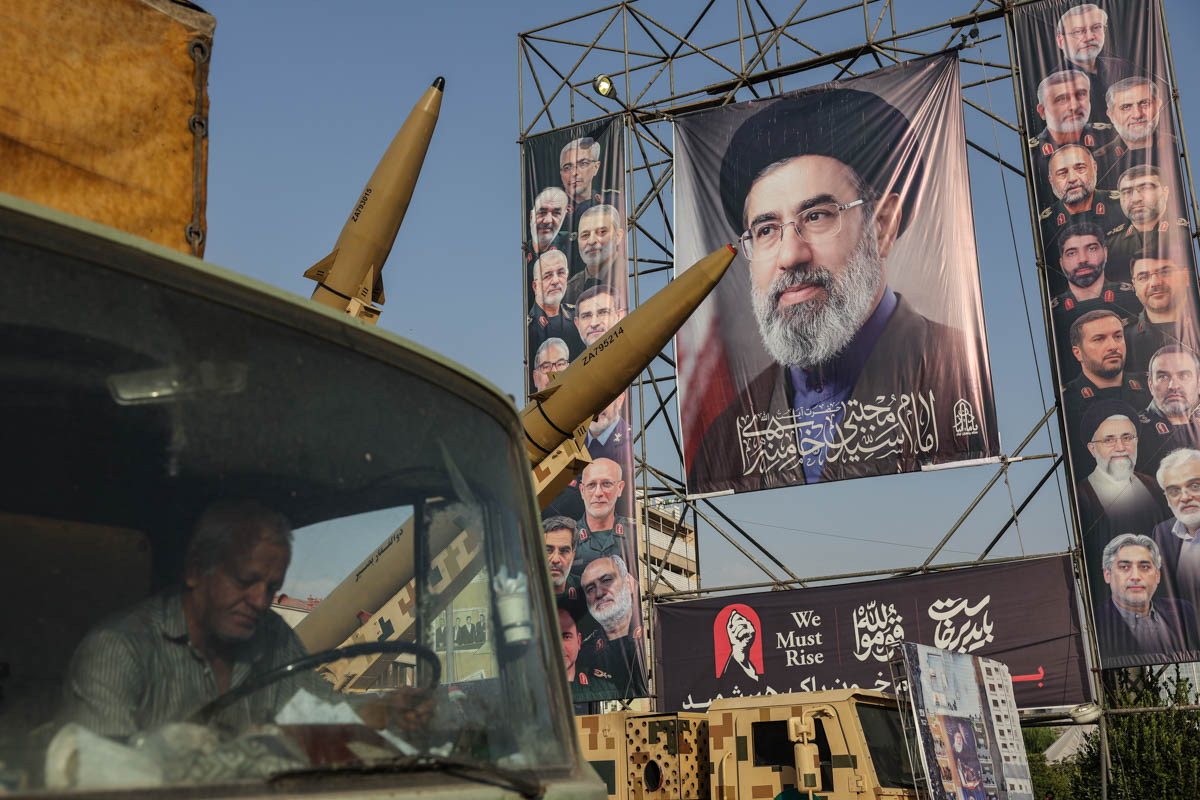
WANA (Nov 22) – Brigadier General Qasem Ghoreyshi, Deputy Head of the Basij Organization, said Iran’s Armed Forces have enhanced the accuracy of their weapons, enabling them to precisely target enemy positions at long distances.
Speaking at an event in Tehran, Ghoreyshi said a recent directive by Iran’s Leader, Ayatollah Seyed Mojtaba Khamenei, to remove restrictions on the range of weapons had been fully implemented, describing it as “good news” for the Iranian people.
He said the directive removed restrictions on weapons range as well as geographical limitations on the Armed Forces, meaning that any threat against Iran could be responded to regardless of where it originated or what means were used to carry it out.
Ghoreyshi explained that the previous restrictions had been based on military assessments of threats within a range of 2,000 kilometers. At the time, there had been no perceived need for missiles and other weapons, including drones, to have ranges beyond 2,000 kilometers.
He said the change came after the threat environment evolved, particularly as U.S. forces moved hundreds of kilometers farther from Iran’s borders and began relying on distant bases. He cited the principle that the era of “hit-and-run” attacks had passed.
Ghoreyshi said that alongside the removal of range restrictions, the Leader had also emphasized increasing the precision of Iranian missiles, saying a missile with a range of 2,000 kilometers should be capable of striking the center of a designated target.
He said missile range could be increased several times through relatively minor technical modifications, adding that such modifications could allow weapons to reach targets at significantly greater distances.
Ghoreyshi warned the United States against assuming that moving 1,000 or 2,000 kilometers away from Iran would guarantee safety. He recalled previous U.S. dismissals of Iranian missiles as “Photoshop”, saying such assumptions would no longer provide a sense of security.
He stressed that, based on the information available to him, Ayatollah Seyed Mojtaba Khamenei’s directive concerning the Armed Forces’ equipment, weapons, intelligence capabilities and firepower had been fully implemented.
Ghoreyshi said the decisions and directives of the Commander-in-Chief of the Armed Forces would be carried out by the Armed Forces at the appropriate time.
Separately, Ghoreyshi described the media as a key instrument in what he called the “cognitive war” and “soft war,” saying journalists were effectively officers, commanders and combatants on the media front.
He urged Iranian media outlets to focus on what he described as the country’s “narrative of progress,” saying they should both document national achievements and explain them to the public.
According to Ghoreyshi, highlighting the country’s achievements could motivate those involved in national development while also strengthening public confidence and optimism.
Ghoreyshi also said that after World War II, victorious powers became rivals and sought to attract other nations by promoting their respective political and ideological narratives. He referred to Marxist movements’ emphasis on workers and the underprivileged and Western powers’ promotion of concepts such as human rights and freedom as examples of ideological and media competition.
Ghoreyshi further called for greater media attention to what he described as the defeat of the United States and Israel and the strength of the Iranian people, including public participation and the readiness of Iran’s armed forces to confront threats.
He also called for continued engagement with media activists participating in the event, saying they should receive the latest information and developments and be briefed on issues and themes requiring greater attention.
Ghoreyshi concluded by commemorating fallen Iranian military commanders, including Qasem Soleimani, Hossein Salami, Mohammad Bagheri, Gholam Ali Rashid and Amir Ali Hajizadeh, and stressing the need to preserve the memory of their sacrifices.
In response to reporters’ questions, following the event, regarding the U.S. blockade, Ghoreyshi said Iran has plans to circumvent the blockade, noting that “good measures” have already been taken both through the Persian Gulf and overland routes.
He added that following measures taken by the United States, the value of Iran’s oil exports has effectively increased. He said that oil previously sold at around $40 or $50 would now be calculated at current prices, meaning that the value of whatever volume Iran is able to export would be several times greater.