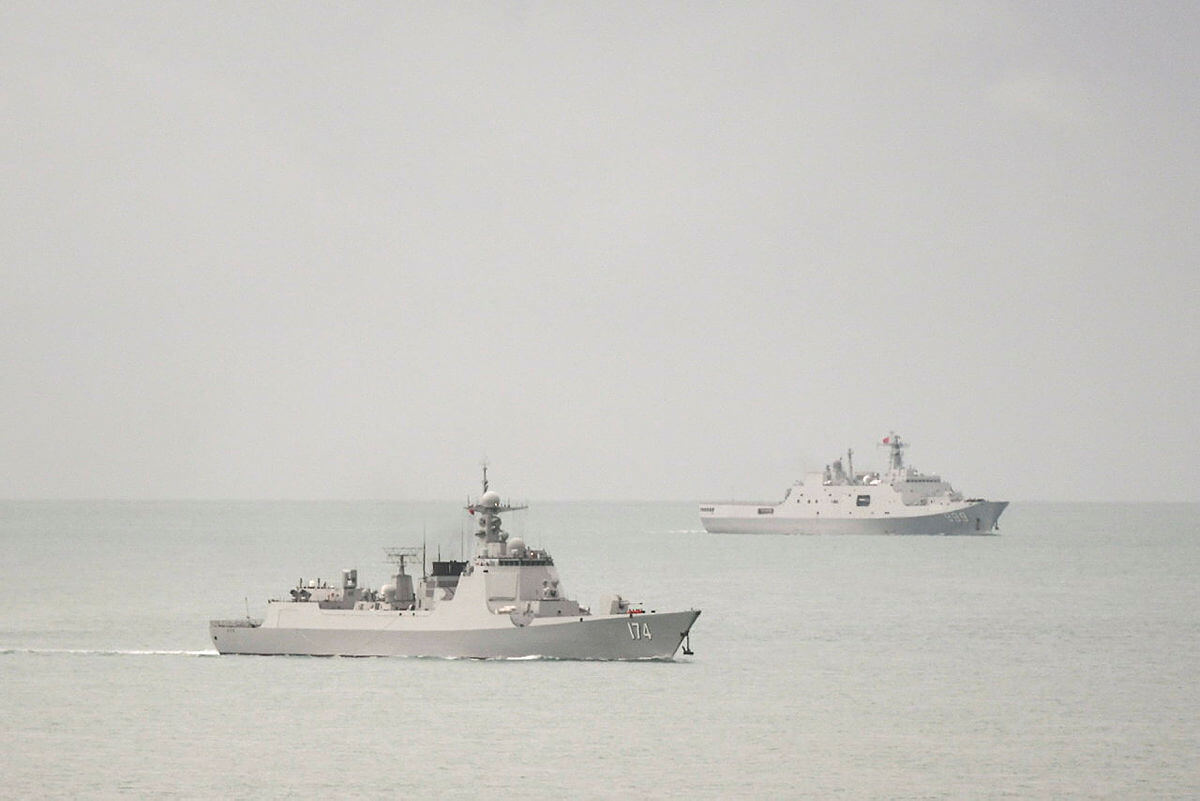
The gap between American and Chinese military capabilities is smaller than it ever has been.
This is a key finding of the 2026 Asia Power Index, published today. The People’s Liberation Army’s (PLA) expansion is such that the United States can no longer lay claim to being Asia’s uncontested military hegemon.
China’s military modernization has been extraordinary. At sea, the PLA Navy (PLAN) surpassed the U.S. Navy in ship numbers last decade, and by some estimates today is 35% larger than its American counterpart.
The PLAN’s newest vessels are large and capable, and Chinese shipyards can build them at speed. The U.S. may have a more technically sophisticated navy and it certainly has more recent combat experience than the PLAN, but it does not have numbers on its side.
In budgetary terms, the U.S. still enjoys a comfortable lead over China, spending nearly three times as much on its military. However, Beijing appears to get more bang for its buck. Its new and potent Type 55 cruisers cost between US$850 and US$920 million, compared to US$2.7 billion for an Arleigh Burke-class destroyer, the workhorse of America’s navy.
Add to that the fact that the PLA’s budget has grown by nearly 1,000% from 2000 to 2026, and we can see that China is spending its money more effectively than the U.S., and spending more and more of it.
China aims to have a world-class military by mid-century. Its shipbuilding rates certainly put it on track to achieve this goal, particularly with aircraft carriers.
The United States is currently building its next class of nuclear-powered aircraft carriers, the Gerald R. Ford-class. The lead ship was laid down in 2009 and launched in 2017; the second was laid down in 2015 and will be commissioned in 2027. Its third ship was laid down in 2022 and is scheduled for launch in the coming months, with its fourth yet to be laid down.
The PLAN makes this pace look glacial. It began building its first nuclear-powered carrier – the Type 004 – in around 2024. (With no known keel-laying ceremony, it is hard to ascertain precise dates; modules for the ship may have been under construction before this time.) In early 2025, construction work was visible by satellite at shipyards in Dalian, northeastern China.
The Center for Strategic and International Studies estimates that the PLA could launch the Type 004 as early as next year. The Pentagon seems to agree. In 2025, the U.S. Department of Defense assessed that the PLA intends to build six additional aircraft carriers by 2035 – one every 20 months.
America will still operate more aircraft carriers than China by 2035. However, its security commitments are far more expansive than China’s, whose short-to-medium-term focus is on the Indo-Pacific. It is worth asking the question: in a worst-case scenario of major conflict in this region, would America be able to marshal all its available military power to confront China without compromising its security interests elsewhere?
Further PLA investments also contribute to closing its military gap with the United States. It is focused heavily on enabling capabilities like air-to-air refueling, and in October it secured access to an airfield in Laos in cooperation with the government in Vientiane, its first such facility in Southeast Asia.
Domestically, too, it has made heavy investments into naval and air bases. Its North, East, and South Sea Fleet Headquarters and associated bases have all been expanded with additional berthing and maintenance facilities.
One gap which China cannot close with the U.S. is in warfighting experience. China was last at war when it invaded Vietnam in 1979. The United States has been at war or had combat forces deployed around the world almost continuously for the whole of the 21st century. This kind of experience, money just can’t buy.

Stay on Top of the Daily Maritime News
The maritime news
that matters most
Get the latest maritime news delivered to your inbox daily.
Regardless, the scope and scale of China’s military expansion is unlikely to slow down any time soon. The PLA might not be a “world class military” today, but its growth has ended unchallenged American military supremacy in Asia.
David Vallance is a Research Associate in the International Security Program at the Lowy Institute. This article appears courtesy of The Interpreter and may be found in its original form here.