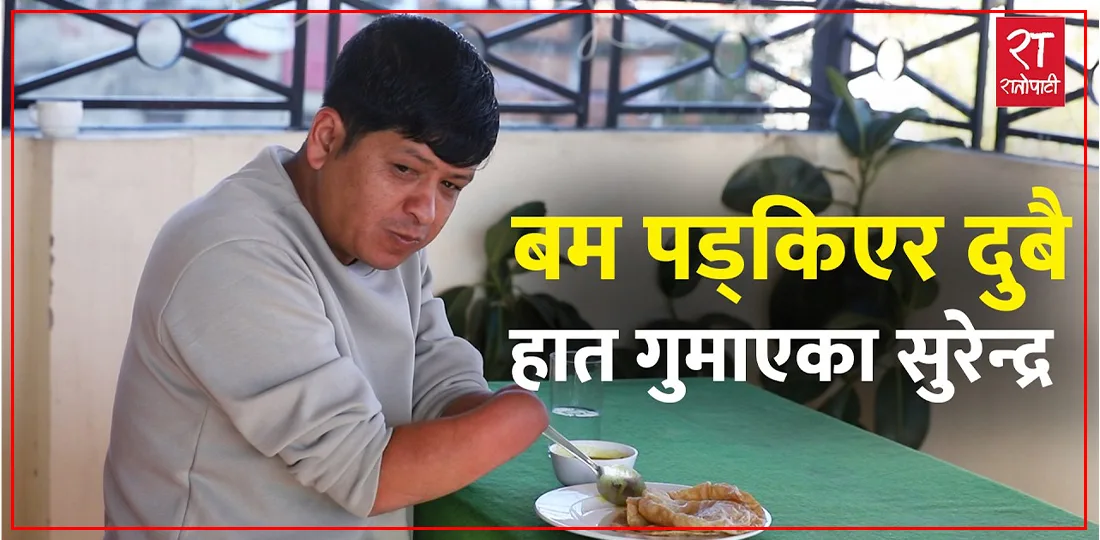
Kathmandu. Upon waking up in the morning and going to bathe, Surendra Khatri of Myagdi drops the soap from his hands for the tenth time. For him, bringing the slippery soap to his head is like winning a great war. This is the struggle he faces daily. After losing both hands, Khatri initially felt he could not live, but gradually he got used to it.
Khatri, from Mangala Rural Municipality-2, Babiachaur, Myagdi, was a healthy 20-year-old youth in 2063 BS. Studying in class 10 at Mangala Higher Secondary School in Babiachaur, his only dream was to become an Indian Army soldier (Lahure). His father being an Indian Lahure also fueled his ambition. He was undergoing training at 39 GTC (Gorkha Training Center) in Banaras and was on leave at home at that time. He had only four days left to return to India.
On Asar 12, 2063 BS, the village was busy with paddy transplantation. His mother and siblings were all busy in the fields. Volleyball enthusiast Khatri was not very interested in household chores. So, he decided to go to a nearby forest to graze goats and tie them up somewhere to play volleyball.

Around 4:30 in the evening, the goats went into the forest. While trying to bring the goats back, he found a small packet of plastic bag. Thinking it might be someone’s belongings, he picked it up and brought it near his house. However, before he could see what was inside, the bag exploded. ‘Perhaps it exploded in my hand, I didn’t even hear the sound of the bomb exploding. I just felt my body shake,’ he recalls that moment, ‘I tried to wipe my eyes thinking something had fallen into them, but my hands couldn’t reach my face. When I forcefully brought my hand up, blood splattered, and I felt the bone.
At that time, Khatri’s left hand was already severed at the scene, and the flesh and bone of his right hand were scattered. Due to the loss of about one kg of flesh and a lot of blood from his ears, nose, and body, the villagers had already given up hope, saying ‘He won’t survive now.’ There was no health post or motorable road in the village. At the initiative of his cousin, Ved Bahadur GC (who was an Indian Lahure), the villagers made a stretcher and carried him down to Tarakhet. From there, he was taken by vehicle to Beni Hospital in Myagdi.
But, alas! Although a ceasefire was in place at that time, a peace agreement had not yet been reached. Instead of treating him at Beni Hospital, security personnel viewed Khatri with suspicion, asking, ‘Is he a Maoist? Where did he get the bomb from?’ After not receiving even primary treatment, he was taken across the suspension bridge and then by ambulance to Gandaki Hospital in Pokhara. ‘I remember the doctor asking me to ‘open your mouth once’ when I reached Gandaki Hospital, and I woke up five days later,’ he says, ‘When I regained consciousness five days later, I realized that both my hands had been amputated.’ During the 45-day hospital stay, the cost was around two and a half to three lakh rupees. The family, which ran on pension, borrowed money to save his life.
‘My three-month-old daughter was called ‘inauspicious’, I hid my hands for eight years
After regaining consciousness on the hospital bed, the mental and social pain became many times heavier for Khatri than the physical pain. At that time, his daughter was only three months old.
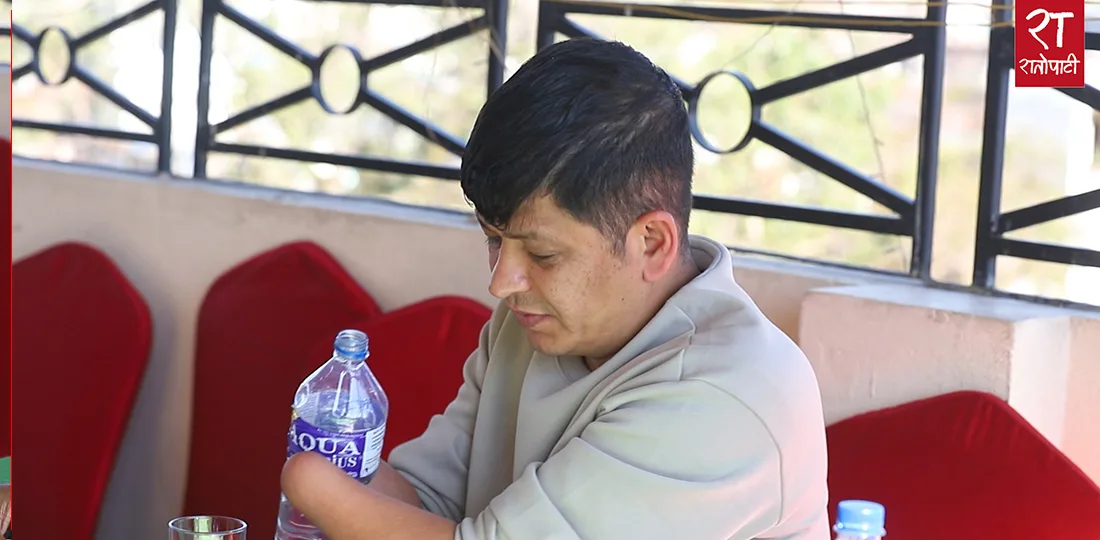
‘Relatives who came to visit would show sympathy by saying, ‘Oh son, how will you earn a living now?’, but those words gave me the pain of ‘I have become useless’,’ he says seriously, ‘Some people would even say, showing my three-month-old daughter, ‘Your daughter was born and your hands were lost, your daughter is inauspicious.’ Being interpreted as a sin from a past life and my own mistake, I was mentally devastated.’
To escape this societal prejudice, Khatri hid both his hands inside the pockets of his jeans jacket for eight years. He did not show his hands to anyone except his family. ‘I didn’t want people to interpret my life’s failure by looking at my missing hands, so I kept my hands in my pockets for eight years,’ he says.
That Tragedy of the Beni Attack
Before his own accident, Khatri had closely witnessed the tragedy of the attack in Beni, Myagdi, on Chaitra 7 and 8, 2060 BS. He was studying in class 9 at that time. The scene of firing from helicopters over his village, located 14-17 kilometers from Beni bazaar, and the fierce fighting that lasted for two days is still fresh in his memory.
The remnants of that horrific war, which destroyed all government structures from the CDO office to the army barracks, and where dozens of bodies were buried in the foundations of the under-construction bridge and roads in Beni, had snatched Khatri’s future three years later.
Khatri, who spent about seven to eight years of his life in a state of inferiority complex, found a new turn in his life after attending organized programs of other people with disabilities. ‘I wasn’t the only one; there were friends who had faced even more difficult situations,’ realizing this, his self-confidence returned. After that, he gradually started learning life skills again. Khatri, who used to hold a pen with the fingers of one hand, has now learned to write in beautiful handwriting on paper with the help of the stumps of both his hands. He now uses a mobile phone and even works on a computer.
In 2075 BS, Khatri’s campaign, which started with ‘Kathashala’ of 14 conflict victims in Kathmandu, took the form of the book ’14 Stories: Living Memory of War’. While traveling to all seven provinces with photo exhibitions and books, 65 new friends were added. In 2076 BS, the ‘National Network of Disabled Conflict Victims’ was formally established, which now includes a hundred ordinary disabled conflict victims from across the country. He is currently the chairman of this organization.
Currently residing in Ramkot, Kathmandu, Khatri does not have any job. His daily life is sustained by the food sent by his parents from the village and the support of his family. However, his work has not stopped. Through the organization, he is teaching ‘story writing’ to 10 victim writers. The second edition of the book has been published, and more than a hundred new stories are in preparation for publication. Also, he shares his experiences in schools and colleges through ‘Peace Education’ so that the pain of war is not repeated, telling his experiences to the new generation.
‘Commissions have become mere places to get jobs, now give justice while we are alive’
Khatri and his organization’s representatives repeatedly met with former Prime Ministers Pushpa Kamal Dahal ‘Prachanda’, Sher Bahadur Deuba, and KP Sharma Oli, among other top leaders, seeking justice. However, they received nothing but assurances. ‘The commissions formed so far have only become places for political appointments, they have not been victim-centric,’ he complains.

He has some doubts and concerns about the delay in transitional justice, even though a powerful government with a majority from Rastriya Swatantra Party has been in power for eight months. Nevertheless, he has high expectations from a stable and powerful government.
‘The state is the guardian of the citizens who have become victims, whether they participated in the conflict or not,’ says Khatri. ‘The government should consult meaningfully with the victims as soon as possible, amend the law, and appoint impartial commissioners who understand the plight of the victims to move forward with the investigation.’ He lamented that many of his friends are waiting for death due to lack of medicine and aid supplies. ‘Giving late is giving injustice, so this government should give us justice while we are alive,’ he added.
He expresses gratitude to his wife, children, Myagdi journalist Ghanshyam Khadka, Australian Denis Dowling, disability activists from Myagdi, conflict victim leaders, and various supporting organizations for bringing his journey this far.
Twenty years ago, an abandoned bomb turned Khatri’s dream of becoming a Lahure to ashes, but rising from those ashes, he is today a living and strong voice for transitional justice and human rights in Nepal.