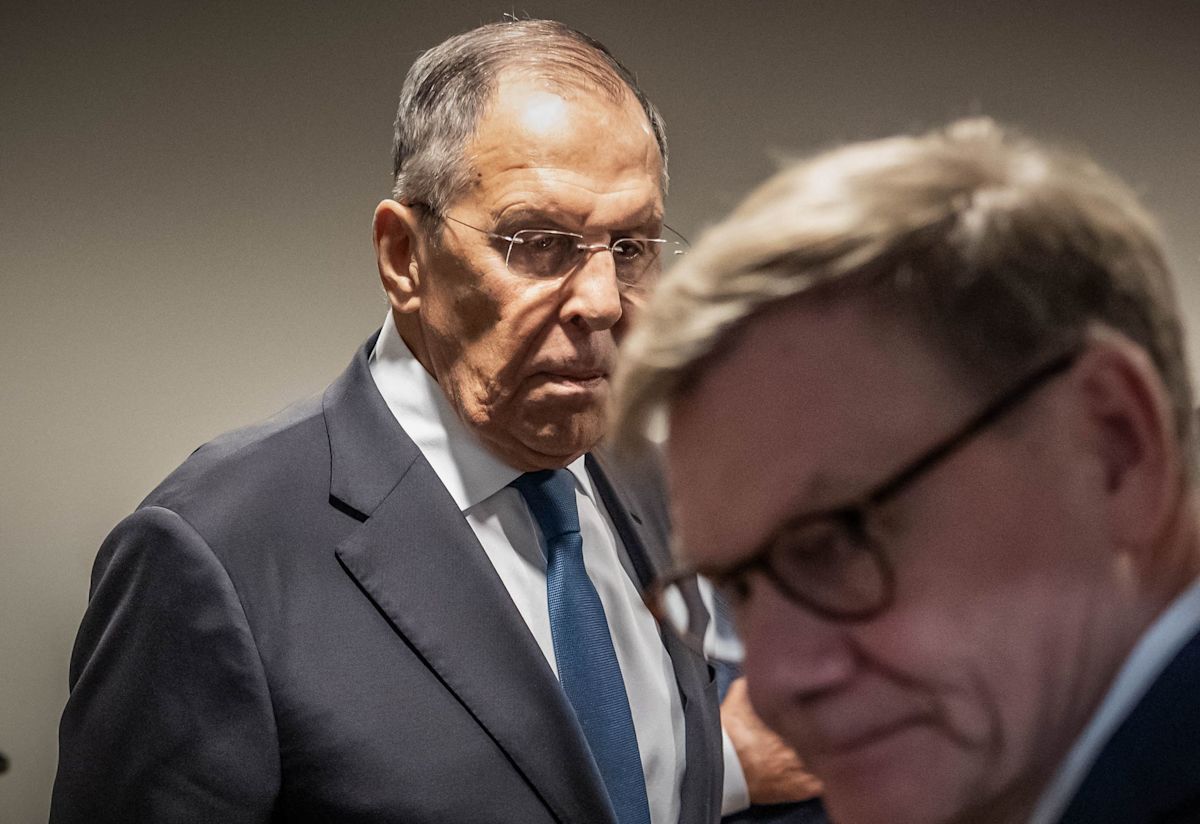
German Foreign Minister Johann Wadephul met his Russian counterpart, Sergei Lavrov, in New York on Saturday for their first bilateral meeting since the start of Russia’s war against Ukraine in 2022.
The meeting took place on the sidelines of the UN General Debate in a meeting room on the Russian side of the UN building and lasted just over 20 minutes, ending with a handshake between the two ministers.
While German and Russian government representatives have been present together at various international meetings since 2022, direct talks at foreign minister level had not taken place.
Lavrov says meeting with Wadephul unnecessary
Lavrov said he sees no progress from his talks with Wadephul, telling dpa in New York that he had “heard nothing different” from what Berlin says publicly every day.
“You could have just called me and said, ‘Read my statement,'” Lavrov said he told the German foreign minister.
Germany had requested the meeting the previous day “at the last minute,” Lavrov said.
The Russian minister said the conversation with the German foreign minister gave “the impression that there was an underlying message: ‘I have come to you, I have condescended to you.'”
He said he gained the impression that Wadephul had expected concessions from Russia on Ukraine and Black Sea shipping in return for the meeting.
German side sees deep divisions
Wadephul said deep disagreements over efforts to end Russia’s war in Ukraine remain after his talks with Lavrov.
“It was an intense conversation. Of course, we did not agree on key points,” the conservative politician told German public broadcaster ZDF. He had “offered to de-escalate, particularly with regard to the situation in Ukraine, but that has not yet found open ears,” Wadephul added.
It had been important to him to make clear that Germany “does not accept things like the drone attack in Leipzig – that this is an escalation that is not acceptable,” he said, adding that he had warned Russia against continuing on that path.
“We can defend ourselves, we can stand our ground, and we will do so,” Wadephul said.
The German government holds Russia responsible for an incident involving an unexploded explosive drone at Leipzig airport. Moscow rejects any responsibility for the incident.
Wadephul: Categorical differences in views
Whether further talks would take place depended largely on Russia, the foreign minister said. “If Russia is ready to talk constructively, and above all if Russia is ready to stop its war against Ukraine, then talks will certainly be possible.”
Wadephul said he had been asked by numerous counterparts to remain open to talks with Russia, with colleagues advising “that at some point direct talks must resume.” He also said he did not want Europeans to leave all contact with Russia entirely to the US side.
Wadephul stressed there were categorical differences between the two governments’ positions, “but those too must be discussed.” Even during the Cold War, there had always been dialogue. “I felt it was right, at this point in time, to seek a first opportunity for an exchange,” he said.
Grain exports via Black Sea a key issue
The principle of not discussing Ukraine without Ukraine naturally continued to apply, Wadephul said. “I am not negotiating about Ukraine – that is for Ukrainians themselves to do. I am calling on Russia to talk to Ukraine.”
The focus now was on enabling grain exports from Russia, but above all from Ukraine. “That is important for these countries, but it is particularly important for the Global South,” he said.
Egypt, for example, sourced a third of its grain supplies from Ukraine. If there were no grain exports, “there will be hunger, particularly in the Global South – and that must be avoided,” Wadephul said.
Wadephul sees Russian attacks reaching ‘new level’
The New York meeting came against the backdrop of ongoing efforts to end the war in Ukraine. Wadephul and Lavrov are in the US city for the UN General Debate.
Just days earlier, Wadephul had expressed concern about further escalation, accusing Russian President Vladimir Putin of escalating aggression against Europe in the face of increasing hybrid attacks.
“Russia’s hybrid attacks against those who support Ukraine and international law have reached a new level,” the conservative politician said at a UN Security Council session on the sidelines of the UN General Assembly.
The German government announced a package of sanctions to be imposed on Moscow after the Leipzig airport incident.
These include terminating the contract for the operation of the Russian House in Berlin, which is suspected of operating as a cultural institute as cover for espionage.
Moscow rejected the accusations and announced countermeasures. Russia subsequently ordered the closure of the Goethe Institutes in the country, among other measures.
Medvedev: Germany has earned punishment
Dmitri Medvedev, deputy head of the Russian National Security Council, said Germany had earned real punishment with its “anti-Russian policy.” The former president specifically mentioned “direct strikes” against arms companies in Germany that supply military equipment to Ukraine.
Germany is Ukraine’s most important supporter.
Ukraine has been defending itself against Russia for more than four and a half years, receiving money and weapons from its Western allies.
Since the US scaled back its support under President Donald Trump, the role of Europe and Germany in particular has grown in importance.

Russia’s Foreign Minister Sergey Lavrov (L) meets German Foreign Minister Johann Wadephul (2nd R) on the sidelines of the UN General Assembly session at the United Nations. (is associated with: «Wadephul says talks with Lavrov showed deep divisions over Ukraine war») Michael Kappeler/dpa