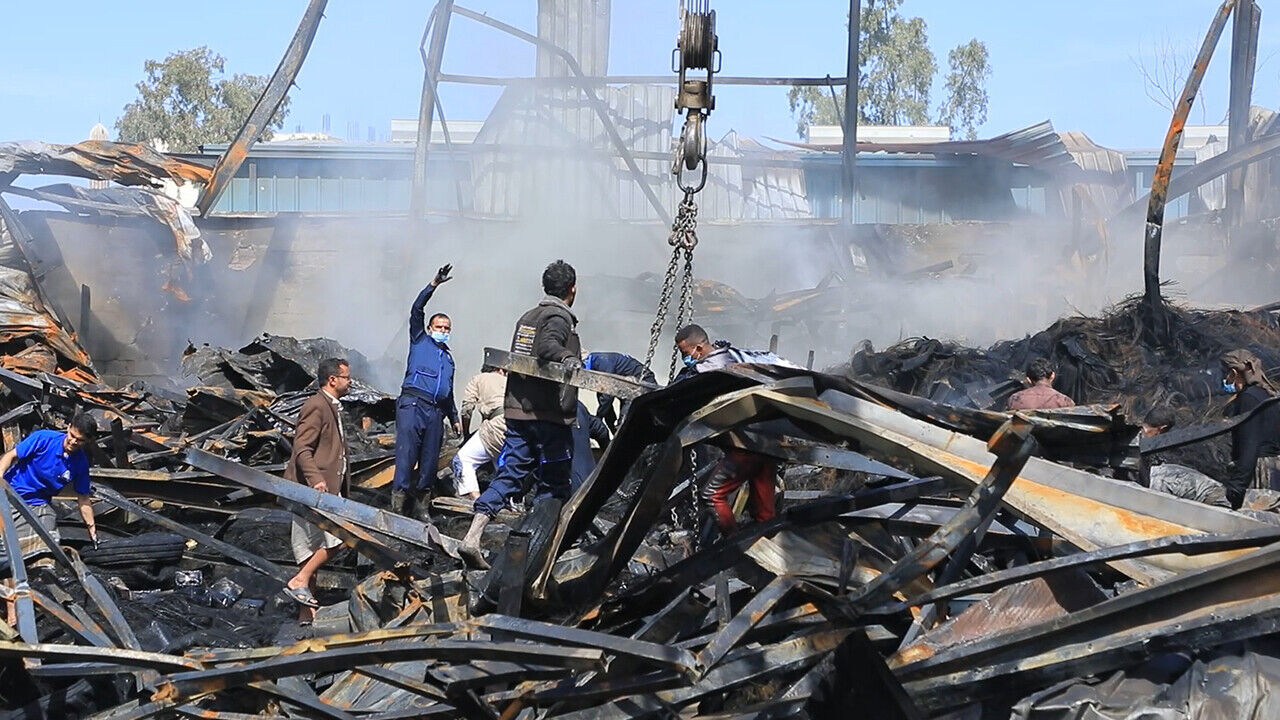
▲ People inspect a vehicle tire warehouse following an airstrike by the Saudi-led coalition in the Yemeni capital of Sanaa.
Amid reports that 26 people were killed after a bus, trucks, and other vehicles were struck in southwestern Yemen, the Iran-backed Houthi rebels and the Yemeni government forces are trading blame over who is responsible for the attack.
On the 24th (local time), a Houthi spokesperson pointed the finger at the Saudi Arabian air force for the previous day’s airstrike in the southwestern province of Lahij, warning of retaliation by stating that “it will not pass without a response.”
In contrast, the Yemeni government forces flatly denied the claim, asserting that the Houthi rebels carried out the attack themselves.
Majed al-Nazli, a spokesperson for the Yemeni government forces, claimed that “the Houthi rebels targeted civilian vehicles without military markings on a key main road used by residents.”
As the two sides traded conflicting claims, multiple local officials told AFP that civilian casualties occurred in the process of Saudi-led coalition warplanes striking Houthi vehicles in Lahij province the previous day.
Lahij province is an area where Houthi rebels have advanced toward Aden, the temporary capital of the Yemeni government, in recent weeks.
One official explained that “coalition warplanes targeted two Houthi-affiliated vehicles at the moment a truck and a bus were passing on the front line,” adding that the airstrike claimed the lives of 12 Houthi fighters and 14 civilians.
Another official confirmed the same death toll, and witnesses reported seeing charred bodies at the scene.
Separately, Houthi officials stated that an airstrike in the coastal province of Hodeidah the previous day killed 17 people and destroyed multiple buildings.
Yemen, one of the world’s poorest nations, has become one of the most intense front lines in the Middle East conflict as the Iran-backed Houthi rebels and the Saudi-led coalition frequently exchange attacks.
Having suffered through more than a decade of civil war, Yemen has also been drawn into the U.S.-Iran conflict after a truce between the Houthi rebels and the Saudi-backed Yemeni government collapsed in July.
According to the latest United Nations figures, the ensuing clashes in Yemen on the Arabian Peninsula have left more than 1,600 dead and displaced over 360,000 people.
Having already seized vast areas of Yemen, the Houthi rebels have captured all government strongholds along the Red Sea coast, strengthening their control over the Bab el-Mandeb Strait.
In addition, they have been launching missile and drone attacks almost daily targeting Saudi military, civilian, and oil facilities.
The Houthi attacks have disrupted Saudi crude oil exports and dealt a direct blow to Saudi Arabia’s plans to diversify its economy by leaping forward as a tourism, travel, and business hub.
The Saudi-led coalition intervened in the civil war in early 2015 after the Houthi rebels captured the capital of Sanaa, prompting the internationally recognized Yemeni government to flee to Aden.
The war caused hundreds of thousands of deaths and a massive humanitarian disaster until a fragile truce took effect in 2022.
(Photo: EPA, Yonhap News)
※ Please note: This article was translated by AI and may contain errors.