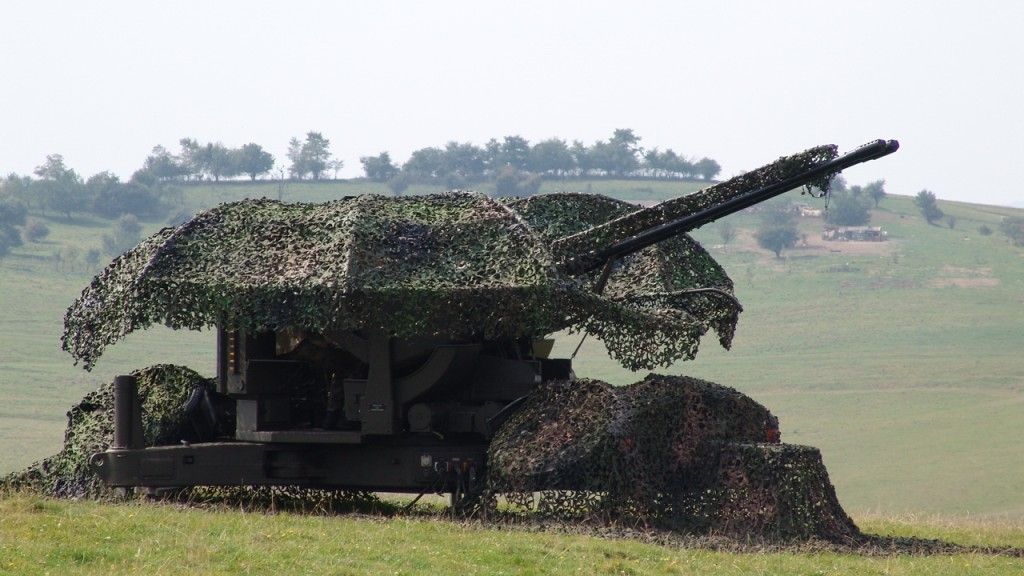


Photo. MAPN / Wikipedia
Romania has imposed its first penalty on German defence contractor Rheinmetall over delays in delivering upgraded air-defence systems. The bill came to more than €8 million.
In December 2023, Romania’s Ministry of Defence signed a contract with German company Rheinmetall AG to upgrade GDF-003 air-defence systems to the GDF-009 TREO standard and integrate elements of the Oerlikon Skynex system. The contract, valued at nearly €330 million, covered the upgrade of four batteries of these systems owned by the Romanian Army.
Problems with Romania’s procurement
Each battery consists of six firing units, meaning that 24 of the 72 systems currently in service were to be upgraded. In addition to the automatic cannon, each battery was to receive a new Oerlikon Skymaster TLCN fire-control system, an X-TAR3D multifunction radar station and two lorries equipped with hook-loader systems to transport them.
Delivery of the first two batteries (12 firing units) was scheduled within two years of the contract being signed, with the remaining systems due to be upgraded and handed over a year later. However, Romanian outlet G4Media reported on 23 September that the programme was already several months behind schedule. The outlet said the first two batteries had been due for delivery in April.
That did not happen because they failed acceptance testing. Further tests were scheduled for September, but it is not known whether the upgraded air-defence systems passed. What is more, the article’s authors said they had obtained Romanian Ministry of Defence documents indicating that “some subsystems do not fully meet the requirements of the procurement’s technical specifications”.
The German side reportedly acknowledged the delays unofficially, citing technical failures and difficulties securing the supply chain, among other reasons. The buyer began calculating contractual penalties from the first day of delay, in accordance with the contract. “Penalties will be charged until the systems’ acceptance certificates are signed without objection,” MAPN told G4Media in response to its request.
Very-short-range Skynex air-defence system.
Photo. Rheinmetall
Millions in penalties for German defence contractor
In early November, Romania’s Defence Minister Radu Oprea said live on Digi24 that the first invoice, dated 8 November, for penalties imposed on the German company amounted to €8.7 million and represented only part of the consequences. He said the first refurbished and upgraded air-defence systems would be delivered in December.
I assume invoices will continue to be issued until the appropriate equipment is received, as this is a partial invoice. However, I promise that we will receive the first refurbished equipment this December, in line with our commitments, because the army has strict requirements in this respect. If there are specific specifications, they must be met.
Romanian Defence Minister Radu Oprea
He stressed that the company’s explanations for the delays would not be enough to ease the authorities’ dissatisfaction. The company points to “the existing pressure on global military equipment supply chains”. Further penalties under the contract remain possible if the ordered equipment does not meet specifications or is again delivered late.
At present, supply chains are stretched to their limits in everything related to equipment deliveries, because demand for military equipment is very high across the world, and sometimes certain products are delayed. These are the explanations we receive. They do not satisfy us, because we need the right equipment, and that is why we impose penalties.
the Romanian Defence Minister explained
Skynex air defence system and GDF-009 TREO
Skynex is a very short-range air defence system developed by German company Rheinmetall Air Defence. It was first presented to the public at the Eurosatory exhibition in Paris in 2016. It consists of an unmanned Skyranger turret module armed with a 35 mm Oerlikon Revolver Gun Mk3 automatic cannon, a command-and-control system with a Skymaster electro-optical sensor head, and an X-TAR3D three-dimensional radar. The cannon has a theoretical rate of fire of 1,050 rounds per minute and can effectively engage a wide range of targets at distances of up to 4,000 metres. The radar, meanwhile, can detect targets at distances of 25 to 55 km, depending on their type. This enables the system to effectively engage small C-RAM targets—including drones, cruise missiles and mortar shells—providing comprehensive very short-range air defence.
Skynex can integrate radar equipment from different manufacturers, highlighting its flexibility for potential customers. The system also offers considerable freedom in its choice of effectors, allowing the integration of many different advanced types of air defence weapon. The only requirement is that each has its own tracking unit. In addition to individual sensors and effectors, existing air defence systems such as the Skyshield and Skyguard families can be incorporated into the new architecture as firing units. At a remote command-and-fire-control centre, the recognised air picture is displayed on a map alongside the sensors and effectors deployed in the field, simplifying target allocation for the air defence assets connected to the system.
Skynex air defence system.
Photo. Rheinmetall
GDF-009 TREO is a very short-range artillery air defence system manufactured by German company Rheinmetall AG. It uses twin Oerlikon 35 mm anti-aircraft guns to engage targets at distances of up to 4,000 metres. Each gun has a stated theoretical rate of fire of 1,100 rounds per minute. The system can be mounted on a four-wheeled towed platform. It can be connected to various fire-control systems, such as Skyguard or Skynex, and integrated with a wide range of radars.
When paired with its own sensors, such as an electro-optical sensor head or radar, it can detect and engage targets independently, without relying on data from external sources. The system has its own power supply, giving it greater operational independence. This variant of the system, based on Oerlikon 35 mm guns, is currently used by countries including Bangladesh and Romania.
GDF-009 TREO air defence system.
Photo. Rheinmetall AG