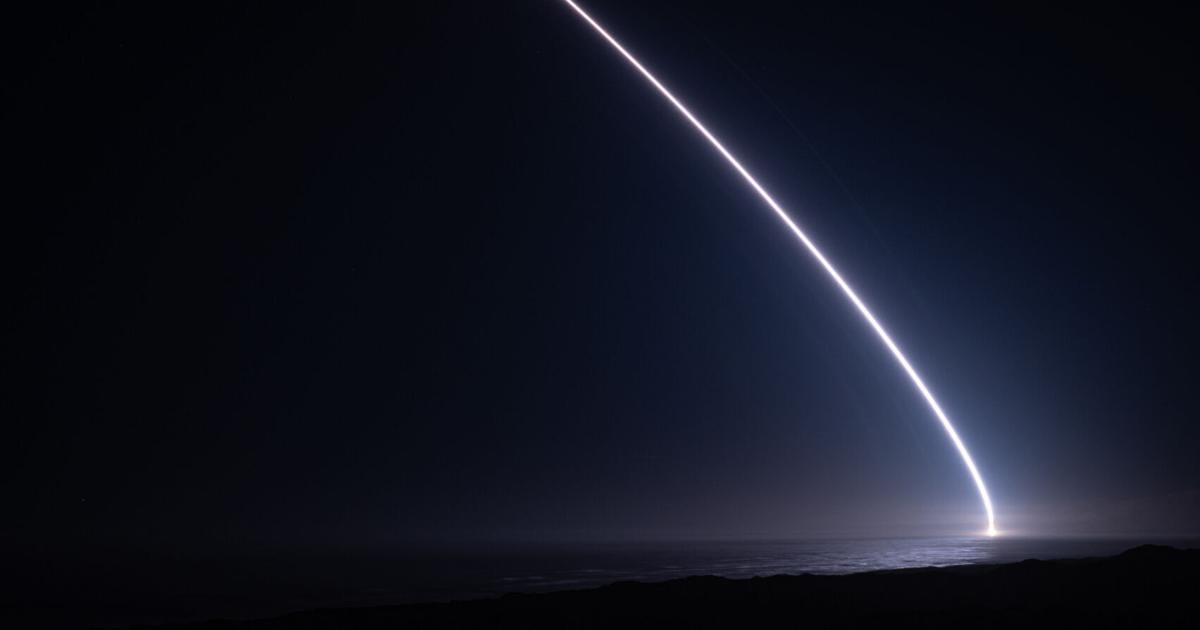
I protest test-launches of (unarmed) ICBM Minuteman III missiles, sent from Vandenberg Space Force Base, 4,200 miles to the Kwajalein Atoll in the Marshall Islands.
The missiles are shipped to VSFB from military bases in other western states, and then fired off from a silo. The U.S. Air Force refers to these flights as “Glory Trips”.
Late at night on Nov. 17, I protested at the main gate of VSFB, witnessing the launch of “Glory Trip 257”.
I was the lone protestor onsite that evening.
At 11:01 p.m., a blazing amber light appeared at the western skyline, from which emerged the ICBM Minuteman III missile, at first silently rising into the starry night sky, with a half-moon setting on the western horizon.
An eerie rumble followed the missile, which disappeared three minutes later over the Pacific Ocean. This was a frightening exhibition of our nation’s military power.
Residents of the Santa Maria and Lompoc valleys are increasingly treated to SpaceX, Falcon 9 rocket launches at VSFB, sometimes several times a week. While these rockets are impressive, the Minuteman IIIs have a more significant purpose — and not an encouraging one.
If armed and fired off, the 400 ICBMs on alert at Warren Air Force Base in Wyoming, the Malmstrom Air Force Base in Montana, and the Minot Air Force Base in North Dakota, and counter armed ICBMs from adversaries like Russia, would unquestionably annihilate humanity.
Not long after the Minuteman III’s departure that night, several hundred vehicles exited VSFB. These were the engineers, military personnel, and other staff members connected to the missile launch.
I held two signs as the vehicles drove by: one read, “Nukes R Nuts”; the other, “Nukes No More!” That was my contribution to the evening’s finale. I doubt it was well received.
Ironically, two days after the Minuteman III test-launch at VSFB, and on the other side of the world in the Chinese city of Shenzhen, leaders of the U.S. (Donald Trump), China (Xi Jinping) and Russia (Vladimir Putin) sat down together for an unprecedented, trilateral meeting with the issue of nuclear weaponry at the top of their agenda.
There were lots of nuclear weapons for these three leaders to talk about.
According to the Stockholm International Peace Research Institute, Russia has 1,796 deployed nuclear warheads and a total inventory of 5,420 warheads; the U.S. has 1,790 deployed warheads and a total inventory of 5,042 warheads; and China has 34 deployed warheads and a total inventory of 620 warheads.
President Jinping, whose nation has a much smaller nuclear arsenal (which admittedly is growing), was the first to speak as host of the meeting. Jinping stole the show. He did so by repeating this statement from a speech he originally gave in 2017 at the United Nations Office in Geneva: “Nuclear weapons, the Sword of Damocles that hangs over humankind, should be completely prohibited and ultimately destroyed over time to make the world free of nuclear weapons.”
Meanwhile, President Trump stumbled over his comments on the reduction of nuclear weapons, speaking off script with these words:
“Once you have nuclear weapons, it’s very hard not to have them. It’s very hard to give them up as a leader of a country. … You have thousands of weapons and you’re supposed to give them up, and yet you have countries in addition to us in much smaller numbers but they have nuclear weapons also. So, it’s not an easy thing to do, give them up.”
Duh, what?
Trump went on, speaking about combatting nuclear proliferation in other nations, specifically mentioning Iran.
Maybe it’s not easy for President Trump to give up nuclear weapons, but it sure seems easy for him to war on Iran, even though it lacks nuclear weapons.
Didn’t the U.S. do this exact thing before, with Iraq? One asks, which nonnuclear country is the U.S. going to attack next to make sure they don’t get nuclear weapons?
Perhaps President Jinping is insincere when he calls for universal, nuclear disarmament, but there is another issue where he seems genuine on trying to prevent nuclear war: “No First Use”.
China has a policy of not making a nuclear strike on another nation unless that nation has first made a nuclear strike on China.
China adopted the No First Use policy in 1964, when it detonated its first nuclear weapon. The policy was reaffirmed by China in a paper it submitted in 2024, to the Conference of the Parties to the Treaty on the Non- Proliferation of Nuclear Weapons in Geneva.
The paper focused on No First Use, with China adhering to it, calling on other nuclear powers to also adopt it.
But both the U.S. and Russia oppose the policy.
The U.S. holds, in its Nuclear Posture Review (NPR) published by the Biden Administration in 2022 and continued by the current Trump Administration, that the No First Use policy is too risky, and maintains a nuclear first strike option even against a nonnuclear adversary. (2022 NPR, Page 9)
Russia formally denounces a No First Use policy in a document titled: “On Basic Principles of State Policy of the Russian Federation on Nuclear Deterrence”, also on the basis of risk. It similarly maintains the option to make a nuclear first strike against a nonnuclear nation.
President Putin recently reaffirmed a possibility of taking such an action, with Ukraine in mind.
The Minuteman III missile I observed on Nov. 17 was real. But I’m not buying the indefinite outcome stated in the Declaration toward Peace published on Nov. 19, at the conclusion of the trilateral summit, that reads:
“The three heads of state reaffirmed that a nuclear war cannot be won and must never be fought. The three countries will conduct a dialogue on reducing nuclear risks and preventing the proliferation of nuclear weapons.”
This looks like a show, lacking real commitment. I so hope I’m wrong.