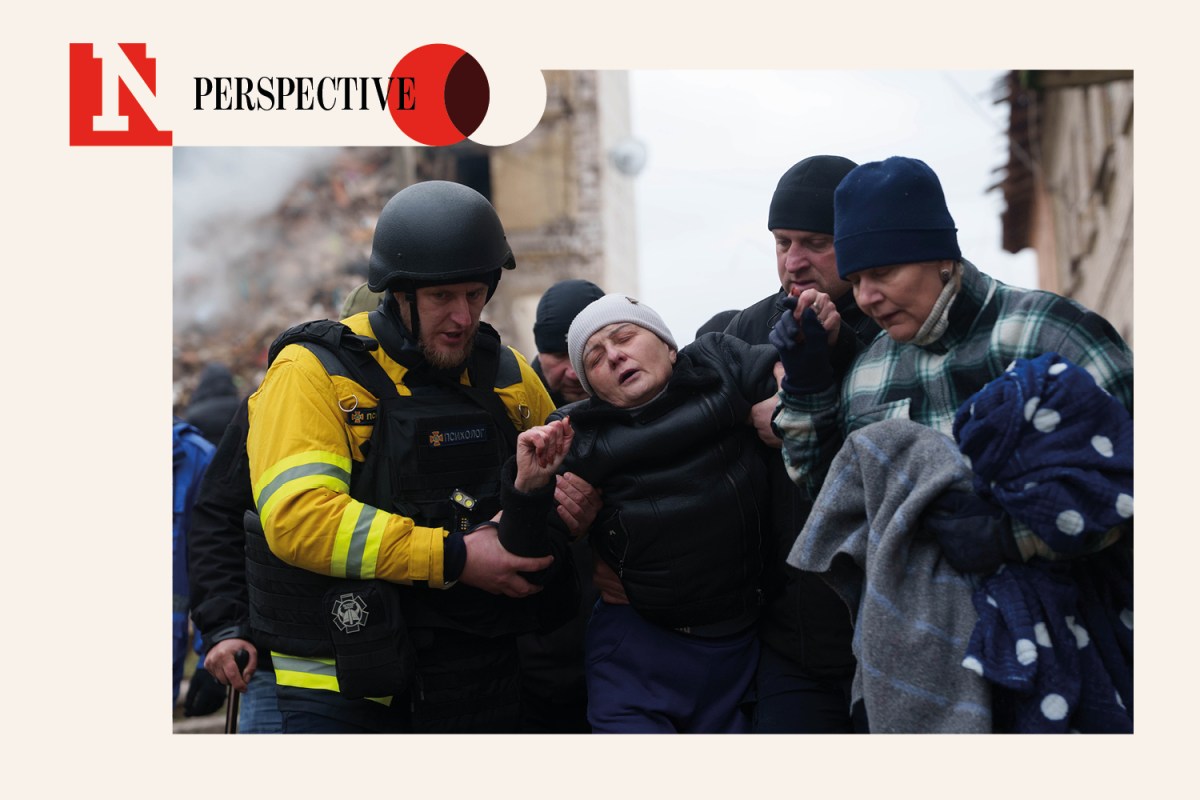
There are two apparently contradictory trends right now in the Russia-Ukraine war. There is an unmistakable escalation, from Ukrainian strikes on Russian vessels as far apart as Finland and Libya, to Moscow’s missiles crashing down in a NATO ally.
But there is also a renewed sense of urgency in the push for peace, with U.S. officials saying Russia has accepted a form of Article 5-style security guarantee for Ukraine, and talk of a deal as soon as January 2027. Talks in Abu Dhabi are expected to continue.
These diverging forces may be cause and effect. The nearer a settlement appears, the stronger each side’s incentive to improve its hand before the bargaining stops, fueling an intensification of offensive activity.
Read More on Analysis
As Italy’s foreign minister, Antonio Tajani, observed on Monday, once peace talks begin, “there is always an increase in military activity.” Ukrainian President Volodymyr Zelensky was clear that Ukraine is haggling over a price for peace that may come sooner than later.
He said the Americans are pushing for a peace deal before January, when a new Democratic-majority Congress takes control after they routed Trump’s Republicans in the midterm elections.
“There’s a desire to move very quickly, both we and the Russians understand that,” Zelensky told Bloomberg. “We understand what the price might be. We very much want peace too, but not at Ukraine’s expense alone.”
Escalation can create the conditions for peace. But brinkmanship works only when everyone can see the brink. From the Baltic to Benghazi, it is getting harder to find. Can peace come before escalation escapes all control?
The Escalatory Path
On Friday, three Russian cruise missiles came down in southeastern Poland, a NATO ally that borders Ukraine. One is believed to have landed about 22 miles from where European troops were holding an unprecedented exercise for a possible postwar mission in Ukraine.
They were, in effect, rehearsing for the peace. Donald Tusk, Poland’s prime minister, said it looked like “an intentional provocation.”
The day before, Trump, Vladimir Putin and Xi Jinping had issued a “Declaration toward Peace” in Shenzhen, China, which did not mention Ukraine, though the leaders committed to “maintaining strategic stability and international security.”
Later that day, Putin, vowing revenge for Ukrainian strikes on the Kerch Bridge, ruled out any moratorium on attacks on energy infrastructure or in the Black Sea. Since then, Ukraine has faced more massive, deadly aerial strikes, including on the capital Kyiv.

This weekend, things escalated further. On Saturday, Ukrainian drones set a military-linked Russian cargo ship ablaze in international waters. It drifted into Finland’s, where Finnish, Estonian as well as Russian crews helped fight the fire.
“War is spilling over into our immediate vicinity,” said Petteri Orpo, Finland’s prime minister, before affirming Ukraine’s right to “fight back against the aggressor.”
Then, on Sunday, Ukrainian sea drones left the Merkury, one of Russia’s newest corvettes, capsized at its berth in Benghazi, Libya, some 1,500 miles from the front line in a stunning attack. The message was clear: Russian hardware is safe nowhere.
So much for stability and security. Events are following their own dangerous and disordered path.
Peace Is War?
Yet Trump says there is still a “real good chance” of a deal on Ukraine, and soon. His son-in-law and envoy, Jared Kushner, believes Russia is “comfortable” with NATO-style security guarantees for postwar Ukraine. There is greater European engagement with Russia, too.
Korea is the classic precedent. Armistice talks began in July 1951 and ran for two years and 17 days. Fighting still continued throughout. About 45 percent of America’s casualties in the war came as negotiators talked. The armistice line was simply where the armies stood.
A similar logic may be at work now. Hunting Russian ships from the Baltic to the Mediterranean raises Moscow’s cost of continuing the war, which Kyiv hopes to convert into leverage at the table. Whether it can is another matter.
Zelensky now calls Russian-flagged ships, and anything carrying weapons or sanctioned cargo, legitimate targets in Russian or neutral waters, a broader test than the law of naval warfare usually allows.
Russia, meanwhile, is once again pounding Ukraine’s power grid as winter months begin to bite, intending to increase the pressure on the population. The U.N. says attacks on energy infrastructure are more extensive and systematic than a year ago.
The situation is plainly worsening, yet neither side is emerging as the winner.

I. William Zartman, an American scholar of negotiation, argued that wars ripen for settlement when both sides feel trapped in a mutually hurting stalemate, see a way out and, ideally, glimpse catastrophe ahead.
“The ripe moment becomes the godchild of brinkmanship,” Zartman wrote. In 1962, a glimpse of the nuclear abyss over Cuba produced a swift bargain: Soviet missiles out of Cuba, American ones quietly out of Turkey.
But Zartman also warned that pain can stiffen resistance rather than soften it, and conceded that his theory explains why talks open, not how they close.
The Ukraine war’s talks have opened once again. But closing them is the hard part. More so when Russia refuses a ceasefire as a condition for peace talks. And some of its officials are already rejecting the terms Americans are floating as tentatively agreed.
A day after Kushner spoke, Sergei Ryabkov, Russia’s deputy foreign minister, called any “quasi membership” of NATO for Ukraine totally unacceptable. Trump waved the contradiction away as negotiating theater.
The last round, in Abu Dhabi, produced another large prisoner-exchange deal but no breakthrough, and the Kremlin says no date is set for the next, though both sides remain open to further talks.
Darker Precedent
That leaves the darker precedent of 1914, when a local war became a global one through alliances and miscalculation.
This war now reaches into divided Libya. The Merkury had docked under a deal with the eastern government while, Libyan officials say, Ukrainian drone teams operate from the west.
Musa al-Koni, a deputy head of Libya’s Presidential Council, even likened the strikes to a declaration of war on Libya. Kyiv, increasingly unbounded by geographical constraints, real or imagined, calls them lawful self-defense under the U.N. Charter.
Perhaps the biggest risk of escalation, though, is in Russia’s relentless testing of European NATO allies through its grey-zone campaign of hybrid warfare. One misjudgment, one overreaction, one misread action and NATO’s Article 5 is in play.
If allies judged one of them to be the victim of an armed attack—perhaps even the recent missiles landing in Poland—then America, too, would be bound to take “such action as it deems necessary, including the use of armed force.”
Britain’s chief of defense intelligence, Lieutenant General Matthew Jones, thinks that Russia does not actively seek war with NATO. “However, my greatest fear is the risk of a significant miscalculation,” he said.
Resolving the war in Ukraine, and perhaps with it coming to a grand European security bargain with Russia, would massively reduce the risk of such a miscalculation befalling us all.
Perhaps that will happen soon, maybe even in early 2027 if all the escalation is, paradoxically, in the service of making peace.
But there is another possibility, as in Korea: years of talking while the death and fighting thunder on in the background, at risk of sparking something much bigger.